The global construction landscape is observing a seismic shift as digital twin technologies and real-time data combination become industry standards. As of early 2026, the Construction 4.0 market is predicted to reach $26.97 billion, developing at an impressive compound annual growth rate (CAGR) of 20.5% (Research and Markets, 2026). Main driver of this evolution is 4D construction monitoring, a development that has moved from being a specialized visualization tool to a fundamental necessity for project success. Research signals that the shift toward 4D in construction workflows can enhance planning efficiency by up to 40% as compared to traditional 2D methods, successfully bridging the notorious productivity gap that has plagued the sector for decades.
What is 4D Construction Monitoring? Defining the Time Dimension
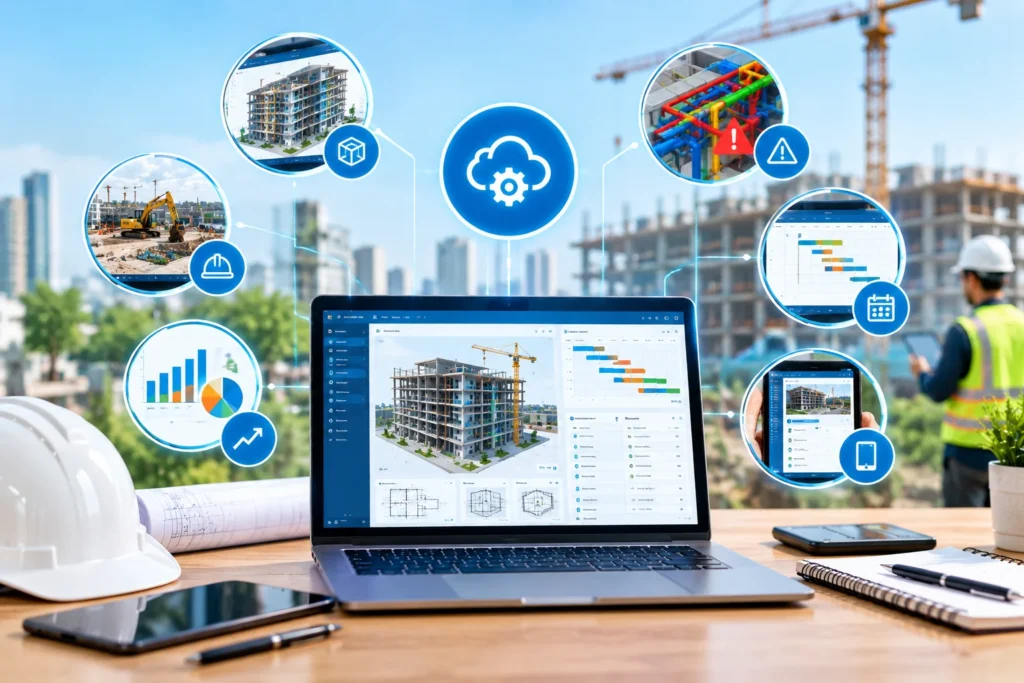
For truly grasping the power of 4D construction monitoring, one should look beyond simple 3D geometry. Although 3D models provide spatial clarity, they remain “static” without the incorporation of time. 4D modeling basically connects the construction schedule directly to the 3D building components. This technical marriage crafts a “living” simulation where every column, slab, and mechanical pipe is given a specific “birth date” and “installation duration.” By using 4D modelling, stakeholders can play back the complete lifecycle of a project before a single shovel hits the dirt.
Deep clarity in 4D construction monitoring implies the bringing together of the Critical Path Method (CPM) with geographic and spatial data. In 2026, this advanced into “Active 4D,” where field data from drones and IoT sensors is fed back into the model to deliver a real-time “Planned vs. Actual” visualization. This empowers project managers to shift away from reactive troubleshooting and toward proactive “spatiotemporal” management, guaranteeing that the project’s digital twin precisely reflects its physical counterpart at any given second.
The Strategic Importance of 4D Modelling in Modern Infrastructure
The complexity of modern infrastructure that ranges from smart skyscrapers to modular bridges stresses a level of coordination that traditional 2D blueprints cannot provide. 4D modelling operates as the backbone of “Constructability Reviews.” During these reviews, engineers use the 4D environment to recognize “clashes in time,” such as two different subcontractors scheduled to work in the same confined space at the same time. This “space-time” clash recognition is a unique feature of 4D construction planning that checks on-site chaos and rework.
Likewise, 4D modelling appears as a powerful communication bridge between technical teams and non-technical stakeholders. For an investor or a city official, a 500-page Gantt chart is mysterious; however, a 4D simulation showing the month-by-month progress of a transit hub is directly intuitive.
From Gantt Charts to 4D Scheduling: A Paradigm Shift
For almost a century, the Gantt chart has been the gold standard for project management. However, traditional 4D scheduling exposes the inherent flaws in static charts: they lack context. A bar on a chart could show that “Foundation Work” is 50% complete, but it won’t show which 50% is completed or if the completed section blocks access for the next stage. By transferring to 4D scheduling, the schedule becomes a visual narrative.
In a 4D scheduling environment, the project team can work on “What-If” scenario testing. For example, if a steel shipment is delayed by two weeks, the scheduler can immediately run a simulation to see how that delay ripples through the entire project. In 2026, this level of agility is critical, remarkably as global supply chains remain volatile. Firms like 4D Construction Inc. and other specialized VDC consultancies are gradually using these simulations to prove project feasibility during the tender stage, giving them a substantial competitive edge.
Reducing Delays and Boosting Efficiency: The Empirical Evidence
The most compelling argument for 4D construction monitoring is its confirmed ability to mitigate delays. According to a 2025 study published in Results in Engineering, 4D-enabled projects saw a 33% reduction in schedule deviations as compared to those using conventional planning. This efficiency gain is driven by the early discovery of logistical bottlenecks like the positioning of tower cranes or the flow of material delivery trucks, which are often ignored in 2D plans.
Efficiency in 4D in construction also continues to labor productivity. When workers know exactly where they have to be and what the site will look like when they arrive, “idle time” is decreased. Real-world data from mid-sized AEC firms suggests that 4D visualization can decrease site-related questions and “Requests for Information” (RFIs) by up to 25%, as the model gives the answers that would otherwise expect a meeting.
Financial Advantages: Cost Savings and Delay Penalties
The financial impact of 4D construction monitoring is directly coupled to the prevention of “Liquidated Damages”, the heavy fines contractors pay for late delivery. In large-scale infrastructure, these fines can reach tens of thousands of dollars per day. Firms effectively buy insurance against these disastrous costs by using 4D construction planning to ensure that the project stays on track.
Moreover, 4D monitoring improves “Cash Flow Forecasting.” Since every activity in the 4D modelling environment is linked to time and date, the finance team can predict precisely when material invoices will arrive and when milestone payments can be claimed. A 2026 report by Fortune Business Insights notes that digital change tools like 4D and 5D BIM can decrease total project costs by 4% to 10% simply by removing waste and optimizing the timing of resource buying.
Steps, Pros/Cons, and Practical Applications
Steps to Implement 4D Construction Monitoring
- Baseline 3D Model: Design a high-LOD (Level of Development) 3D model with clear component breakdown.
- Schedule Integration: Bring in the CPM schedule (from Primavera P6 or Microsoft Project) into 4D software.
- Component Linking: Connect specific model elements to their corresponding schedule tasks.
- Simulation & Review: Run the 4D simulation to recognize spatial conflicts and logistical gaps.
- Field Syncing: Use mobile apps or drones for updating the model with daily progress data for “Planned vs. Actual” tracking.
Pros and Cons of 4D in Construction
- Pros: Extreme reduction in rework, enhanced site safety through hazard visualization, and better stakeholder buy-in.
- Cons: High initial software costs, the need for skilled BIM coordinators, and the “Data Silo” risk if not shared with field teams.
Top Applications of 4D Construction Planning
- Modular Construction: Managing the precision timing of off-site module deliveries.
- Urban Infill Projects: Administering tight site logistics and traffic diversions in crowded cities.
- Safety Training: Applying the 4D model to show workers the high-risk zones during different phases of the building.
Future Horizons: AI, IoT, and 4D-5D Convergence
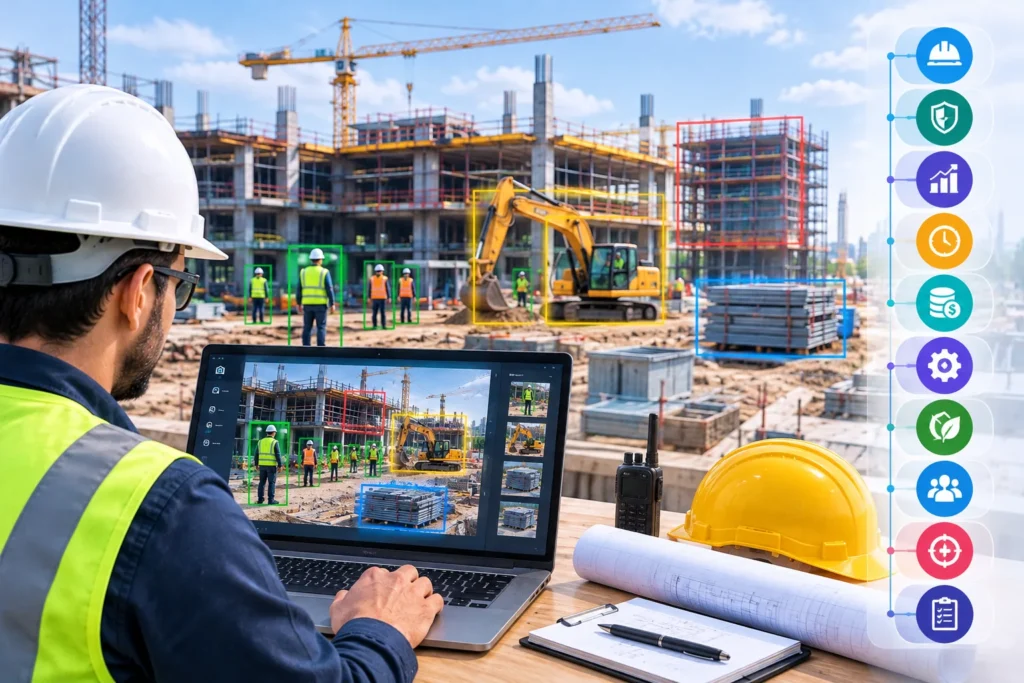
The future of 4D construction monitoring is progressively connected with Artificial Intelligence. In 2026, AI algorithms are starting to analyze 4D simulations to suggest “optimal paths”, automatically re-sequencing jobs to shave weeks off a schedule. We are also realizing the total convergence of 4D (Time) and 5D (Cost). In this integrated environment, a delay in a 4D sequence doesn’t just show a visual lag; it produces an instant update to the project’s projected final cost.
“Live 4D” are going to become the norm as IoT sensors are becoming cheaper. Cranes, excavators, and even wearable vests will flow location data directly into the 4D modelling environment, generating a truly autonomous project monitoring system.