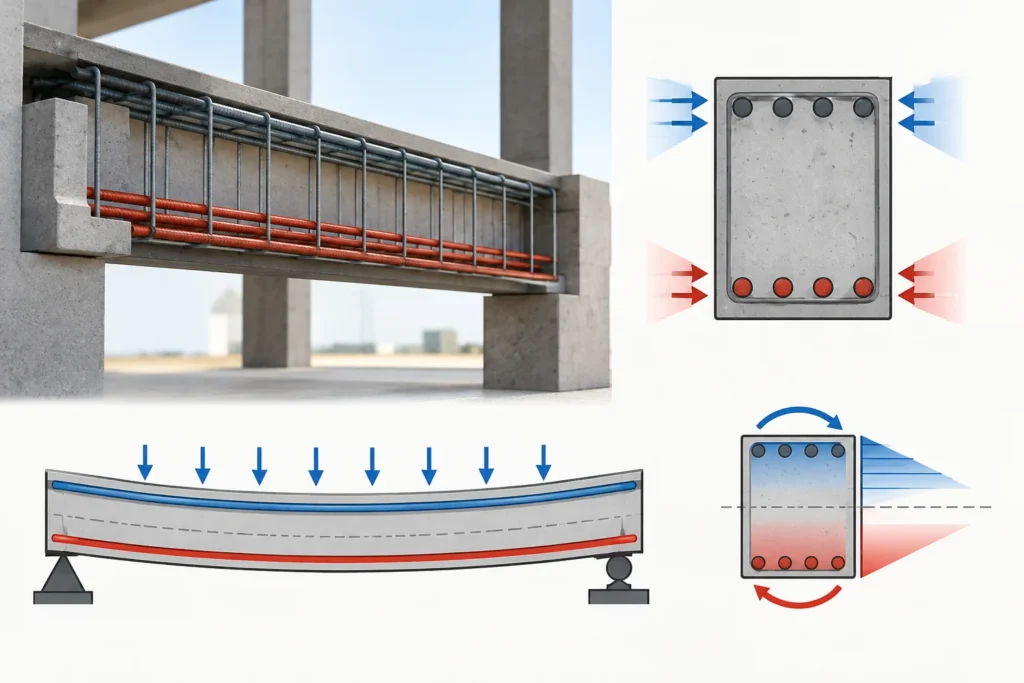
A beam can run out of depth before it runs out of demand. Architectural clearance may fix the section, yet gravity loads, continuity moments, or seismic detailing still require greater flexural resistance. A Doubly Reinforced Beam addresses that constraint by placing longitudinal steel in both the tension and compression zones. The added bars do not make every narrow beam acceptable; they create another internal force couple that must satisfy strength, strain, serviceability, anchorage, and constructability checks.
What Is a Doubly Reinforced Beam?
If a designer asks what is a doubly reinforced beam, the direct answer is a reinforced-concrete beam with designed longitudinal reinforcement near both faces: tension steel on the side that elongates under the governing moment and compression steel on the opposite side. Stirrups provide shear resistance and confinement but do not, by themselves, make the section doubly reinforced.
How Does a Doubly Reinforced Beam Carry Bending?
A useful conceptual decomposition is Mₙ = M₁ + M₂. M₁ represents the contribution associated with the concrete compression block and a corresponding portion of tension steel. M₂ represents the additional couple between compression steel and additional tension steel. This is explanatory, not a stand-alone design formula: steel stress may be below yield, and code-specific strength-reduction and strain limits still apply.
Plane sections are assumed to remain plane, so strain varies approximately linearly through the depth. The neutral axis has zero longitudinal strain. From compatibility, the engineer finds steel strains; from material models, the corresponding stresses; and from equilibrium, the neutral-axis depth. Assuming compression steel yields without checking its strain can overstate capacity.
When Is a Doubly Reinforced Beam Used?
Designers consider compression reinforcement when:
- Beam width or depth is restricted and a singly reinforced section cannot provide the required design strength.
- Moment reversal requires reinforcement near both faces.
- Ductility, rotation capacity, or moment redistribution objectives justify compression steel under the governing code.
- Bar continuity, erection stability, or seismic detailing already places substantial steel near both faces.
Singly Versus Doubly Reinforced Beam Design
A singly reinforced beam relies on concrete for compression and designed longitudinal steel primarily for tension. It is usually simpler and more economical when geometry provides adequate strength and serviceability. A Doubly Reinforced Beam adds designed compression steel and matching tension capacity, but also adds material, detailing, and placement demands.
Design Workflow for a Doubly Reinforced Beam
- Establish factored load combinations, span behavior, support conditions, and design moments.
- Choose trial dimensions and materials; check whether a singly reinforced section is adequate.
- Set a strain-compatible section model and solve equilibrium for concrete and steel forces.
- Check nominal and design flexural strength, tension-controlled behavior, minimum and maximum reinforcement provisions.
- Design shear reinforcement and verify deflection, cracking, durability, fire resistance, and vibration as applicable.
- Detail development lengths, hooks, splices, cutoff points, cover, spacing, supports, and constructability.
Detailing, Takeoff, and Drafting Coordination
A reinforced-concrete beam requires rebar schedules and placing details, not a structural-steel bill alone. structural steel takeoff services typically quantify rolled sections, plates, bolts, and related framing items. If a scope includes concrete reinforcement, it should explicitly request rebar takeoff or reinforcing-steel quantity work. Clear terminology prevents missing bars and misleading procurement totals.
Likewise, structural steel drafting services usually produce fabrication information for steel members and connections. Reinforced-concrete deliverables need bar marks, shapes, laps, hooks, layers, spacing, sections, and bending schedules. Some multidisciplinary providers offer both structural steel drafting services and rebar detailing, but the contracts, models, and checking procedures should identify which is included.
Current market scale makes coordination material: the U.S. Census Bureau estimated July 2026 construction spending at a seasonally adjusted annual rate of $2.1576 trillion. The statistic does not measure beam errors, but it shows why standardized information exchange across design, fabrication, and site teams has economic relevance.
How Do Tying Tools Affect Site Execution?
A steel wire tie tool secures intersecting bars so the cage maintains its intended position during handling and concrete placement. A manual reinforcing steel tying tool may be sufficient for limited work; a powered wire tying machine can reduce repetitive hand tying on suitable, accessible intersections. Ties position reinforcement—they are not a substitute for required development, lap, weld, coupler, or anchorage design.
Comparing wire tying machine cost requires more than purchase price. Include compatible wire, battery cycles, maintenance, consumables, access, tie consistency, training, repair support, and expected tie volume. A second wire tying machine may improve continuity on a large placement, whereas a simple steel wire tie tool can remain more practical for congested or irregular locations.
Credible Sources Used
- American Concrete Institute: https://www.concrete.org/
- StructurePoint, Doubly Reinforced Concrete Beam Design ACI 318-14: https://structurepoint.org/publication/pdf/Doubly-Reinforced-Concrete-Beam-Design-ACI318-14.pdf
- U.S. Census Bureau, Construction Spending, July 2026: https://www.census.gov/construction/c30/current/index.html