A supervisor cannot watch every worker, crane, vehicle, material stack, and unfinished floor at once. Cameras can. The real challenge is turning thousands of site images into timely decisions. computer vision in construction uses AI to interpret visual data from fixed cameras, drones, mobile devices, and machine-mounted sensors, helping teams detect conditions that deserve attention. The business case is increasingly practical: the U.S. Bureau of Labor Statistics recorded 1,034 construction fatalities in 2024, including 389 deaths from falls, while OSHA continues to identify falls as construction’s leading cause of death. Visual intelligence cannot replace safety leadership, but it can expand what teams see and how quickly they respond.
What the Technology Does
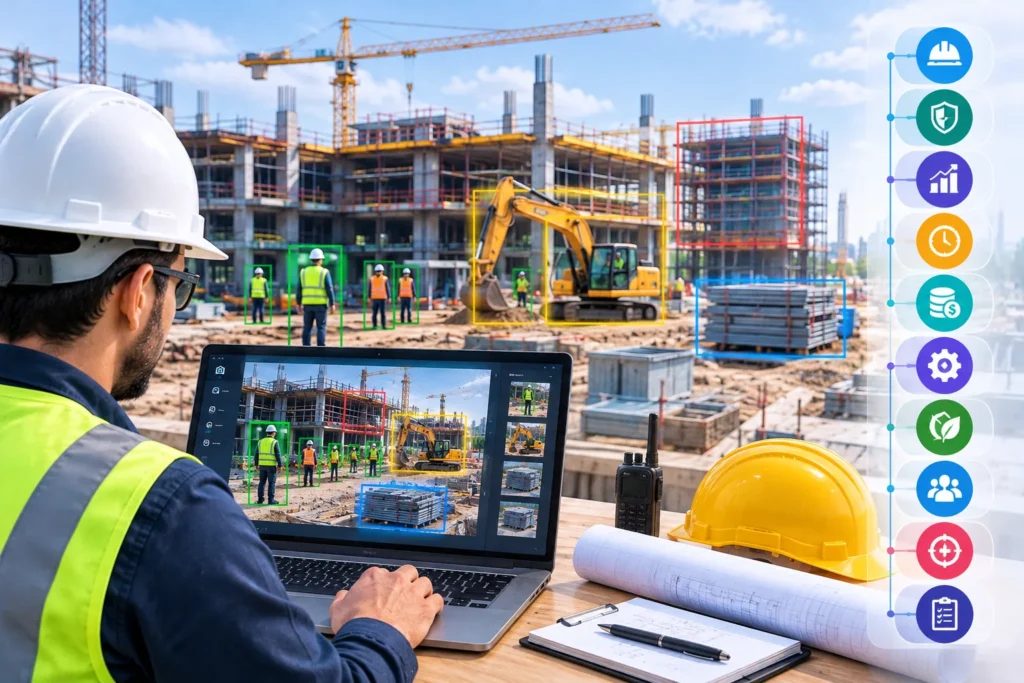
computer vision in construction applies machine-learning models to images or video so software can recognize objects, people, activities, defects, progress, and spatial relationships. Typical tasks include:
- object detection
- image classification
- segmentation
- tracking
- pose estimation
- and comparison of actual site conditions against BIM, schedules, or approved drawings.
The technology is useful because construction environments change hour by hour. Unlike a periodic inspection, visual systems can process repeated observations and flag patterns for human review. A 2025 peer-reviewed Procedia Computer Science study reported 89% accuracy for a YOLOv8 safety-monitoring model, compared with 92% for trained human observers. That gap is important: the strongest deployment model is human-plus-AI, not unattended automation.
Why Computer Vision in Construction Industry Is Gaining Ground
Construction firms are under pressure to improve safety, schedule certainty, documentation, and productivity without adding layers of manual checking. Autodesk’s 2025 State of Design & Make construction research surveyed more than 3,500 industry leaders across 28 countries and found that 32% of construction leaders were approaching or had achieved their AI goals. This suggests AI has moved beyond experimentation, although implementation maturity still varies.
computer vision in construction industry projects are especially attractive when teams already collect photos, CCTV footage, drone imagery, or 360-degree site captures.
How Computer Vision for Site Monitoring in Construction Works
A practical workflow starts with a clearly defined decision: detect missing PPE, identify access to a restricted zone, measure installed work, recognize equipment movement, or document visible defects. Cameras or drones capture imagery; models infer what is present; rules score the event; and an application sends an alert, updates a dashboard, or queues an item for verification.
For computer vision for site monitoring in construction, camera position, lighting, occlusion, weather, worker distance, and data quality matter as much as the model itself. A successful pilot therefore measures false positives, missed detections, latency, coverage, privacy constraints, and the action taken after an alert.
Where Computer Vision Automation Fits
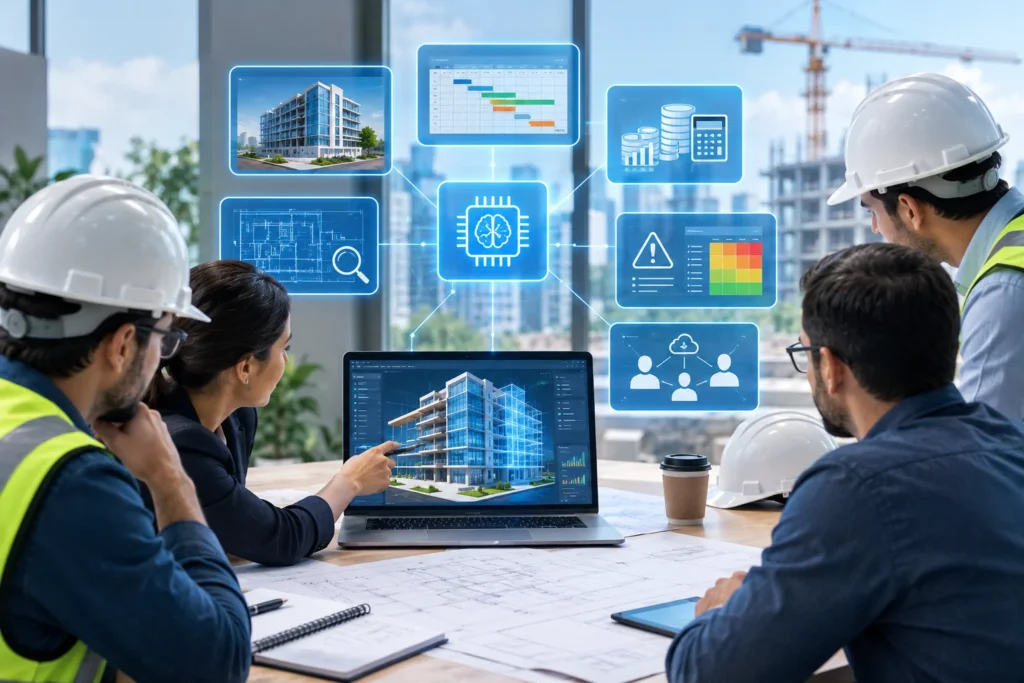
computer vision automation is most valuable when it removes repetitive observation while keeping accountable people in the decision loop. It can classify routine images, count detected objects, compare zones over time, and surface exceptions. Safety-critical decisions, contractual acceptance, and engineering judgments should still follow project procedures and qualified review.
10 Benefits of Computer Vision in Construction
1. Earlier Safety-Hazard Detection
Models can identify missing hard hats, unsafe proximity, entry into exclusion zones, or fall-risk conditions from camera feeds. computer vision for site monitoring in construction can help safety teams prioritize where to inspect first rather than relying only on scheduled rounds.
2. Better Progress Verification
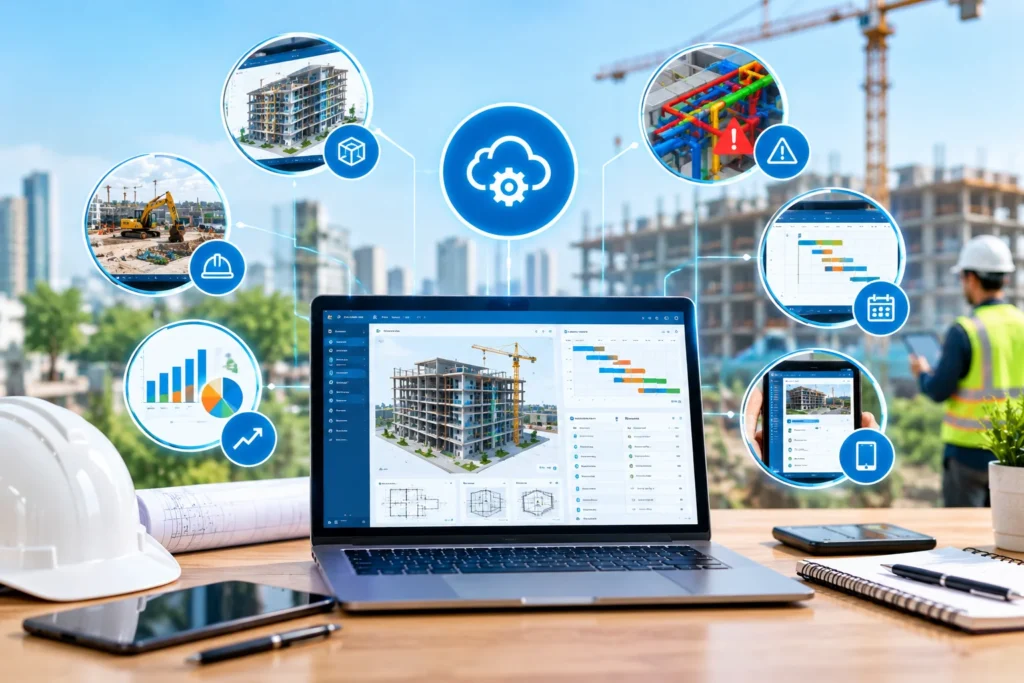
Visual records can be analyzed against work packages, BIM elements, or planned sequences. computer vision in construction gives project controls teams another evidence stream for understanding what appears complete, what is delayed, and where field verification is needed.
3. Faster Documentation
Instead of manually sorting thousands of photos, computer vision automation can tag images by location, object, activity, or date. This improves retrieval for daily reports, owner updates, claims support, quality reviews, and handover documentation.
4. More Consistent Quality Checks
Models can be trained to flag visible surface defects, missing components, incorrect placements, or incomplete finishes. The goal is not to certify workmanship automatically, but to make repetitive screening more consistent so inspectors can focus on exceptions.
5. Improved Equipment Awareness
Object detection and tracking can show where vehicles or major machines are operating. For computer vision in construction industry use cases, this may support logistics planning, utilization studies, congestion analysis, and safer separation of people and equipment.
6. Stronger Material and Inventory Visibility
Computer vision can count or classify visible materials when the scene and labeling rules are controlled. Combined with procurement or inventory systems, the output can help teams investigate shortages, misplaced items, or unexpected changes before they affect work fronts.
7. Reduced Manual Monitoring Load
Continuous observation is tiring and difficult to scale. computer vision automation can screen high volumes of footage and escalate selected events. Supervisors still decide what the observation means and whether action is required.
8. Better Remote Site Visibility
Owners, consultants, and managers cannot always be physically present. computer vision for site monitoring in construction can convert recurring imagery into structured dashboards, progress indicators, and exceptions, giving remote teams a faster way to understand site conditions.
9. Data for Planning and Productivity Analysis
Tracked movement, occupancy, queueing, and activity patterns can reveal workflow bottlenecks when collected responsibly. computer vision in construction industry analytics can complement schedules and field reports with observed operational patterns, helping teams test whether site-layout or sequencing changes are working.
10. A Foundation for Digital Twins and Smarter Automation
Visual data becomes more valuable when connected with BIM, schedules, IoT, GIS, or digital twins. Visual analytics can provide a field-observation layer that keeps digital models closer to real conditions and supports responsive project controls.
Implementation Challenges Teams Should Address
Computer vision is not install cameras and add AI. Project teams should define ownership, retention periods, permitted uses, cybersecurity controls, worker communication, and escalation rules.
A robust computer vision in construction industry program also needs representative training data. Models that perform well in a curated dataset may degrade on a cluttered site. Teams should track precision, recall, false-alarm rate, response time, and business outcomes instead of relying on a single accuracy number.
When a Custom Computer Vision Development Company Makes Sense
Off-the-shelf tools may work for standard PPE or people-counting scenarios. A custom computer vision development company becomes more relevant when a project has unusual equipment, proprietary workflows, specific camera infrastructure, BIM integration, edge-processing requirements, or unique reporting rules.
Selection should focus on:
- domain discovery
- dataset strategy
- model evaluation
- MLOps
- integration capability
- security
- and post-deployment monitoring. The right custom computer vision development company should also explain where the model can fail and how human review will be built into the workflow.
Conclusion
computer vision in construction is most useful when it turns visual evidence into faster, more consistent decisions while keeping people accountable for safety and quality. Teams should start with a measurable problem, validate performance in real site conditions, and integrate outputs into existing workflows.
Innovation M Services provides AI/ML development capabilities for organizations that need tailored visual-intelligence workflows. For projects requiring a custom computer vision development company, IMS can support discovery, model development, integration, and managed delivery.