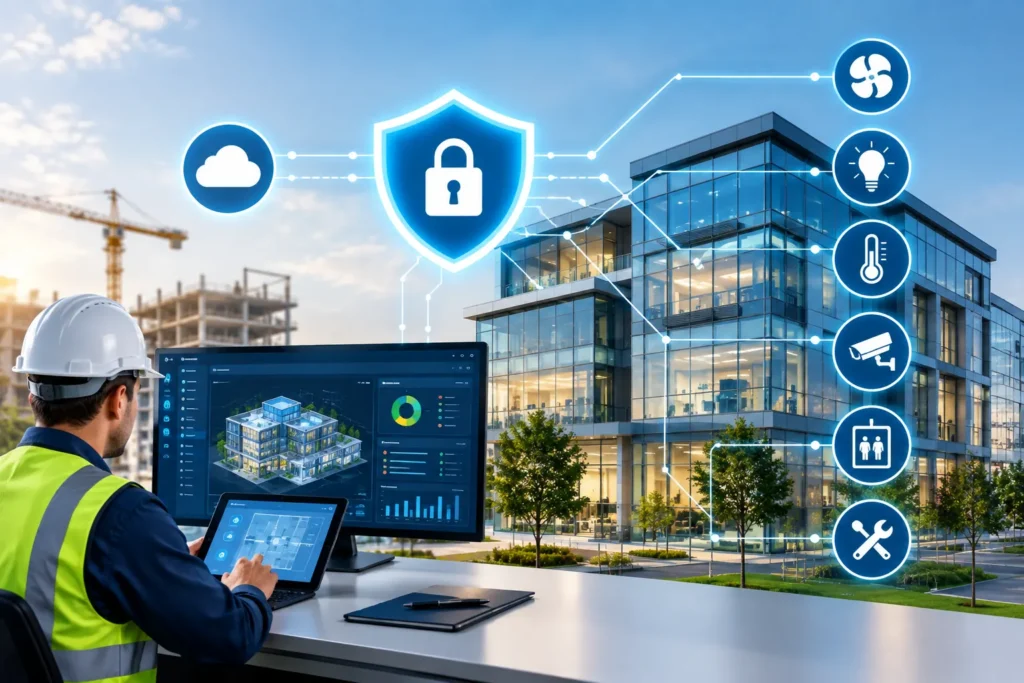
BIM and digital twin approaches are gaining momentum as in construction industry it is no affordable to face wastage of time, quality and cost. NIST found that poor interoperability costs the U.S. capital facilities industry $15.8 billion per year, largely impacting owners and operators during operations and maintenance. McKinsey has also reported that digital transformation can produce 14–15% productivity gains and 4–6% cost reductions in engineering and construction when implemented efficiently. Industry research has regularly shown many BIM users perceive positive ROI (Return on Investment), especially when BIM is employed collaboratively across project stakeholders.
This guide describes BIM and digital twin in simple terms, answers the common “BIM vs twin” inquiries, and demonstrates how the combined approach supports cost-efficient construction and smarter building operations.
What is Building Information Modeling (BIM)?
Building Information Modeling (BIM) is a structured way to establish and achieve a digital representation of an asset’s geometry and its data (materials, specs, quantities, IDs, relationships). BIM is most powerful when it becomes the ‘single source of truth’ during design and construction, enabling teams to coordinate using consistent, version-controlled information.
A strong BIM setup normally comprises:
- design models (architecture, structure, Mechanical/Electrical/Plumbing)
- coordination systems (clash detection + issue tracking)
- coordinated sharing via a Common Data Environment (CDE)
- clear definition of Level of Development (LOD) at each phase
What is a Digital Twin?
A Digital Twin (DT) is a virtual interpretation of a physical asset or system that stays correct by using real-world data. IBM depicts a digital twin as a virtual representation that utilizes real-time data to reflect an object or system’s performance, presentation, and conditions across its lifecycle.
In practical terms, a digital twin usually connects:
- the “as-built” model (often derived from BIM)
- operational data from Internet of Things (IoT) sensors
- building systems (e.g., Building Management System (BMS))
- maintenance data from a Computerized Maintenance Management System (CMMS)
That’s why BIM and digital twin are paired: BIM creates the reliable asset definition; the twin keeps it “alive” during operations.
BIM vs Digital Twin
Here’s the easiest answer to what is the difference between BIM and digital twin:
- BIM is predominantly a project and asset information model used heavily in design and construction.
- Digital twin is a linked model used to monitor, analyze, and optimize the real asset after (and sometimes during) construction.
Autodesk describes that while BIM can be an important element of a digital twin, the key difference is that a digital twin is connected to the physical world through data, making it dynamic rather than static.
Quick Comparison BIM vs Digital Twin
- Best phase
- BIM: design + construction
- Digital twin: operations + performance management
- Data freshness
- BIM: versioned updates (milestones, revisions)
- Digital twin: continuous/near-real-time updates
- Core inputs
- BIM: design intent + project documentation
- Digital twin: BIM + IoT + BMS + CMMS + analytics
- Primary output
- BIM: coordinated deliverables + constructability clarity
- Digital twin: monitoring, simulation, optimization, predictive actions
Is BIM a Digital Twin?
The short answer is not by default.
A BIM model can be exceptionally detailed, but it becomes a digital twin only when it is:
- coupled to the real asset (“as-operated,” not just “as-designed”)
- supplied by operational data (IoT/BMS/CMMS)
- utilized for ongoing monitoring, simulation, and decision-making
Therefore, in most projects, BIM is best viewed as the foundation for a twin—especially if the BIM data is structured and consistent.
What is Digital Twin in BIM?
Whilst people question what is digital twin in BIM? they usually mean: “How does BIM turn into a twin?”
Think of it as a maturity path:
- Step 1: BIM model (design + construction coordination)
- Step 2: As-built BIM (validated record of what was constructed)
- Step 3: Connected BIM (links to BMS/CMMS/IOT datasets)
- Step 4: Digital twin (analytics + simulation + operational decision loops)
Academic and industry conversations generally describe the digital twin as an evolution that builds on BIM by combining sensors, analytics, and real-time feedback.
Core Terms You Must Understand
To obtain BIM and Digital Twin benefits, the team should align these terms:
- Clash detection: automated checks to find conflicts (e.g., duct through beam or excavation of spillway when it is located near the dam embankment ) before site work.
- Model federation: blending discipline models into one coordinated model for review.
- Common Data Environment (CDE): the controlled system where models, drawings, issues, and revisions are available.
- Level of Development (LOD): how detailed and dependable model elements are at a given stage (not just “more detail”).
- Request for Information (RFI): proper clarification request during construction when documents are unclear or conflicting.
3D, 4D, 5D BIM
When BIM and Digital Twin conversations get financial, 5D is where it becomes real.
- 3D BIM: geometry + data coordination
- 4D BIM: time (schedule) linked to model elements
- 5D BIM: cost linked to quantities and assemblies (cost planning + change impact)
5D is the link between “modeling” and financial control—particularly when it’s tied to cost codes and procurement packages.
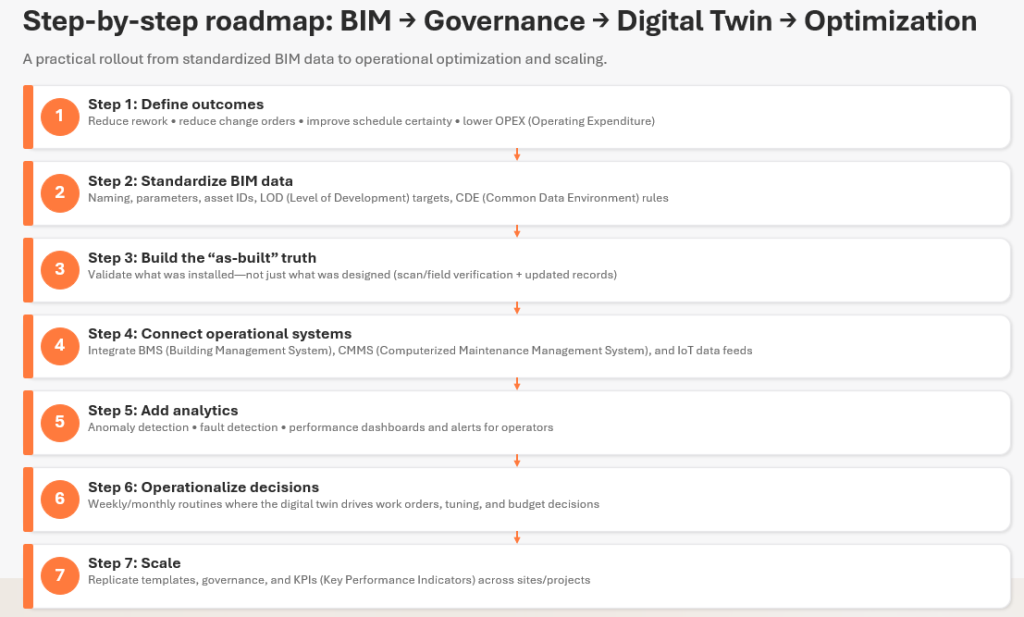
Step-by-Step Roadmap: BIM → Governance → Twin → Optimization
A practical rollout for BIM and digital twin appears like this:
Pros and Cons of BIM and Digital Twin
Pros
- earlier issue exposure → less rework
- better organization → fewer RFIs (Requests for Information)
- effective change control with 4D/5D
- better operations view and optimization after handover
Cons
- Upfront effort (modeling + data standards)
- concentrate on high-risk zones first, then scale
- Integration complexity (BMS/CMMS/IoT)
- start read-only, then automate actions after validation
- Data quality risk
- treat naming, tagging, and asset IDs as non-negotiable
Mini-scenario 1: Construction stage (coordination + 4D/5D + change control)
A hospital project has dense Mechanical/Electrical/Plumbing systems and crowded ceiling zones.
How BIM and Digital Twin Improves During Construction:
- BIM federation + clash detection reduces field conflicts
- 4D sequencing exposes trade-stacking and access issues
- 5D cost linking shows the budget impact of late changes early
Outcome: less “surprises” on site and faster agreement on what changes cost before they become expensive.
Mini-scenario 2: Operations stage (digital twin buildings for performance + maintenance)
A commercial tower efforts with comfort complaints and rising energy bills.
Digital Twin Buildings Workflow:
- the as-built BIM model is connected to BMS trend data and IoT sensors (occupancy, CO₂)
- maintenance tickets from CMMS are connected to specific assets (air handlers, valves)
- analytics pointed out the abnormal runtime and setpoint conflicts
Outcome: fewer complaints, lower energy waste, and better maintenance planning—because decisions are based on measured behavior, not guesses.
Financial Outcomes: Digital Twin Buildings, Cost Control in Digital Construction, and Cost Estimation
This is where BIM and Digital Twin develop into a board-level conversation.
What is BIM Cost Estimating?
What is BIM cost estimating? It’s the use of BIM quantities and object data to support cost planning and estimating—often by mapping model elements to:
- cost codes
- assemblies (e.g., wall types, MEP packages)
- productivity assumptions and procurement packages
When BIM data is reliable, estimating becomes faster, more repeatable, and easier to revise after design changes.
How Digital Twin Buildings Improve Cost Control in Digital Construction
Cost control in digital construction gets robust when the model is linked to reality:
- progress tracking decreases “unknowns” and helps forecast cost-to-complete
- change tracking increases decision speed (approve/avoid/phase)
- operational performance (energy + downtime) is measured, not supposed
- Predictive maintenance lowers emergency repairs and service disruption
Autodesk highlights that BIM may repeat an asset’s design detail, but a digital twin’s value comes from being connected to the physical asset through data—making ongoing optimization feasible.
Cost Categories Most Impacted
- rework and field fixes
- RFIs and change orders
- schedule delays and time-related overhead
- procurement waste (over-ordering, wrong sequencing)
- energy consumption (post-handover)
- maintenance labor and downtime
What it Costs to Implement
- software/platform licensing
- modeling and coordination effort
- data integration (BMS/CMMS/IoT)
- sensors and connectivity (where needed)
- training + governance operations
Simple ROI Mini Example
Assumptions (example only):
- Project value: $30M
- Typical rework/change leakage: 2% = $600,000
- BIM + 4D/5D program cost: $220,000
- Savings from reduced conflicts + better change control (assume 40% of leakage avoided):
$600,000 × 0.40 = $240,000
Net Year-1 benefit ≈ $240,000 − $220,000 = $20,000, plus ongoing benefits from better handover data.
If a digital twin reduces annual energy + maintenance by even $80,000–$150,000, payback can accelerate meaningfully—particularly for complex facilities.
KPIs to Track
- rework cost (% of contract value)
- change order value (%)
- RFI volume and response time
- schedule variance (planned vs actual)
- estimate accuracy (design stage vs awarded vs final)
- procurement variance (ordered vs installed quantities)
- energy intensity (kWh/m²) after handover
- maintenance backlog (work orders aging)
- downtime hours for critical systems
- comfort complaints per month
Common Difficulties
- Ambiguous asset IDs
- fix: define ID standards early and keep them consistent across BIM/BMS/CMMS
- Model is “pretty” but not structured
- fix: enforce parameter requirements for 5D and handover
- No operating process
- fix: create weekly routines where dashboards drive actions
- Too big, too soon
- fix: pilot one building system (HVAC) or one zone, then scale