Presently, the construction industry is standing at a pivotal crossroads, moving away from disjointed, reactive management toward a data-driven future. As of early 2026, the global Building Information Modeling (BIM) market has exceeded an evaluation of $10.27 billion, with the shift toward high-dimensional modeling speeding up at a Compound Annual Growth Rate (CAGR) of over 13% (Fortune Business Insights, 2026). Within this expansion, 5D BIM modeling has appeared as the most critical progression for financial stakeholders. Research implies that projects that utilize combined 5D workflows may experience up to a 35% reduction in estimation time and a 20% improvement in cost predictability (ResearchGate, 2026). This article explores how adding the “fifth dimension” i.e. cost to the digital twin is changing the AEC (Architecture, Engineering, and Construction) landscape for InfraTech Hub.
Beyond Geometry: Defining the 5D BIM Model
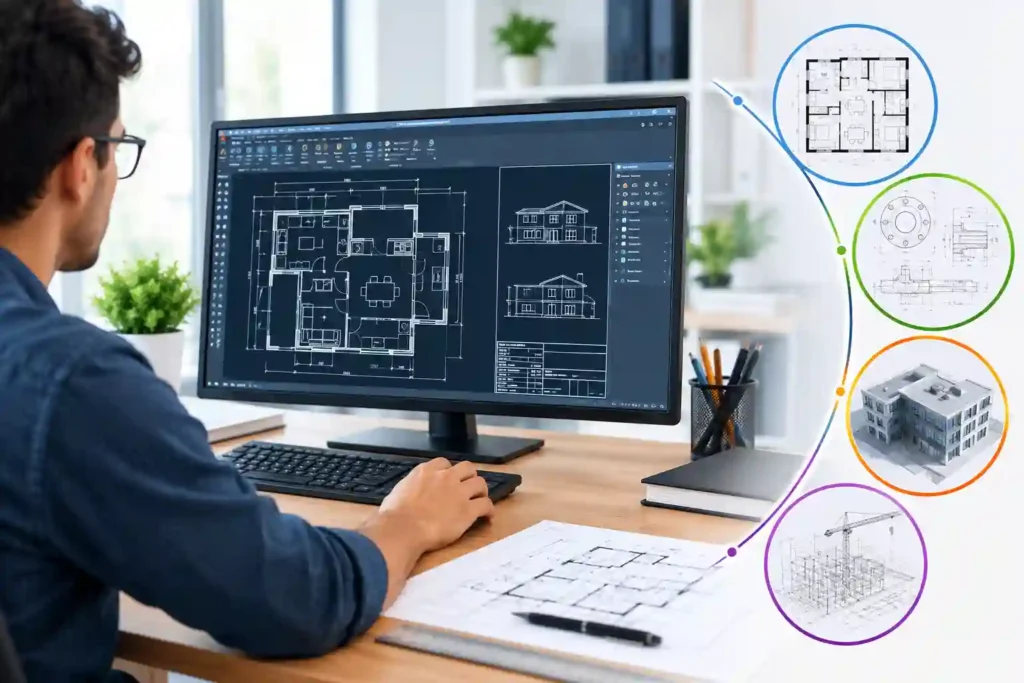
To comprehend the impact of 5D BIM modeling, one should first differentiate it from its predecessors. While 3D BIM concentrates on the “what” (spatial geometry) and 4D BIM adds the “when” (time/scheduling), 5D BIM establishes the “how much.” A real 5D BIM model is an intelligent, data-rich virtual representation where cost information is parametrically correlated to 3D components and 4D schedules. This implies that every beam, slab, and mechanical unit in the digital environment is not associated with just its dimensions, but its unit price, labor rate, and assembly cost.
For the technical professional, 5D BIM represents the shift from static spreadsheets to a dynamic “single source of truth.” In this environment, manual entry is replaced by “Assembly-based Costing”. When an architect changes a wall type from masonry to glass, the 5D BIM model by design recalculates the material quantities, amends the labor hours expected for installation, and updates the total budget in real-time. This level of technical clarity removes the data silos that conventionally lead to financial inconsistencies between designers and estimators.
Financial Predictability: The Impact of 5D Cost Estimation
The core value of 5D cost estimation lies in its ability to deliver instant feedback during the design phase. Traditionally, cost estimation was a “post-mortem” activity; it means that estimators would receive a 90% completed design and employ weeks performing manual quantity take-offs (QTO). If the project was over budget, the design had to be sent back for “value engineering,” a cycle that often used to delay projects by months. By utilizing 5D BIM in construction, this feedback loop is reduced from weeks to hours.
Real-world statistics from 2026 industry surveys show that 5D BIM services enable teams to identify the impact of design changes on the budget almost instantly. According to a 2026 systematic review, 5D integration has advanced cost accuracy by over 10% in more than half of documented infrastructure projects. This accurateness is driven by the model’s ability to perform automated QTOs, which decreases the human error inherent in measuring thousands of components across hundreds of 2D drawings.
Risk Mitigation Through Real-Time Data and 5D BIM Services
Risk in construction is often a byproduct of ambiguity. 5D BIM modeling mitigates this by delivering “spatiotemporal” financial data. When the 5D model is resource-loaded, it creates a “Cash Flow Curve” that is directly linked to the construction sequence. This enables CFOs and project owners to ensure exactly when capital will be necessary, avoiding the liquidity crises that often stop progress on major works.
Additionally, 5D BIM in construction acts as a powerful tool for dispute resolve and management of change order. When a change is projected in the field, the 5D BIM model provides a transparent “delta” (difference) report. It shows precisely how many units were added or removed and the pre-agreed rates associated with them. This level of transparency substantially reduces the legal friction between contractors and owners, which McKinsey notes can be responsible for up to 15% of total project costs in traditional “adversarial” contracting environments.
Comparing BIM Dimensions
| Dimension | Focus Area | Primary Benefit |
|---|---|---|
| 3D BIM | Geometry & Visualization | Clash detection and spatial coordination. |
| 4D BIM | Time & Scheduling | Construction sequencing and site logistics. |
| 5D BIM | Cost & Budgeting | Real-time cost tracking and ROI analysis. |
Implementation Strategies, Pros/Cons, and Applications
Steps to Implement 5D BIM in Construction
- Define Standards: Determine a common Work Breakdown Structure (WBS) and Cost Breakdown Structure (CBS).
- Select Software: Choose a 5D BIM model platform that enables for seamless integration between Revit, Navisworks, and cost databases.
- Cost-Loading the Model: Give unit rates, labor productivities, and equipment costs to model elements.
- Continuous Synchronization: Guarantee that every design revision automatically generates a refresh of the 5D cost estimation.
- Field Integration: Use cloud-native platforms to enable field teams to report progress directly into the 5D environment.
Pros and Cons of 5D BIM Modeling
- Pros: Extraordinary budget transparency, automated quantity take-offs, faster “what-if” scenario testing, and decreased litigation.
- Cons: High initial investment in 5D BIM services and software, needing a substantial cultural shift and specialized staff training.
Top Applications of 5D BIM Services
- Pre-Construction Feasibility: Comparing the financial ROI of different building forms in the concept phase.
- Progress Payments: Automating subcontractor payments that are based on the percentage of model elements completed.
- Change Order Analysis: Promptly calculating the financial impact of site-level design modifications.
- Life Cycle Costing: Assessing the long-term operational costs of an asset before it is even built.
The Future of Finance in Construction: AI-Driven 5D Modeling
As we progress through 2026, the combination of Artificial Intelligence (AI) with 5D BIM modeling is the next edge. AI assistants are now being used to scan historical data and propose unit rates or recognize “pricing anomalies” in a 5D BIM model. This enables firms to move beyond simple estimation into “Predictive Analytics,” where the system can alert a project manager that a certain material’s price is likely to surge based on global supply chain developments.
The adoption of 5D BIM services is not just a competitive advantage; it is becoming a necessity for government and institutional tenders. With obligations like ISO 19650 standardizing how information is managed, the “digital twin” is becoming the legal and financial record of the project.
Conclusion
Combining 5D BIM modeling into the construction lifecycle is a strategic move toward financial strength. By bridging the gap between the 3D design and the project’s bank account, 5D BIM confirms that every decision is informed by its cost and risk implications. For InfraTech Hub readers, the message is clear: the future will be appropriate for those who can visualize their budget as clearly as their buildings.
At IM Engineering Services, businesses looking to hire dedicated BIM modelers can access skilled professionals who deliver accurate, cost-efficient, and collaborative BIM solutions for modern construction projects.