The emerging practical “decision engine” for cities is a geospatial digital twin. It is no longer now a futuristic concept. Urban stakes are increasing quick: 55% of the world’s population lives in cities today, and that share is forecasted to reach 68% by 2050 (UN DESA, 2018). That growth makes planning trade-offs challenging: housing, transport, utilities, climate resilience, and budgets should be balanced with less mistakes.
Climate risk is also accelerating the cost of wrong decisions. The World Bank has issued a warning that annual flood losses in cities could reach about $50 billion by 2050 if vulnerabilities continue (World Bank, Jan 27, 2026). In geospatial news today 2026, the idea is clear: city leaders desire tools that convert fragmented data into quicker, defensible actions and that’s accurately where a geospatial digital twin fits.
What a Geospatial Digital Twin Is
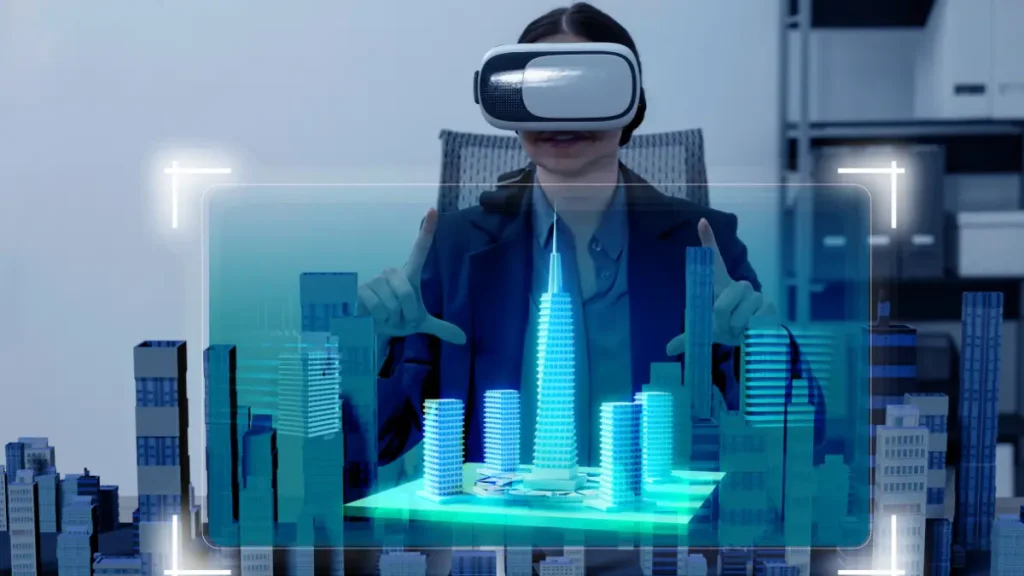
A geospatial digital twin is a virtual representation of a place (city, district, corridor, network) that is built on geographic context, linked to real-world conditions, and designed to run “what-if” scenarios before money is spent or policies are imposed. Esri describes the idea plainly: when a digital twin is formed on a geographical foundation, it becomes a geospatial digital twin.
This is important because it’s not just a 3D model. Also, it isn’t “BIM-only,” or merely a dashboard. A digital twin geospatial system naturally relates geometry, assets, rules, performance signals, and time, so it becomes supporting for planning and operations together.
Main terms, in simple language:
- GIS: the map-based system for spatial analysis and layers (land use, parcels, risk zones).
- BIM: the building/infrastructure model with object intelligence (components, quantities, specs).
- LiDAR / point clouds: reality capture of the built environment (high-detail geometry).
- 3D tiles: efficient running of large city-scale 3D data for web and apps.
- Simulation / scenario modeling: testing results (traffic, flooding, heat, capacity) before implementation.
- Interoperability & governance: standards and rules so that many departments can safely share data.
How Digital Twin Geospatial Systems Work End-to-End
A geospatial digital twin usually develops from static mapping to a living system. Many city programs begin with parcels and base layers, then add 3D reality capture, then associate sensors and operations.
The Data Layers (base maps → 3D → sensors → operations)
Most deployments go along a layered stack: authoritative maps and assets, 3D context, then dynamic feeds (IoT, mobility, environment), then operational workflows (permitting, maintenance, incident response). Esri’s overview highlights that time-aware data and real-world relationships are core of a geospatial digital twin. For city-scale 3D foundations, standards like CityGML are broadly used to structure and exchange 3D urban data.
The “Twin Loop” (observe → simulate → decide → act)
A digital twin geospatial methodology becomes beneficial when it runs as a loop, not a one-off model.
A simple twin workflow:
- See conditions (assets, land use, demand, sensor signals)
- Combine and confirm data (quality checks, timestamps, authority)
- Simulate situations (policy, design options, risk events)
- Compare consequences (cost, equity, service levels, resilience)
- Choose and approve (governance + stakeholder sign-off)
- Act and monitor (implementation + feedback into the twin)
Digital Twin Geospatial Applications in Urban Planning
The best digital twin geospatial applications are the ones that decrease uncertainty where cities spend the most money i.e. land, infrastructure, and risk mitigation. A strong geospatial digital twin provides support to both long-range planning and short-cycle operational decisions.
Common digital twin geospatial applications involve:
- Land-use, zoning, and density scenario testing
- Transit and traffic planning with multi-modal impacts
- Utilities planning (water, drainage, energy) with capacity constraints
- Flood and heat risk planning tied to neighborhoods and assets
- Construction phasing insights for disruptions and access
- Permitting and development review with 3D context
- Emergency response pre-plans (routes, shelters, vulnerable assets)
- Public engagement through clear 3D communication
Flood strength is a prime example: cities can compare drainage upgrades vs. nature-based solutions, then assign priority to projects by risk and cost. The World Bank’s 2050 city flood-loss warning features why this use case is increasing in geospatial news today 2026.
Smart City Benefits: Service Quality, Risk Reduction, Faster Decisions
A geospatial digital twin enhances decision quality by making trade-offs visible. Planners can see how a zoning change influences heat exposure, how a bus-lane redesign shifts travel time, or how a new development pressures water and power networks. It also enhances coordination: engineering, planning, and emergency services can work from a shared, time-aware map instead of competing spreadsheets and stale PDFs.
A less evident benefit is “decision explainability.” When a city can display assumptions, scenarios, and impacts in a consistent model, public confidence and stakeholder alignment often improve, markedly in high-conflict projects.
Finance Lens: Cost Savings, ROI, and Investment Considerations
City leaders seldom fund a geospatial digital twin for aesthetics. They fund it to decrease rework, avoid misallocated capital, and manage risk.
Costs in general include data capture (LiDAR/imagery), platform licensing or cloud services, combination work, analytics/simulation tooling, training, and governance. ROI levers often come from less redesigned cycles, optimized capex timing, decreased site visits, faster approvals, and smarter maintenance prioritization.
A characteristic warning on fragmented systems comes from NIST: $15.8 billion per year in costs related to interoperability were quantified for the U.S. capital facilities industry (based on 2002 data), demonstrating the “hidden tax” of disconnected tools and workflows (NIST, 2004). Cities can’t remove fragmentation overnight, but a digital twin geospatial method can decrease it by aligning layers, identifiers, and processes.
Zooming out, infrastructure investment pressure is considerable: McKinsey assesses $106 trillion in cumulative investment is required through 2040 for new and updated infrastructure (McKinsey, Sept 9, 2025). A geospatial digital twin assists cities defend where and when that investment should land, and how to evaluate benefits after delivery.
Consider a practical ROI logic (kept simple): if scenario testing checks even one mis-sized upgrade (or prevents one year of wrong sequencing), the prevented cost can exceed the yearly platform budget, particularly for flood, transport, or utility projects.
Challenges and Limitations
Cities often underrate non-technical work. The major failures are usually governance failures: unclear data ownership, weak authorization, privacy gaps, and “pilot paralysis” where a model never becomes functioning.
Interoperability is another difficult edge. Research on urban digital twins has stressed how modern OGC APIs (including features, tiles, and sensor data patterns) can decrease integration friction across diverse sources. Standards like CityGML help to structure urban 3D models, but they still need disciplined implementation.
Pros & Cons:
- Pros: faster scenario testing, better coordination, clearer public interaction, increased resilience planning, smarter asset prioritization
- Cons: data governance burden, privacy/cyber risk, expertise gap, vendor lock-in risk, high upfront combination effort, ongoing data maintenance
This is why [Internal link: Digital Transformation for Public Sector Engineering…] is often the missing companion to a digital twin roadmap.
Geospatial Digital Twin News and Trends
In geospatial news today 2026, the focus is moving from “3D wow” to operational readiness: real-time data pipelines, open standards, and web-scale execution. One visible signal is the extending ecosystem around urban digital twin events and workstreams. Esri is hosting an Urban Digital Twin Summit in 2026, indicating stronger practitioner demand and city-to-city knowledge sharing.
Another tendency in geospatial digital twin news is interoperability-by-design. A 2025 technical paper highlights how newer OGC APIs can allow lightweight exchange across 3D city models, IoT sensor streams, and imagery, precisely the mix that cities need for a working twin. And performance is also important: a 2026 research article discusses web visualization pipelines built around OGC 3D Tiles approaches, signaling the push to run gigantic urban datasets without heavyweight desktop installs.
On the platform side, planning-centric tools continue to progress. Esri’s ArcGIS Urban updates in late 2025 highlighted zoning and suitability analysis enhancements, aligning with how cities estimate proposals and policy scenarios. Put simply, geospatial news today 2026 shows cities trying to link planning rules, 3D context, and real-time signals, so that decisions are faster and more defensible. That is also why geospatial digital twin news increasingly remarks governance, not just graphics.
Mini Case Studies
Virtual Singapore (Singapore): Singapore’s “Virtual Singapore” has been publicly explained as a detailed 3D digital model that is designed for data-rich simulations and smarter planning decisions. OECD’s innovation write-up also outlines it as a high-resolution virtual model combining multiple data types to simulate scenarios before acting in the real world. It is a robust example of a geospatial digital twin used to decrease risk in a space-constrained, high-complexity urban environment.
Helsinki 3D (Finland): The City of Helsinki describes its 3D city models as the city’s digital twin, i.e. combining technology services, open data, and updating information to characterize the city’s environment and changes over time. Bentley also reports that Helsinki presented a €1 million project to produce a digital twin to develop internal services and processes and share city models as open data. This exhibits the “public value” framing: better service workflows plus ecosystem enablement.
Future Predictions
The next phase is convergence i.e. BIM + GIS + operations. Expect more cities to regard 3D data as a shared infrastructure layer, not a departmental asset. Interoperability work will keep rising. CityGML and modern OGC APIs will remain central reference points as teams pressure more plug-and-play incorporation.
AI will probably show up first as “automation for the boring parts”: change discovery, QA checks, sensor anomaly triage, and scenario generation, less as fully autonomous planning. That’s consistent with what geospatial news today 2026 is marking: scale, speed, and governance beat novelty.
Conclusion
A geospatial digital twin is restructuring urban planning by allowing cities test policies and investments before committing money, land, and political capital. With acceleration of urbanization and flood risk rising, cities require scenario-ready systems that link geography, assets, time, and operations and not just 3D visuals.
For cities and private developers, the smartest beginning point is a focused pilot with strong governance: describe one decision workflow, align data ownership, and assemble the “twin loop” so insights become action. InfraTech Hub can support a pilot roadmap, data strategy workshop, and implementation plan for your next geospatial digital twin initiative, specifically where resilience and infrastructure ROI are the priority.