The landscape of Building Information Modeling (BIM) is moving at an extraordinary pace in 2026. According to the 2026 Engineering and Construction Industry Outlook by Deloitte, investment in digital structures is likely to pivot from a 2025 decline to a growth of 1.8% this year, that is supported heavily by AI-related data center outlays and infrastructure modernization. Moreover, recent market data from Fortune Business Insights assesses the global BIM construction software market at almost $10.27 billion in 2026, with a projected surge to over $27 billion by 2034. This growth is not merely in numbers; it indicates a fundamental shift from static 3D modeling to “agentic” BIM, where AI-driven assistants proactively control clashes, schedules, and costs before they impact the physical job site.
Understanding BIM Construction Software in 2026
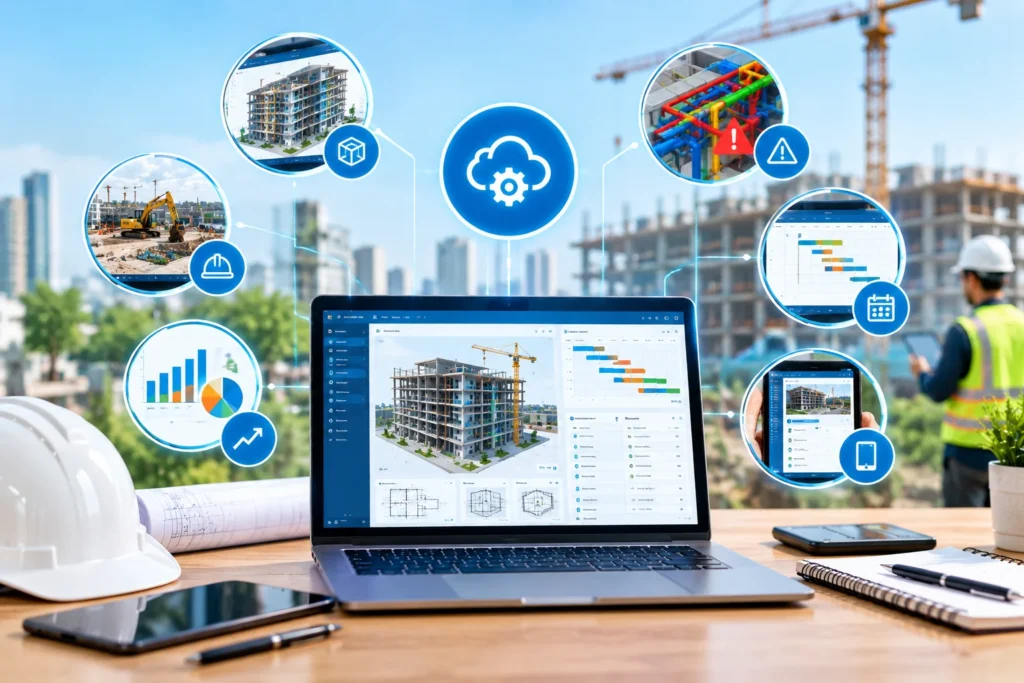
To realize the current BIM construction software news today, one should understand how technology has grown. BIM is a multi-dimensional data engine rather than just being a drafting tool. While 3D BIM manages geometry, 4D introduces the element of time (scheduling), and 5D combines real-time cost estimation. In 2026, the industry is increasingly switching toward 6D (sustainability/LCA) and 7D (facility management). Modern BIM software for construction acts as a Common Data Environment (CDE), guaranteeing that architects, structural engineers, and MEP (Mechanical, Electrical, and Plumbing) experts are working from a single, synchronized “source of truth” hosted in the cloud.
Top BIM Construction Software News: 2026 Updates and Releases
The start of 2026 has brought numerous landmark releases that are redefining project workflows. One of the most important updates comes from Trimble, which revealed its 2026 Tekla Software suite in March. This release introduces “AI Cloud Fabrication Drawings,” a human-in-the-loop service that uses historical project data to produce steel and concrete detailing automatically. In addition, Autodesk has made a pivotal change in its cloud architecture. As of February 15, 2026, the legacy ZIP-based download for Revit Cloud Models has been replaced by a restructured “Signed URL” workflow via Autodesk Platform Services, meaningfully improving how linked models are managed in enormous infrastructure projects.
Spotlight on BIM 360 Construction Management Software vs. ACC
The link between BIM 360 construction management software and the newer Autodesk Construction Cloud (ACC) is a common point of confusion for many firms. While BIM 360 was the pioneer of unified cloud modules, Autodesk’s focus in 2026 has shifted completely to the ACC platform, explicitly products like Autodesk Build and Forma. ACC offers a more modern interface and features like “Bridge,” that allows for seamless model linking across different project accounts. For firms that are still on BIM 360, the best BIM software for construction approach now involves a “Project Migration” plan to ACC to take benefits of the 40+ updates released in early 2026, counting the new Quality KPI dashboards and AI-powered Autodesk Assistant.
Choosing the Best BIM Software for Construction in 2026
Deciding on the right platform depends on your given role within the project lifecycle. While Autodesk Revit is still the market leader with a 36.29% share, other specialized tools are also gaining ground. Graphisoft Archicad 2026 recently combined a new “AI Assistant” to automate repetitive architectural documentation, while Tekla Structures continues to be the gold standard for constructible structural BIM. For coordination and clash finding, Navisworks Manage is often combined with Revizto to provide real-time issue tracking across different software ecosystems. Pricing models have also evolved, with many vendors providing “Flex” or “Pay-as-you-go” token systems for firms that only need high-end coordination tools during limited project phases.
Project Management Benefits: Scheduling, Collaboration, and Finance
The primary reason for adopting BIM construction software is the massive enhancement in project predictability. In 2026, the integration of 4D scheduling enables project managers to run “Visual Sequence” simulations. This recognizes workspace congestion, where two different subcontractors might be scheduled to work in the same hallway concurrently, reducing on-site friction.
- Collaboration: Cloud-based CDEs have reduced “Information Latency” (the time it takes for a design change to reach the field) i.e. information reaches in seconds which once took days.
- Financial Planning: 5D BIM tools now deliver “Automated Quantity Takeoffs,” allowing estimators to produce cost implications for design changes in real-time.
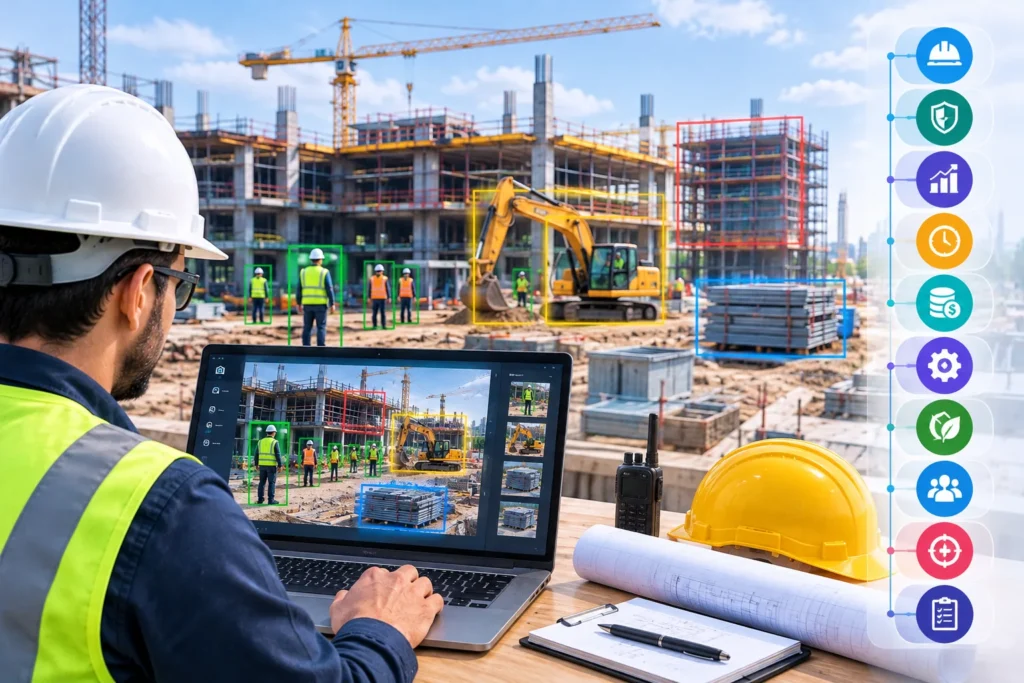
- Risk Mitigation: AI-driven risk dashboards can now identify “Out of Tolerance” as-built data by comparing drone scans directly to the BIM model.
Real-World Applications and Case Studies
Global megaprojects deliver the best evidence for the ROI of BIM. For instance, the expansion of major international airports in 2025-2026 has applied “Digital Twin” ecosystems to monitor passenger flow and energy consumption even before the terminal starts functioning. In the residential sector, modular construction firms are using BIM construction management software for driving off-site robotic fabrication, which has been shown to decrease material waste by 30%. A notable 2026 case study involving a high-rise in London showed that using “Agentic BIM” for MEP coordination saved over $2.5 million in potential rework costs by catching over 400 “hard conflicts” before the concrete was poured.
Software Comparison and Pricing Options
| Software | Best For | 2026 Pricing (Estimated) |
|---|---|---|
| Autodesk Revit | Full Design & Documentation | ~$3,005/year or $380/month |
| Tekla Structures | Structural Engineering & Steel | ~$2,860/3-year or Perpetual options |
| Archicad | Architectural Design | ~$225/month (Collaborate Plan) |
| BIM 360 / ACC | Cloud Management | ~$125/user/month (Build/Docs) |
| Navisworks | Clash Detection & 4D | ~$1,145/year (Simulate version) |
Future Trends: AI, Sustainability, and Beyond
Looking toward the end of 2026 and into 2027, the “agentic future” of BIM is the most obvious trend. AI agents will run in the background, suggesting more efficient material layouts to meet carbon footprint targets (6D BIM) rather than a user manually checking for errors. We are also seeing the emerge of “Mobile BIM,” where field teams use AR (Augmented Reality) headsets to overlay the digital model directly onto the physical site, enabling for “X-ray vision” through walls to see hidden utility lines. These tendencies are turning BIM from a necessity into a high-yield financial approach for modern contractors.