This guide describes in detail how generative AI is converting construction and civil engineering, emphasizing key use cases such document search, project management automation, and design generation. It facilitates engineers and contractors resolve industry productivity challenges, overcome adoption barriers, mitigate implementation risks, and establish a structured roadmap for integrating trustworthy, AI-driven workflows into their project operations.
Summary of Generative AI in construction
| Generative AI in construction is stepping ahead from experimental chat tools into engineering, estimating, planning, procurement, field coordination, and project controls. | |
| The actual question for engineers and contractors is whether AI can:use trusted project data, maintain context, obey approvals, enhance decisions without making accountability weak. | The answer is that is used correctly, it can:decrease repetitive work, speed up options, enhance project information search. |
| However, if used inaccurately, it can establish confident errors with cost, safety, contractual, and design risk. | |
What Generative AI in Construction Truly Means
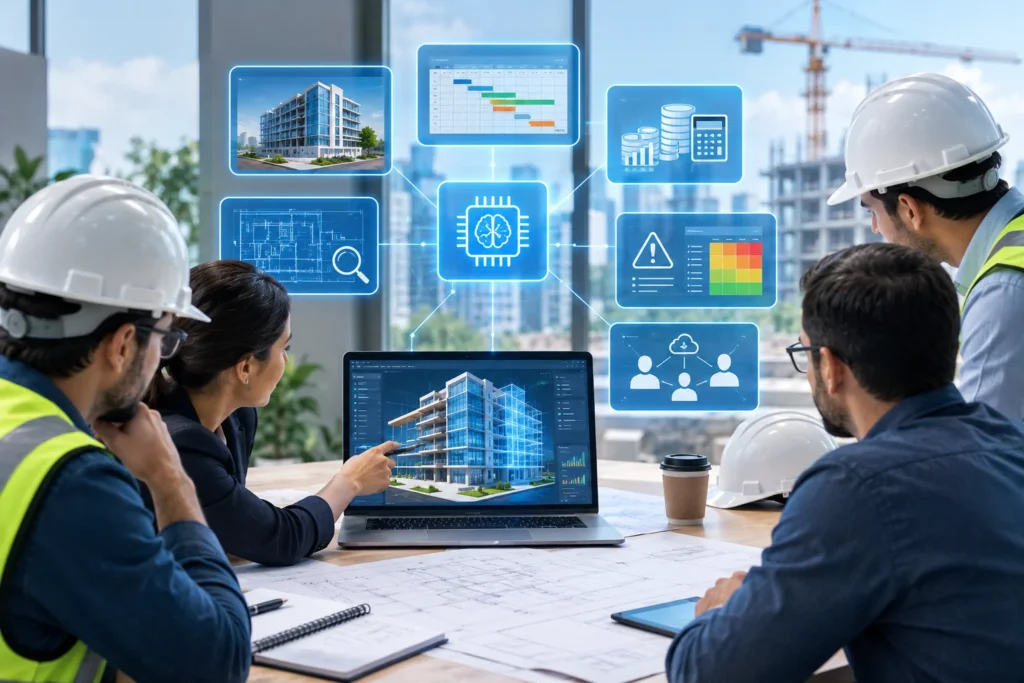
Generative AI in construction implies systems that produce or convert content like text, drawings, schedules, code, images, specifications, summaries, or design possibilities from prompts and project information. Large language models are only one layer. The broader stack comprises multimodal models, grounded retrieval, generative design, optimization, and AI agents that accomplish identified steps.
Predictive AI produces estimations of outcomes from patterns; generative AI designs new outputs. Teams repeatedly relate both, like guessing cost exposure and then producing an explanation or mitigation draft.
Why the Generative AI in Construction Market Is Accelerating
Large productivity challenge is triggering development of generative AI in construction market. McKinsey informed in July 2026 that worldwide construction output was about $15 trillion in 2025 and could reach $22 trillion by 2040. Its analysis learned that volume construction productivity rose only 10 percent from 2000 to 2022. If it is compared with manufacturing; that rose 90 percent during that period.
Adoption stays immature. RICS surveyed more than 2,200 construction professionals in 2025: 45 percent of them reported no AI functioning, 34 percent were in early pilots, and less than 1 percent organization used widely. Autodesk‘s 2025 construction research observed that 32 percent of construction leaders were either approaching or had achieved their AI goals.
Demand is strong, but results still depend on data readiness, skills, governance, and integration.
Core AI Use Cases in Construction
The most practical AI use cases in construction begin with information intensive work where humans remain responsible for technical judgment.
Common applications include:
• Searching specifications, drawings, RFIs, submittals, contracts, and lessons learned.
• Drafting RFIs, method statements, meeting summaries, reports, and correspondence.
• Comparing design alternatives against defined requirements.
• Generating estimate narratives and quantity takeoff notes.
• Identifying document inconsistencies for human review.
• Producing schedule scenarios and explaining critical path impacts.
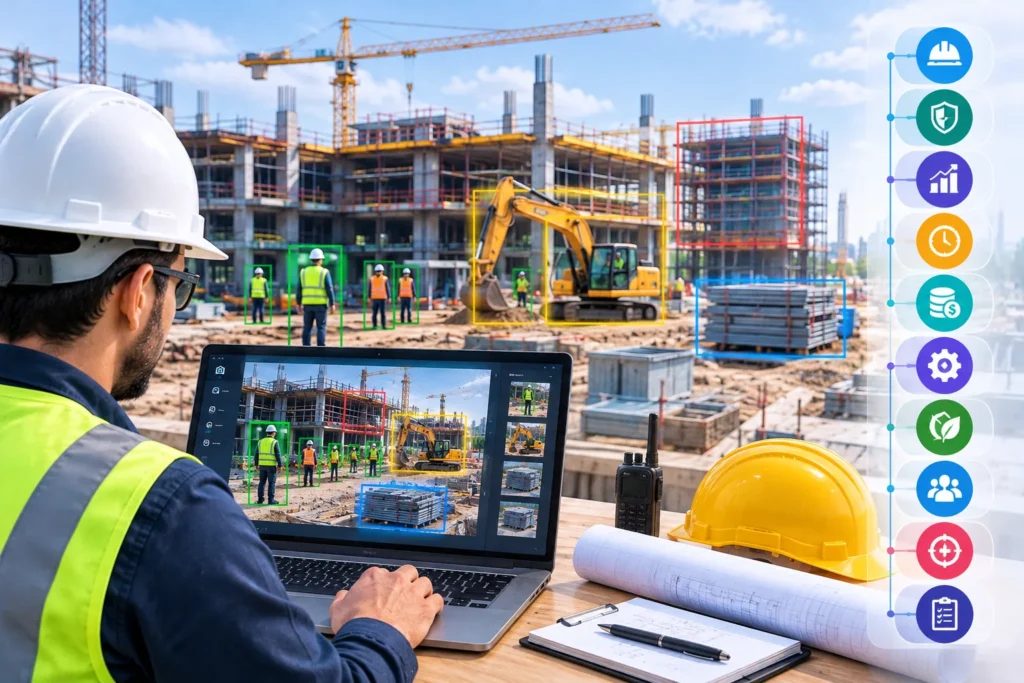
• Classifying site observations for quality or safety workflows.
• Translating technical content for multilingual teams.
• Creating scripts, formulas, and data transformations for engineering automation.
The strongest AI use cases in construction are narrow enough to validate. Define sources, expected outputs, reviewers, acceptance criteria, and escalation before automation.
AI in Construction Project Management
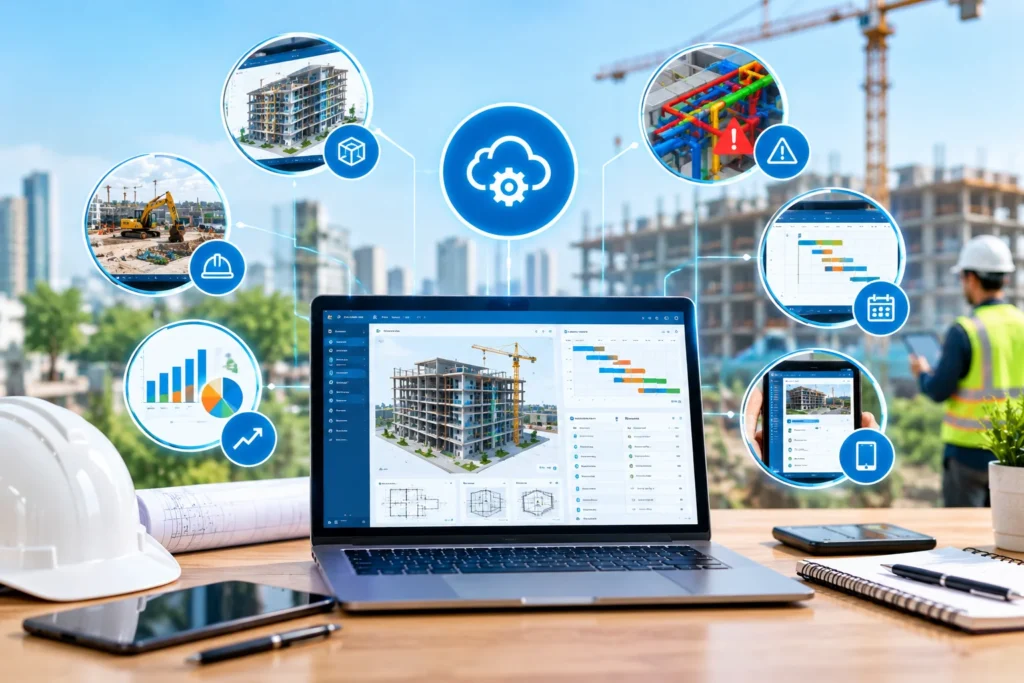
ai in construction project management can reduce administrative load and improve visibility across schedule, cost, risk, change, procurement, and communications. A grounded assistant can summarize reports, identify actions, compare progress with baseline, or draft a delay narrative.
Advanced workflows can connect language models with approved systems, letting managers query RFIs, change orders, procurement dates, or progress evidence. McKinsey‘s 2026 AEC analysis estimates that AI has the potential to automate 39 percent of nonphysical work in construction.
Still, AI in construction project management should not become automated authority. Contract notices, payment decisions, safety instructions, claims, and schedule conclusions require competent human review because context and legal consequences matter. Mature AI in construction project management keeps evidence, approvals, and accountability visible.
AI for Civil Engineering
AI for civil engineering can support structural, geotechnical, transportation, water, environmental, and infrastructure workflows when models are grounded in engineering data and constraints. Engineers can use AI to search design standards, generate calculation templates, organize inspection records, compare alternatives, or create scripts for repetitive analysis.
For example, AI for civil engineering may draft drainage alternatives, summarize borehole records, or classify inspection defects. Engineers must still verify assumptions, units, boundaries, codes, and calculations.
The best AI for civil engineering is augmentation: faster exploration and documentation with engineers retaining accountability.
Technologies Behind Generative AI Integration
Successful implementation usually combines several technologies rather than one chatbot.
Key components include:
• Large language models for drafting, extraction, reasoning, and conversation.
• Retrieval augmented generation, or RAG, for grounding responses in controlled documents.
• Multimodal models for interpreting photographs, drawings, scans, charts, and text together.
• Generative design and optimization for exploring engineering alternatives.
• AI agents for executing approved multistep workflows across software systems.
• Knowledge graphs and structured asset data for preserving relationships and context.
• APIs and connectors for BIM, CDE, ERP, scheduling, GIS, estimating, and document platforms.
• Guardrails, access controls, logging, evaluation, and human approval.
Good data architecture is essential. Weak naming, permissions, revision status, identifiers, or ownership will make outputs less dependable.
Generative AI in Construction for Design and Engineering
In design, generative systems can accelerate option studies, specification searches, compliance checklists, design narratives, and coordination tasks. It can turn requirements into prompts for generative design or simulation.
Generative systems are useful early, when many alternatives are needed. Later stages require tighter controls for codes, contracts, manufacturer data, and coordinated models. The workflow is generate, test, verify, document, approve.
For contractors, the same principle applies to work packaging, logistics, procurement, temporary works, and sequencing. Speed matters only with traceability.
Generative AI in Construction Market: Benefits and Constraints
The generative AI in construction market targets costly information friction through faster review, shorter response cycles, knowledge reuse, scenario exploration, and less repetitive drafting.
Autodesk reported that 63 percent of construction organizations in its 2025 research were using AI to become more sustainable. RICS, however, found major barriers: 46 percent cited a lack of skilled personnel, 37 percent system integration challenges, and 30 percent poor data quality.
For generative AI in construction market participants, buying licenses is easier than redesigning workflows, cleaning data, training staff, and creating governance.
Risks Engineers and Contractors Must Control
Key risks include hallucinations, outdated sources, data exposure, biased recommendations, automation errors, weak traceability, and overreliance on plausible language.
Before deployment, teams should:
• Restrict access according to project roles and contractual obligations.
• Ground answers in approved information where possible.
• Display source references and revision status.
• Test outputs against representative engineering cases.
• Require human approval for high consequence decisions.
• Keep audit logs for prompts, sources, outputs, and actions.
• Define prohibited uses for safety critical or legally sensitive tasks.
• Monitor performance after model or data changes.
AI governance belongs beside quality, information management, cybersecurity, and professional review.
A Practical Generative AI Integration Roadmap
A reliable generative AI integration program can start small:
1. Select a repetitive, measurable workflow with manageable risk.
2. Establish approved data sources and access rules.
3. Define accuracy, time, cost, and quality metrics.
4. Build a pilot with human review at critical steps.
5. Evaluate errors, missing context, and user behavior.
6. Improve prompts, retrieval, data structure, and controls.
7. Integrate with project systems after the pilot is stable.
8. Scale through documented standards, training, and ownership.
This approach keeps implementation tied to measurable value using real project evidence.
IMS Generative AI Development
Innovation M Services, or IMS, builds generative AI solutions, RAG systems, workflow automation, integrations, and AI enabled applications for engineering and construction businesses. IMS supports safe pilots and production systems linked to existing projects and enterprise platforms.