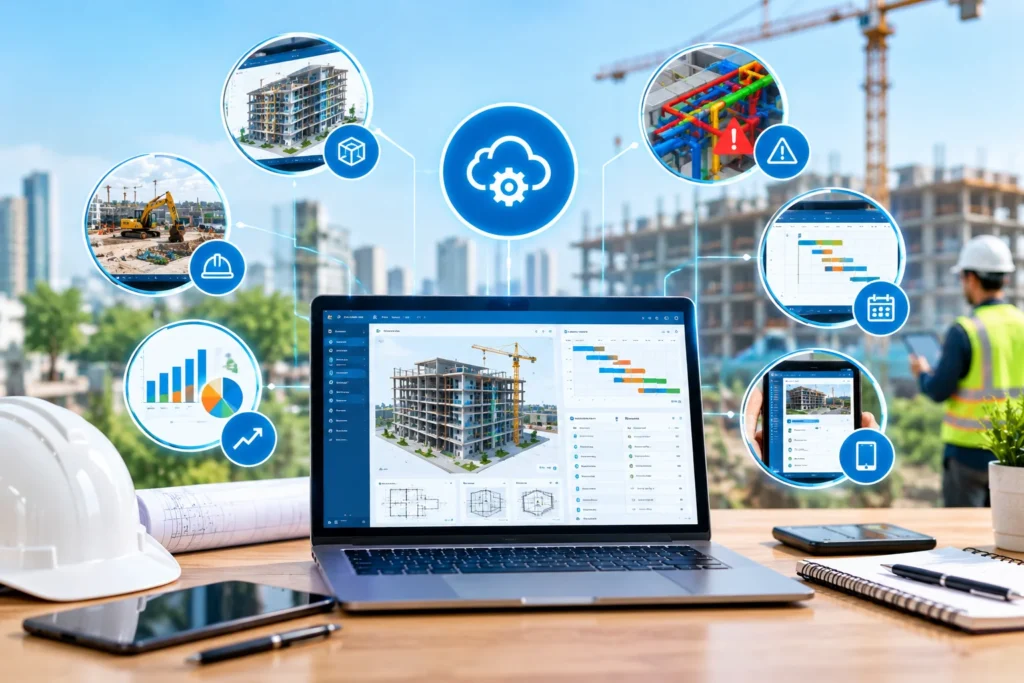
A superintendent notices the problem before the dashboard does: yesterday’s drawing is outdated, a delivery has reached elsewhere, and the office cost report will not reflect either issue correctly until Friday. Construction Software Development addresses that operational gap by turning scattered field events into governed workflows. The goal is not another app. It is a dependable system that connects people, project data, equipment, documents, and decisions while work is moving.
What Is Construction Software Development?
Construction Software Development is the design and engineering of digital products that are prepared precisely for contractors, owners, consultants, and field teams. These systems are not like generic project tools, because they model construction actualities, i.e. revisions, RFIs, submittals, quantities, crews, assets, locations, inspections, change orders, and contractual approvals.
The market context is substantial. The U.S. Census Bureau guessed in July 2026 that at a seasonally adjusted annual rate, construction spending was $2.158 trillion. At that scale, even small delays in information can compound across thousands of decisions. A well-scoped Construction Software Development Service therefore begins with process mapping and data ownership, not a feature wish list.
Why Does Construction Software Development Matter?
Construction creates information in the office, trailer, vehicle, and workface. When those records remain in email, spreadsheets, paper forms, and disconnected platforms, teams re-enter data and debate which version is authoritative. NIST’s historical interoperability study quantified a $15.8 billion annual cost burden in 2002 for inadequate interoperability in U.S. capital facilities. The figure is dated, but the mechanism remains instructive: systems that cannot exchange usable information create avoidable labor and uncertainty.
The benefits of Construction Software Development are most credible when tied to a defined workflow:
- Faster decisions through current drawings, structured approvals, and role-based alerts.
- Improved cost control by joining commitments, quantities, progress, variations, and predictions.
- Effective quality records through mobile inspections, photographs, signatures, and audit trails.
- Safer management by making observations, permits, and corrective actions visible to accountable teams.
- Less administrative duplication through integrations with BIM, accounting, scheduling, document, and asset systems.
Which Features Belong in Construction Software?
A useful platform follows the project’s control points. Core modules mostly involve document versioning, daily logs, RFIs, submittals, scheduling, procurement, cost codes, progress measurement, inspections, punch lists, equipment records, and dashboards. Offline capture is important because connectivity is doubtful on many sites. Permissions, encryption, backups, retention rules, and immutable activity logs are likewise important.
A capable Construction Software Development Service also designs integrations early. Open APIs and stable identifiers allow project, vendor, asset, and location records to move without creating duplicates. This is where IoT development consulting becomes practical: specialists define sensor identity, connectivity, sampling intervals, edge processing, data quality, and alerts before devices are purchased.
How AI Fits the Construction Workflow
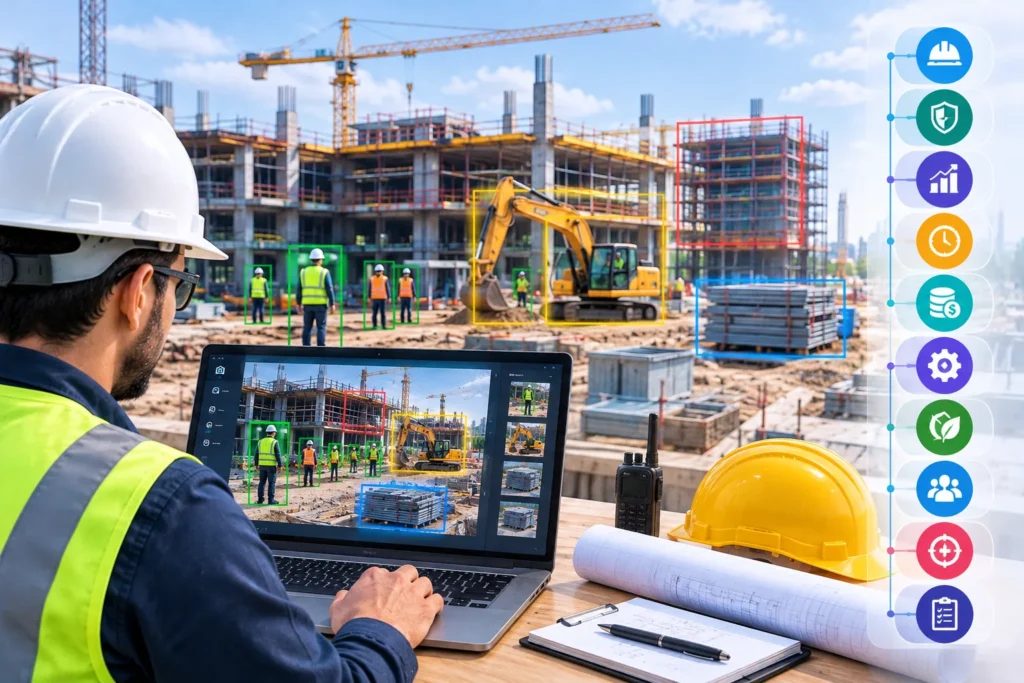
AI is most useful when attached to a controlled decision. affordable AI/ML development solutions might classify site photographs, predict equipment maintenance, extract quantities, flag document conflicts, or rank schedule risks. Affordable should mean a narrow use case with measurable value, not a low-cost model deployed without validation.
Generative ai integration can summarize daily reports, draft RFI responses, compare specifications, and retrieve approved project knowledge. It requires source citations, permissions, evaluation datasets, and human approval for contractual or safety-sensitive outputs. A second generative AI integration pattern is multilingual field assistance, where the system retrieves controlled procedures instead of inventing instructions.
Agentic AI consulting services address workflows in which software plans and performs several steps, such as collecting missing closeout documents or preparing a procurement exception for review. Guardrails should limit tools, spending, data access, and final actions. Effective agentic AI consulting services also define escalation paths and logs so managers can reconstruct what an agent attempted.
AI chatbot consulting services can design assistants for document search, subcontractor onboarding, support, or site reporting. Strong AI chatbot consulting services test retrieval accuracy, refusal behavior, latency, privacy, and handoff to a person. The chatbot should say when evidence is missing.
Where Is Construction Software Development Applied?
During preconstruction, teams use estimating, bid comparison, constructability review, and design coordination. Mobile workflows handle production, quality, safety, materials, and changes during delivery. At the time of handover, structured asset data, warranties, commissioning records, and maintenance tasks shift to the operator.
A Practical Implementation Sequence
Successful Construction Software Development is usually incremental:
- Select an expensive workflow and document its actors, decisions, exceptions, and evidence.
- Determine baseline time, error, rework, adoption, and data-quality measures.
- Prototype with field users, involving offline, low-light, glove, and shared-device conditions.
- Integrate the minimum authoritative systems and mark a master record for each entity.
- Pilot on a representative project, review failures, train users, and scale through releases.
How to Select a Development Partner
IMS can help organizations translate a defined construction problem into secure web, mobile, IoT, and AI software. Its teams can support discovery, architecture, development, integration, testing, and staged rollout. Begin with a workflow assessment and a measurable pilot before committing to a larger platform.
References
- U.S. Census Bureau, Construction Spending, July 2026: https://www.census.gov/construction/c30/current/index.html
- National Institute of Standards and Technology, Inadequate Interoperability: https://www.nist.gov/publications/inadequate-interoperability-closer-look-costs