A computer-vision demo can impress executives on Friday and fail customers on Monday. Noisy data, slow inference, fragile integrations, unexplained errors, or rising cloud costs are common causes. Deep learning development turns an experimental neural network into a monitored business capability. The objective is a valuable solution that should be reliable enough for people to use, rather than the largest model.
What Is Deep Learning & How It Works?
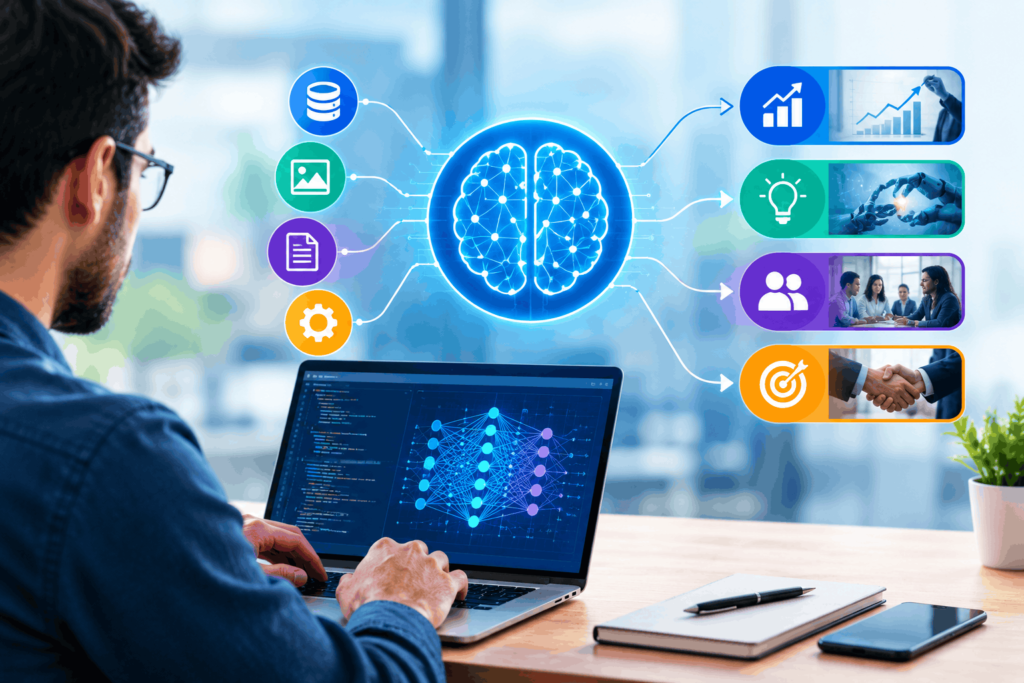
Deep learning is defined as a branch of machine learning that utilizes neural networks with several computational layers to acquire representations from data. At first step, during training, an optimizer amends parameters to decrease a defined loss. On next step, during inference, the trained network maps new inputs to projections, classifications, rankings, generated content, or other yields.
Why Does Deep Learning Development Matter to Business?
Deep learning development can extract patterns from images, video, speech, text, and time series where rules become brittle. It supports inspection, recommendations, forecasting, document understanding, conversational interfaces, and anomaly detection. Simpler analytics often win when data is small, relationships are stable, or explanations must be direct.
Stanford HAI’s 2025 AI Index reported that inference cost for a system performing at GPT-3.5 level fell more than 280-fold from November 2022 to October 2024. Lower unit cost expands feasible uses but does not guarantee value. Teams must measure quality, latency, error impact, cost, and adoption.
Well-designed deep learning solutions can create value by:
- Automating high-volume perception tasks while routing uncertain cases to reviewers.
- Personalizing search, recommendations, or assistance within approved business rules.
Which Deep Learning Models Fit Different Problems?
Convolutional networks learn visual patterns; transformers model relationships in language, vision, audio, and multimodal data; recurrent networks suit some sequences; autoencoders learn compressed representations and anomalies; graph networks represent connected entities; and diffusion models generate media. Architecture names do not select the product.
Compare candidate deep learning models with a simple baseline. Consider precision, recall, calibration, latency, memory, throughput, robustness, interpretability, licensing, privacy, retraining effort, and serving cost. A smaller model may offer more value if it responds faster, runs at the edge, or is easier to govern.
How Does Deep Learning Development Move from Idea to Production?
deep learning development follows this sequence:
- Build a reproducible baseline before increasing model complexity.
- Separate training, validation, and test data to reflect future operating conditions.
- Deploy with versioning, observability, access controls, rollback, and human escalation.
- Monitor drift, quality, latency, cost, incidents, and actual business outcomes.
What Are the Challenges of Developing Processors for Deep Learning?
Processor design balances speed, memory bandwidth, energy, numerical precision, programmability, cost, and availability. Training moves large tensors repeatedly; inference may need low latency. Accelerators improve selected operations, yet software compatibility, compilers, interconnects, thermal design, and workload changes can limit gains.
This explains what are the challenges of developing processors for deep learning beyond arithmetic. Memory movement consumes energy and time; parallel units can idle when workloads map poorly; lower precision saves resources but may affect quality; and edge hardware faces power, space, privacy, and reliability limits. Benchmark the actual model on intended hardware, not peak specifications.
The IEA projects data-centre electricity consumption to more than double to 945 TWh by 2030. This sector-wide forecast is not one model’s footprint. Responsible deep learning solutions track utilization, energy, carbon context, and hardware life while avoiding unnecessary training or oversized inference.
How Should Businesses Govern Deep Learning Models?
NIST’s AI Risk Management Framework uses Govern, Map, Measure, and Manage. For deep learning models, document intended use, affected people, data rights, limitations, test evidence, accountability, monitoring, and response. Review data poisoning, adversarial inputs, model theft, exposed endpoints, dependencies, and privileged access.
When Should You Buy, Build, or Hire Deep Learning Developers?
Buy when a proven product fits the workflow, integrates securely, exposes controls, and avoids lock-in. Build when proprietary data, unusual constraints, intellectual property, or specialized integration creates durable value. Businesses may hire deep learning developers for sustained ownership, or engage a partner for a bounded outcome.
A Practical Pilot for Deep Learning Development
Select one repeated, measurable task with a responsible owner. Run the model silently beside the existing process. Predefine thresholds, review false positives and negatives, record overrides, and compare net benefit after infrastructure and review costs. Scale only when performance remains stable under realistic load and controls are understood.
IMS builds deep learning solutions through discovery, data engineering, model design, application integration, MLOps, and pilots. Organizations that need to hire deep learning developers or assemble teams should begin with the decision, baseline, evidence standard, and deployment constraints—not an architecture.
Credible Sources Used
- Stanford HAI, 2025 AI Index Report: https://hai.stanford.edu/ai-index/2025-ai-index-report
- International Energy Agency, Energy and AI Executive Summary: https://www.iea.org/reports/energy-and-ai/executive-summary
- NIST AI Risk Management Framework: https://www.nist.gov/itl/ai-risk-management-framework