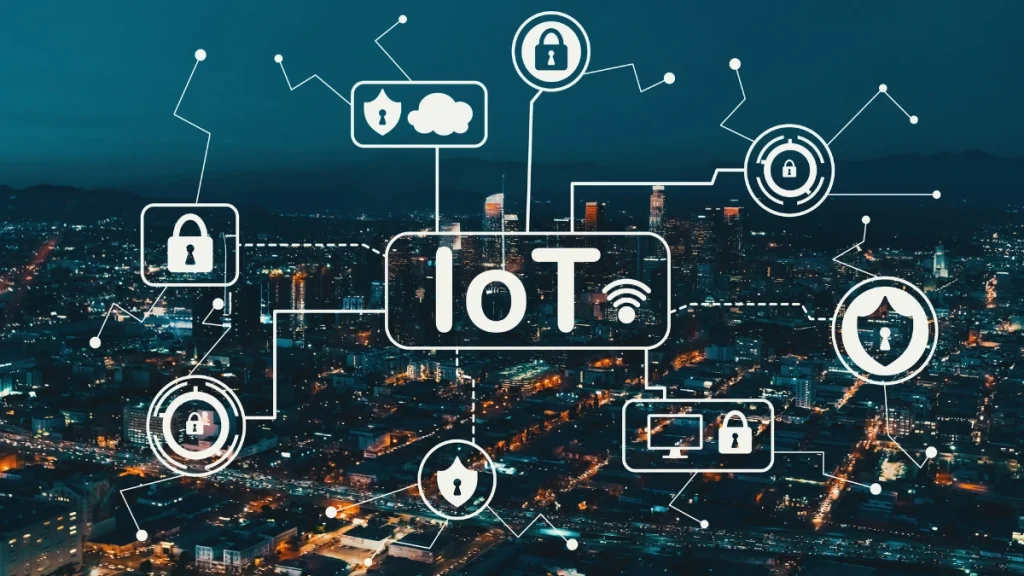
A bearing runs hotter during the night shift, but its condition reaches maintenance only after the line stops. The sensor worked; the surrounding system did not. Reliable industrial IoT infrastructure connects equipment signals to governed decisions through devices, networks, edge computing, platforms, data models, security controls, and operational workflows. Its value is not the number of connected assets. It is whether trusted information arrives quickly for someone—or an approved system—to act safely.
What Is Industrial IoT Infrastructure?
industrial IoT infrastructure is the technical and operational foundation that connects industrial assets with applications and people. It typically spans sensors and actuators, PLCs or controllers, gateways, industrial networks, edge systems, device management, data platforms, analytics, integrations, identity, monitoring, and lifecycle governance.
Which Layers Make Industrial IoT Infrastructure Work?
- Field layer: sensors, meters, actuators, drives, PLCs, RTUs, and machine interfaces.
- Connectivity layer: industrial Ethernet, fieldbus, Wi-Fi, private cellular, LPWAN, or other fit-for-purpose links.
- Edge layer: protocol translation, buffering, filtering, local analytics, and low-latency rules.
- Platform layer: device registry, message ingestion, time-series storage, digital context, APIs, and fleet management.
- Application layer: maintenance, quality, energy, production, safety, traceability, and management workflows.
- Trust layer: identity, segmentation, encryption, logging, backups, patching, and incident response across every layer.
Why Does Industrial IoT Infrastructure Matter?
A dependable foundation supports several business outcomes:
- Condition monitoring that detects changes in vibration, temperature, pressure, current, or lubrication.
- Energy visibility by asset, line, batch, shift, or product.
- Quality traceability linking process conditions with materials and finished output.
- Production insight through cycle time, downtime reason, throughput, and constraint data.
- Remote support using current alarms, trends, manuals, and approved diagnostic steps.
The U.S. Department of Energy reported that the industrial sector accounted for about one-third of U.S. energy consumption and related carbon emissions, while manufacturing used roughly four-fifths of industrial end-use energy. Those figures explain why granular measurement and control strategies matter, but they do not guarantee savings. Baselines, operating constraints, and verified interventions determine results.
How Do Edge and Cloud Roles Differ?
An industrial IoT solution should state which decisions occur at the controller, gateway, site platform, or cloud. It should also define synchronization, duplicate handling, clock accuracy, retention, model deployment, rollback, and human override. “Real time” must be expressed as a measurable latency requirement, not a slogan.
How Should Security Shape Industrial IoT Infrastructure?
NIST notes that connecting operational technology and IT can improve productivity while increasing exposure to malicious threats. Security therefore begins with asset inventory and architecture. Segment networks, minimize trust paths, use unique identities, restrict privileges, protect configurations, monitor changes, test recovery, and coordinate patching with production risk.
Where Do Engineering Services Fit?
industrial engineering services translate operational problems into process maps, instrumentation requirements, acceptance criteria, and safe work changes. Software teams then implement connectivity, data, applications, and integrations. This pairing prevents dashboards from being designed without maintenance, process, electrical, controls, or reliability input.
For production facilities, engineering services for industrial manufacturing may cover line balancing, utilities, instrumentation, controls, layouts, energy, quality, or automation interfaces. The IoT scope should identify authoritative tags, equipment hierarchy, operating envelopes, alarm ownership, and management-of-change requirements before deployment.
Mines, metals plants, cement works, ports, and similar assets add distance, dust, heat, vibration, high voltage, large rotating equipment, and remote operations. heavy industry engineering services help establish ruggedization, communications, power, hazardous-area, maintainability, and shutdown constraints. A generic office-network design is not enough.
How to Implement an Industrial IoT Solution
Start with one decision, not a platform purchase:
- Define the loss, decision owner, baseline, target, and acceptable false-alarm rate.
- Inspect assets, signals, protocols, network paths, cybersecurity zones, and data rights.
- Pilot representative equipment, including outages, bad data, sensor drift, and manual override.
- Measure adoption, latency, availability, alert quality, avoided loss, energy intensity, or another relevant KPI.
- Document support, calibration, patching, backups, model monitoring, spares, and retirement.
Experienced industrial engineering services can validate the workflow and instrumentation, while software specialists build the data path and user experience. For complex facilities, combine engineering services for industrial manufacturing with cybersecurity and controls expertise. Where environments are severe, include heavy industry engineering services during discovery, site verification, commissioning, and operational handover.
Selecting the Right Partner
Ask candidates to explain a failure scenario end to end: what the device records, how the gateway behaves offline, who owns the alert, how security events are detected, and how recovery is tested. A qualified team should discuss OT safety and software delivery without blurring them. IMS can support scoped IIoT discovery, edge and cloud software, integrations, analytics, and staged pilots alongside the client’s engineering authorities.
Credible Sources Used
- NIST Cybersecurity for IoT Program: https://www.nist.gov/itl/applied-cybersecurity/nist-cybersecurity-iot-program
- NIST NCCoE Industrial Control System Integrity: https://www.nccoe.nist.gov/manufacturing/protecting-information-and-system-integrity-industrial-control-system-environments
- U.S. DOE Industry and Manufacturing Energy Assessment: https://www.energy.gov/articles/qtr-webinar-chapter-8-industry-and-manufacturing