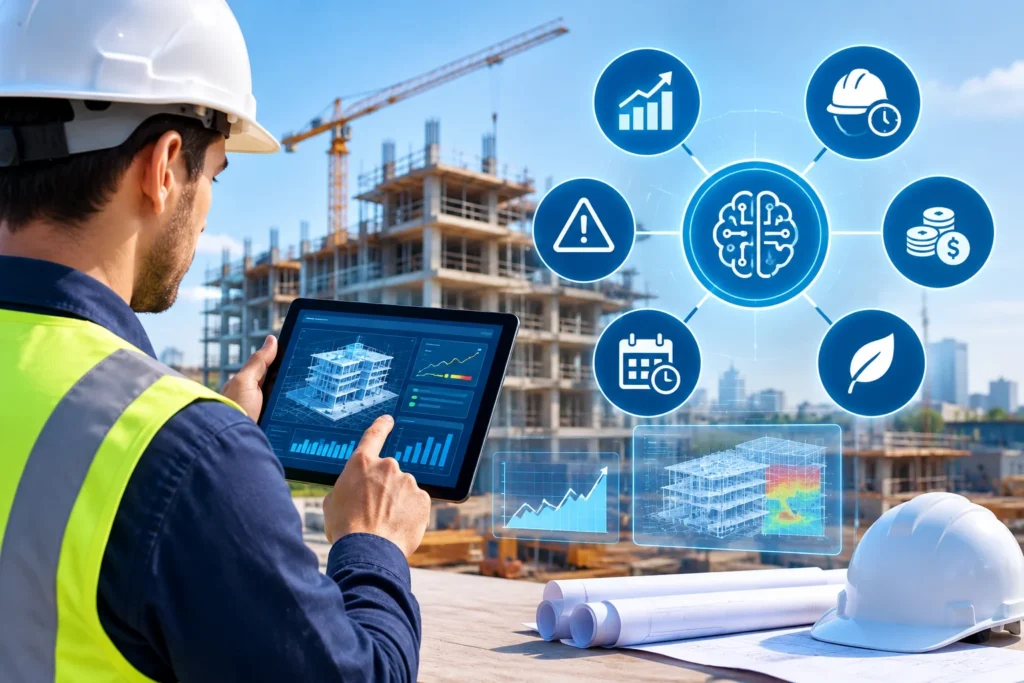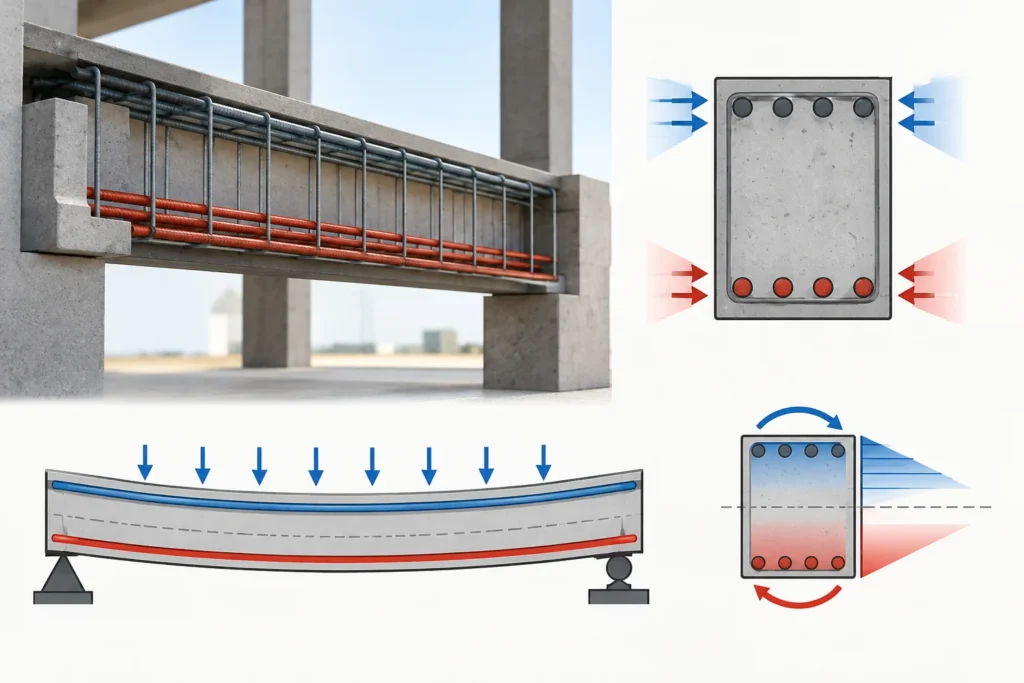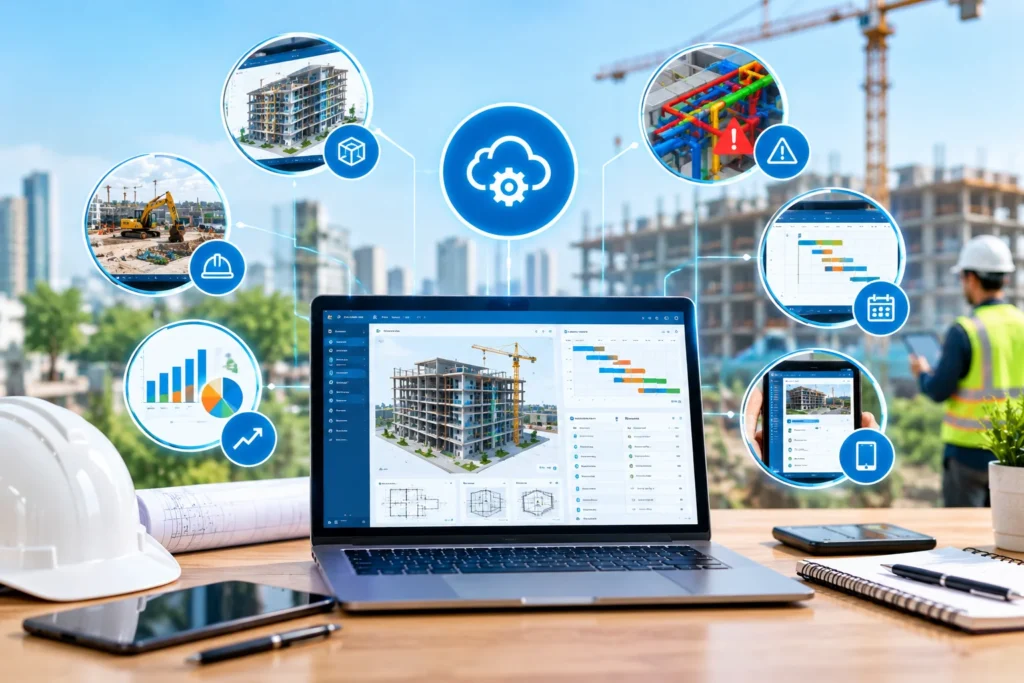
The monthly report says a project is healthy; two weeks later, a late submittal blocks procurement and the critical path moves. ai ml predictive analytics in construction is useful in that gap between recorded status and emerging consequence. It combines project data, statistical methods, and machine-learning models to estimate likely outcomes early enough for managers to investigate and act. The output is a probability or forecast—not a fact, instruction, or replacement for engineering judgment.
What Is AI ML Predictive Analytics in Construction?
Predictive analytics uses historical and current observations to estimate a future value or event: completion date, final cost, incident risk, equipment failure, cash requirement, or likelihood of rework. Machine learning can capture nonlinear relationships and interactions, while simpler regression or rules may be more stable and explainable when data is limited.
This differs from generative AI, which produces new text, images, or other content. A language model might summarize a delay narrative; a predictive model estimates delay probability from defined features. It also differs from a deterministic CPM schedule, which calculates dates from durations, logic, constraints, and calendars. Strong systems use these methods together without confusing their outputs.
Why Does AI ML Predictive Analytics in Construction Matter?
Practical benefits include:
- Earlier attention to schedule activities whose current signals resemble prior delays.
- Updated cost-at-completion ranges using commitments, quantities, production, changes, and trends.
- Focused review of safety, quality, procurement, or equipment risks without replacing accountable professionals.
- Consistent portfolio screening across projects while preserving project-specific context.
- Faster learning when predictions, interventions, and actual outcomes are stored together.
Key Applications of AI ML Predictive Analytics in Construction
Schedule models can combine activity progress, float, logic density, design release, RFI aging, submittals, procurement milestones, weather, crew availability, and production rates. Useful output includes a range and contributing signals, not merely a red score. Planners still test recovery logic and field feasibility.
Cost models may forecast final quantities, labor productivity, contingency drawdown, change exposure, or cash flow. When outsourcing construction estimating, the client should define measurement rules, estimate basis, exclusions, uncertainty, version control, and feedback from actual costs. External estimates become stronger training data only after coding and scope differences are reconciled.
Safety analytics may identify combinations of conditions deserving review, such as work type, shift, weather, congestion, supervision, or prior observations. BLS reported 1,034 deaths in private-sector construction during 2024; 389 involved falls, slips, or trips. These figures establish the seriousness of prevention, not permission to label individuals or automate disciplinary action.
What Data Does Predictive Construction AI Need?
Before training, teams should:
- Define the outcome, prediction horizon, decision owner, and cost of false positives and false negatives.
- Align project, activity, vendor, location, asset, and cost identifiers.
- Prevent information leakage by excluding data unavailable at prediction time.
- Separate training, validation, and test data by time or project where appropriate.
- Document missing values, coding changes, privacy constraints, and known bias.
How Are Models Developed and Governed?
Effective ai ml engineering services start with the decision workflow, then establish data pipelines, baselines, features, candidate models, evaluation metrics, explanations, monitoring, and retraining criteria. Accuracy alone is insufficient. Calibration, recall, precision, lead time, stability across project types, and business usefulness may matter more.
NIST’s AI Risk Management Framework organizes risk work around Govern, Map, Measure, and Manage. Applied here, teams define accountability, intended use, affected people, limitations, testing, monitoring, and response. High-impact recommendations require human review, access controls, audit logs, model versioning, and a safe fallback when data or services fail.
Specialized ai ml software development services connect the model to project systems and the user’s workflow. Production work includes APIs, permissions, feature pipelines, dashboards, alerts, testing, observability, deployment, and support. A notebook that predicts well once is not yet a reliable construction product.
Build, Buy, or Hire AI ML Developers?
Evaluate ai ml software development services on construction knowledge, data engineering, MLOps, security, UX, and measurement—not model vocabulary. Credible ai ml engineering services will challenge unclear targets, compare against simple baselines, and expose failure modes. If outsourcing construction estimating is part of the pipeline, verify estimator qualifications, review procedures, data rights, and coding consistency.
A Practical Pilot Sequence
- Choose one repeated decision with sufficient historical outcomes.
- Create a simple baseline and define acceptance thresholds before model selection.
- Test retrospectively, then run silently beside the current process.
- Pilot with named reviewers and record interventions as well as predictions.
- Scale only after checking drift, adoption, net benefit, and unintended effects.
IMS can support discovery, data engineering, model development, application integration, MLOps, and staged pilots with care. Start with a measurable construction decision and an auditable baseline; expand only when field users can explain how the prediction improves action.
Credible Sources Used
- NIST AI Risk Management Framework: https://www.nist.gov/itl/ai-risk-management-framework
- U.S. Bureau of Labor Statistics, Construction Fatal Injuries 2024: https://www.bls.gov/opub/ted/2026/national-safety-stand-down-highlights-fall-hazards-in-construction.htm