A route can look cheaper on a map and become uneconomic once outages, cable charging, access, or permitting enter the design. Comparing underground vs overhead transmission lines requires a system decision. Test voltage, distance, transfer, terrain, hazards, repairs, programme, and community impacts together.
Underground vs Overhead Transmission Lines at a Glance
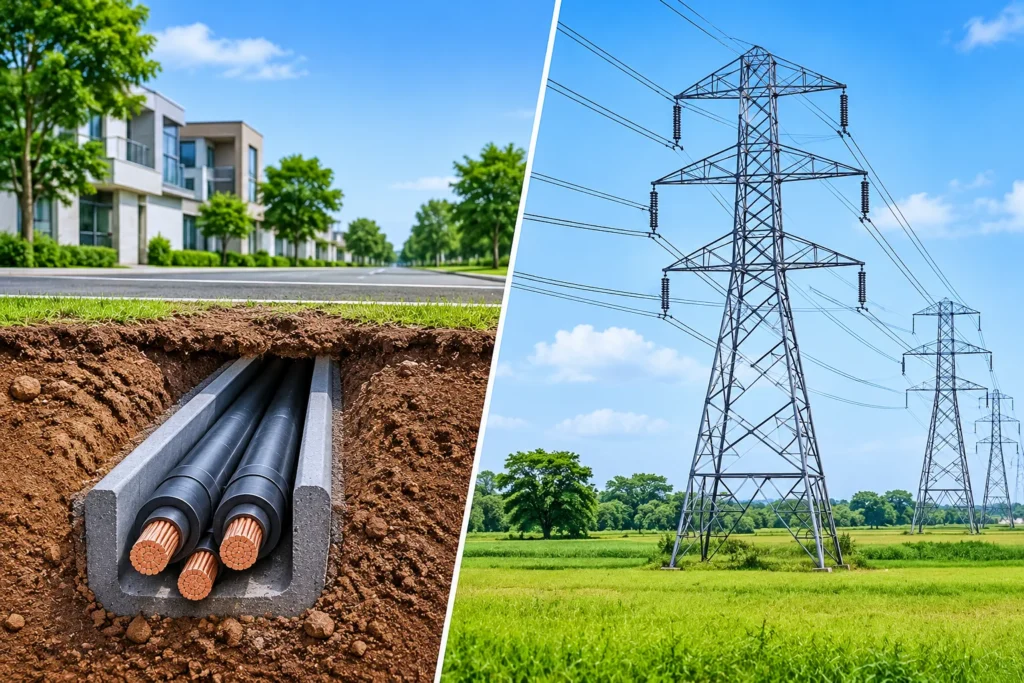
overhead transmission lines suspend bare conductors from towers or poles, using air as insulation. underground transmission lines use insulated cable systems installed in trenches, ducts, tunnels, or directional-drilled crossings. Both can carry bulk power, but their electrical behaviour, civil footprint, failure modes, and operating constraints differ.
Cost and Construction Differences
For underground vs overhead transmission lines, compare equivalent voltage, capacity, route, terminals, compensation, land, mitigation, and contingency capability.
- Overhead work usually needs towers, foundations, access tracks, conductor stringing, and a wider permanent corridor.
- Underground work needs excavation or tunnelling, cable protection, joint bays, drainage, thermal backfill, and transition compounds.
- Urban congestion, rock, groundwater, utilities, archaeology, contaminated soil, and traffic management can dominate underground cost.
- Mountain access, long spans, aviation constraints, severe icing, or complex foundations can raise overhead cost.
Electrical Performance and Capacity
AC cables have higher capacitance. Long circuits generate charging current and reactive power, potentially requiring compensation. Switching, overvoltage, insulation-coordination, and harmonic studies may become decisive.
Airflow cools overhead conductors; cable ratings depend on soil resistivity, depth, spacing, ground temperature, circuits, ducts, and drying. underground transmission engineering services must connect route investigation with ampacity modelling.
underground transmission engineering services also assess bonding, sheath voltages, induced currents, joint design, earthing, terminations, and partial-discharge requirements. For overhead transmission lines, engineers model sag, tension, wind, ice, galloping, corona, lightning, clearances, and tower loading.
Reliability Faults and Repair Time
Underground assets avoid many wind, tree, lightning, wildfire, and vehicle faults, but excavation, water, accessories, heat, manufacturing, or installation can cause permanent faults. Automatic reclosing may be restricted.
Fault location and repair are usually slower underground. ENTSO-E has reported cable-fault repair time four to five times greater than overhead-line repair. That figure is an older European planning reference, not a promise for every project; actual duration depends on access, spares, cable type, joints, permits, and specialist crews.
Land Environment and Public Acceptance
Overhead corridors affect views, birds, aviation, vegetation, farming operations, and nearby communities. FERC vegetation rules require clearances around applicable overhead transmission lines for reliability and public safety. Underground routes avoid routine conductor-to-tree clearance but must protect cable easements from incompatible excavation, deep-rooted planting, and building.
Underground Power Lines vs Overhead Selection Criteria
A useful underground power lines vs overhead assessment starts with constraints, then compares whole-life outcomes. Screen these questions:
- What voltage, capacity, distance, contingency standard, and future expansion are required?
- Which route minimizes combined technical, environmental, social, land, and schedule risk?
- Can the AC network absorb cable charging, or would compensation or HVDC be justified?
- How will faults be located, isolated, repaired, and supplied with strategic spares?
- Which hazards dominate: storms, wildfire, flooding, landslide, excavation, corrosion, or third-party damage?
- What are the comparative capital cost, losses, maintenance, outage exposure, and end-of-life obligations?
The best underground power lines vs overhead option may be hybrid: overhead across open land, underground through constrained urban areas, environmentally sensitive sections, airports, major crossings, or locations where resilience benefits justify added cost.
Power Line Consulting for Defensible Decisions
Effective power line consulting coordinates system, cable, line, civil, environmental, protection, cost, and schedule inputs into traceable alternatives.
Choosing an Electric Engineering Company
An electric engineering company should demonstrate relevant voltage-class experience, validated study tools, route and asset knowledge, checking procedures, and familiarity with local codes. Ask who owns interfaces among system studies, primary design, protection, civil works, environment, procurement, and commissioning.
When organizations hire electrical engineers, competence should match the chosen technology. Cable projects need installation, bonding, joints, thermal design, and diagnostics; overhead projects need line geometry, structures, clearances, sag-tension, and weather loading. An electric engineering company must also explain uncertainty and residual risk.
Before you hire electrical engineers, require checked samples, verified software, site assumptions, and named responsibilities.
Compare underground vs overhead transmission lines through power line consulting. underground transmission engineering services define underground transmission lines. Clients hire electrical engineers to justify selections between underground vs overhead transmission lines and underground transmission lines.
Make the Choice at System Level
The answer to underground vs overhead transmission lines depends on what the network must achieve and which risks the project can manage. InfraTech Hub supports option studies, route engineering, system analysis, design review, and technical due diligence for overhead, underground, and hybrid transmission projects.
Source Notes
U.S. Department of Energy 2024 review: undergrounding transmission and distribution lines
ENTSO-E planning position: underground cable repair duration
FERC reliability standard: transmission vegetation management
UK government cost study summary: transmission cable cost findings