Bricks and mortar are not the only items that describe the global construction industry; rather, it is becoming a digital-first frontier. Recent research from the McKinsey Global Institute specifies that while the sector has historically lagged in digital maturity, firms that are now accepting digital transformation in construction; they are now seeing an average productivity increase of 15% and a direct cost decrease of 6%. Furthermore, a 2024 Deloitte analysis shows that companies see a 1.14% increase in expected revenue for every additional digital technology combined. In spite of all that, the cost of implementing digital construction across projects remains a complex obstacle for many firms. Understanding the granular breakdown of these budgets, starting from initial software licensing to long-term data maintenance is vital for any organization aiming to move from analog workflows to high-fidelity digital twins.
Defining Digital Construction and its Financial Landscape
Digital construction denotes to the addition of digital tools and processes like Building Information Modeling (BIM), Internet of Things (IoT) sensors, and cloud-based management across the whole lifecycle of a built asset. The cost of digital transformation is a multi-layered investment strategy rather than just a single line item. For small to medium enterprises (SMEs), cost of a targeted digitization project might range from $50,000 to $500,000, whereas full-scale enterprise-wide shifts for Tier-1 contractors can surpass $5 million yearly. These figures signify more than just “buying software”; they include the architectural shift toward a digital transformation construction industry standard where data becomes the main asset.
Key Components of Digital Transformation Budgets
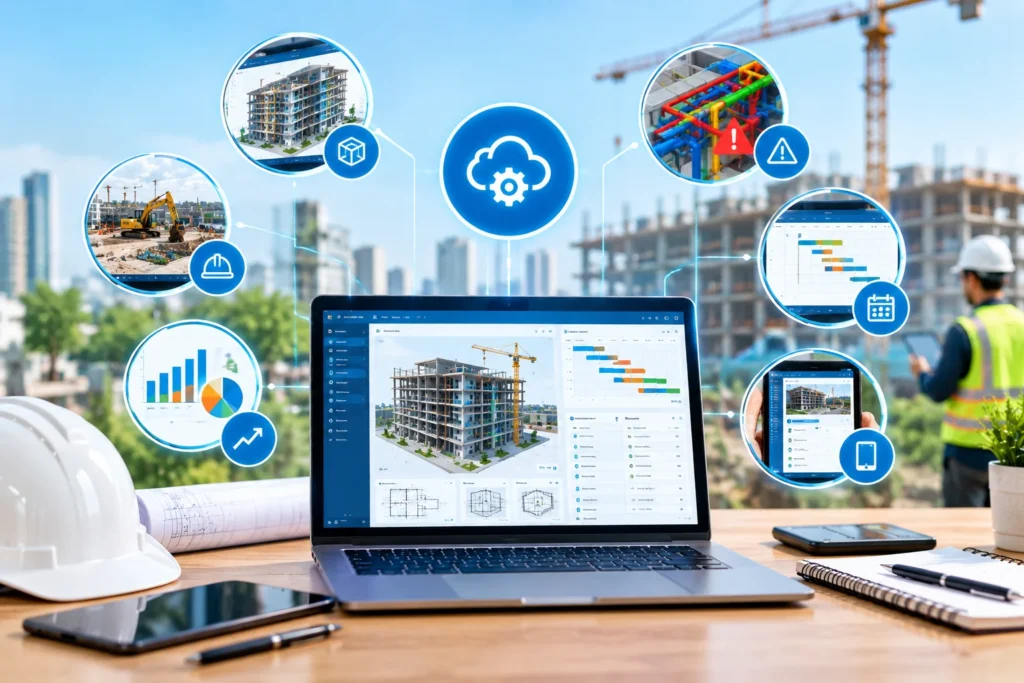
For accurately estimation the cost of implementing digital construction across projects, a budget should be divided into direct and indirect expenses. Direct costs comprise hardware like high-end BIM workstations, VR/AR headsets for site walkthroughs, and specialized IoT sensors. Software costs are often the most visible, that involve recurring SaaS subscriptions for project management platforms and 3D modeling engines. However, the digital transformation budget should also account for “soft” costs, like the initial data cleanup and the migration of legacy paper-based records into a combined data environment.
Primary Cost Drivers in Digital Construction
Several variables decree the final price tag of a digital rollout. The complexity of the project is the most noteworthy driver; a residential high-rise needs a different level of detail compared to a sprawling infrastructure project like a bridge or tunnel. Another major factor is the “Level of Development” (LOD), compulsory for BIM models. High-fidelity digital twins that provide real-time operational data through IoT addition are knowingly more expensive than static 3D models used only for design coordination. Moreover, the geography of the project can influence costs due to varying labor rates for digital experts and the availability of high-speed 5G connectivity on distant sites.
Comparison of Costs Across Project Types
The financial pledge for digital transformation in construction fluctuates wildly depending on the asset class. For example, applying a digital twin for a Grade A commercial office building (approx. 600,000 sq. ft.) characteristically carries a budget between $1.2 million and $1.7 million. In contrast, a more complex facility like a General Hospital (2.1 million sq. ft.) can incur high cost between $3 million and $4.2 million due to the intricate mechanical, electrical, and plumbing (MEP) systems that need digital mapping. Educational facilities and distribution centers generally fall on the lower end of the spectrum, with digital implementation budgets often starting about $300,000.
Strategic Financial Planning for Digital Adoption
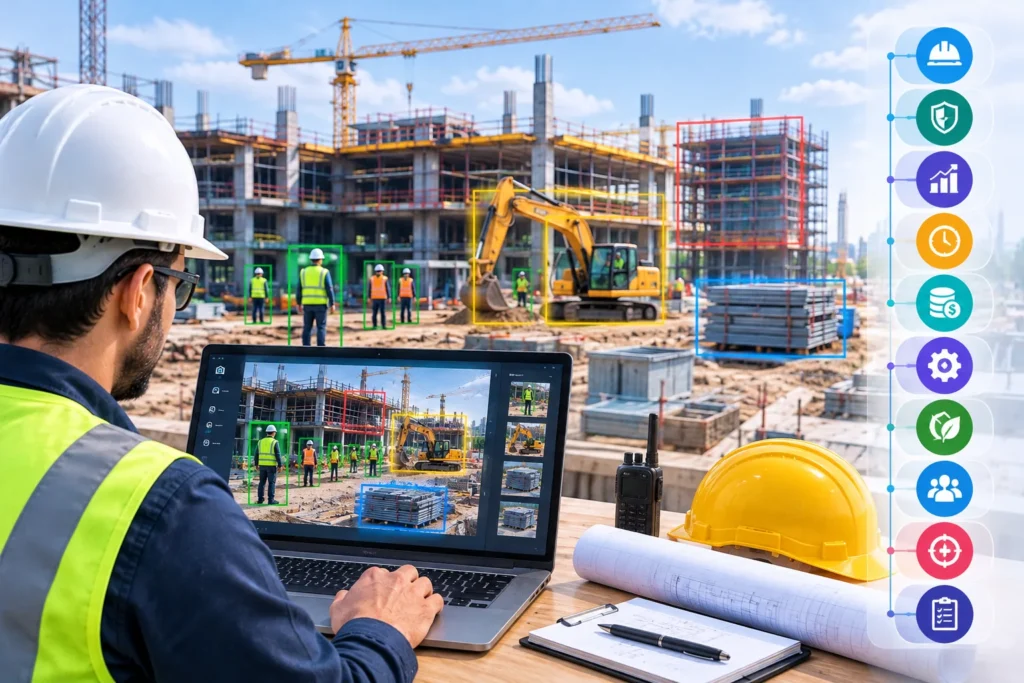
Successful firms do not consider the cost of digital transformation as a sunk expense but as a phased investment. Financial planning should begin with a “Pilot Program” approach, which 92% of high-performing organizations now use to lessen the risk of failure. By focusing on a single high-impact area like equipment tracking or safety monitoring, firms can demonstrate a rapid return on investment (ROI) within 90 days. This phased approach allows for “Agile Budgeting,” where the savings produced from the first phase are reinvested into more complex additions like AI-driven predictive analytics in the second year.
Measuring ROI and Long-Term Savings
Although the upfront cost of implementing digital construction across projects is high, the long-term savings are frequently transformative. Research illustrates that firms using BIM report a 20% to 30% decrease in overall project costs, averaging $1.2 million in savings for large-scale developments. These savings originate from a 48% reduction in rework and a 55% enhancement in collaboration efficiency. Moreover, IoT implementation has been shown to decrease equipment downtime by 40%, saving mid-sized contractors upwards of $2.5 million yearly. Over a 10-year asset lifecycle, the “Digital Dividend” far outweighs the initial application budget.
Overcoming Challenges in Digital Budgeting
During the journey toward a digital transformation construction industry, leaders are fraught with financial pitfalls. One of the most common challenges is “Scope Creep,” as the digital requirements expand mid-project without a corresponding budget adjustment. Another obstacle is the “Skills Gap”; firms often underestimate the cost of training their current workforce or the premium salaries essential to hiring BIM managers and data scientists. To mitigate these, best practices propose assigning at least 20% of the digital budget precisely to change management and training, guaranteeing that the tools purchased are actually applied by the field teams.
Steps to Cost-Effective Digital Transformation
- Audit Current Assets: Recognize existing software and hardware that can be integrated instead of being replaced.
- Define Clear Objectives: Determine if the goal is to decrease rework, enhance safety, or improve client reporting.
- Select Scalable Platforms: Select “Agnostic” software that can grow with the company’s needs across several projects.
- Invest in Training: Confirm that site supervisors and subcontractors are expert in the new digital workflows.
- Monitor and Adjust: Use real-time dashboards for tracking the ROI of each digital tool during the project lifecycle.
Pros and Cons of In-House vs. Outsourced Digital Implementation
- In-House Implementation Pros: Total control over data safety, building internal intellectual property, and long-term cost efficiency.
- In-House Implementation Cons: High initial overhead for hiring experts and slower initial rollout.
- Outsourced Implementation Pros: Immediate access to skilled knowledge, lower initial risk, and rapid deployment of advanced tools.
- Outsourced Implementation Cons: Higher long-term recurrent costs and possible dependency on external vendors for data access.
Future Trends in Digital Construction Budgets
Looking toward 2026 and beyond, we imagine a change in how the cost of digital transformation is characterized. We are observing a move from “Capital Expenditure” (CapEx) toward “Operational Expenditure” (OpEx) as more firms accept cloud-native, subscription-based models. Artificial Intelligence (AI) is also becoming a standard budget line item, with AI-driven generative design tools anticipated to be a $1.8 billion market by 2027. Moreover, the addition of sustainability tech within digital twins will become compulsory as global carbon reporting regulations tighten, making digital construction an indispensable part of green building certifications.