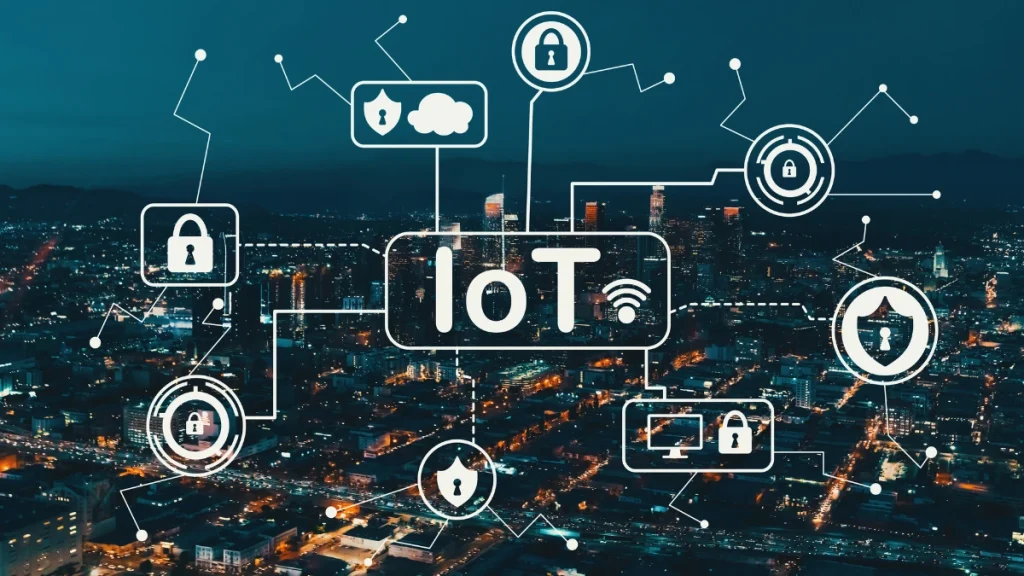
IoT in telecommunication is moving from “interesting” to unavoidable because operators look for new growth and operational efficiency. GSMA Intelligence predicts the global Internet of Things (IoT) market to reach about 38.7 billion connections by 2030, with enterprise connections accounting for ~63% of the total. At the same time, Ericsson estimates cellular IoT connections reaching 4.5 billion by end-2025, growing toward ~8 billion by 2031, driven in part by Massive IoT technologies like NB-IoT and Cat-M. And while telecom remains massive, growth pressures are real, Deloitte projected global telecom revenues around US$1.53 trillion in 2024 with modest growth.
IoT and Telecommunications
Let’s define the core terms clearly:
- Internet of Things (IoT): physical devices (sensors, meters, trackers) which collect data and communicate over networks.
- Telecommunications (Telecom): networks and services that facilitate connectivity (mobile, fixed, private networks, roaming, security services).
Key note mobile and IoT connectivity terms you’ll see in IoT in telecommunication programs:
- Fifth Generation (5G) and Fourth Generation Long-Term Evolution (4G LTE)
- Narrowband Internet of Things (NB-IoT) and Long-Term Evolution for Machines (LTE-M) (also called Cat-M)
- Embedded Subscriber Identity Module (eSIM)
- Multi-access Edge Computing (MEC)
- Application Programming Interfaces (APIs)
- Operations Support Systems / Business Support Systems (OSS/BSS)
- Key Performance Indicator (KPI), Average Revenue Per User (ARPU), Operating Expenditure (OPEX), Capital Expenditure (CAPEX)
What is IoT in Telecommunications?
What is IoT in telecommunications meanings in plain English?
It’s the end-to-end ability to:
- Link devices consistently (coverage + Quality of Service (QoS))
- Handle devices over their lifecycle (activation, security, updates, retirement)
- Collect and use data of device (dashboards, alerts, analytics, industry outcomes)
- Make money from the solution (connectivity + platform + managed services + SLAs)
So IoT in telecommunication is not just “selling SIM cards.” It’s packaging connectivity, control, and outcomes into an enterprise offer.
The Enabling Technologies Behind IoT in Telecommunication
Most productive IoT in telecommunication industry programs use a combination of connectivity and compute options:
Connectivity Options
- NB-IoT (Narrowband Internet of Things): It is best for low data, deep coverage, long battery life (meters, simple sensors). Ericsson notes NB-IoT is devised for extended coverage and long battery life for ultra-low complexity devices.
- LTE-M (Long-Term Evolution for Machines): better mobility and higher throughput than NB-IoT (asset tracking, wearables).
- 4G LTE / 5G: higher bandwidth and lower latency for cameras, routers, industrial gateways, and mission-critical workloads.
Make it Enterprise-Grade Layers
- eSIM for easier provisioning at scale (especially cross-border deployments)
- MEC (Multi-access Edge Computing) for low-latency decisions near the network
- APIs to incorporate into customer apps and operator platforms
- OSS/BSS incorporation to automate activation, billing, assurance, and customer care
Where IoT in Telecommunication Makes Profit
A positive way to think about IoT solutions for telecom is a value stack:
- Connectivity revenue: device connections, roaming, private APNs, QoS tiers
- Platform revenue: device management, application enablement, data routing
- Analytics revenue: dashboards, anomaly detection, optimization recommendations
- Vertical solutions: smart metering bundles, fleet tracking bundles, industrial monitoring
- Managed services: install + operate + monitor + SLA reporting
GSMA focuses “beyond connectivity” opportunities and has quoted large incremental value creation potential from platforms, applications, and services built on IoT.
This is why IoT in telecommunications is progressively positioned as a B2B (Business-to-Business) growth engine.
IoT Applications in Telecommunication
Followings are practical IoT applications in telecommunication that operators and enterprise customers really buy:
High-ROI Enterprise Use Cases
- Smart metering: electricity, water, gas (NB-IoT/LTE-M strong fit)
- Fleet and asset tracking: logistics, cold chain, high-value equipment
- Industrial monitoring: vibration, temperature, pressure for factories
- Smart buildings: energy monitoring, occupancy, equipment health
- Agriculture: soil moisture + irrigation controls
- Healthcare: asset tracking, remote monitoring (where regulations allow)
Operator Internal Use Cases
- Tower/site monitoring: power systems, batteries, generators, fuel levels
- Predictive maintenance: reduce failures and truck rolls
- Network performance sensors: site environment + equipment health
- Energy optimization: smarter cooling/power management at sites
That mix, i.e. external revenue + internal savings, is the quickest path to making IoT in telecommunication industry financially meaningful.
Benefits of IoT in telecom: why operators invest
The benefits of IoT in telecom usually fall into two buckets:
1) Revenue Benefits
- New enterprise ARPU streams (connections + platform fees)
- Less churn through “sticky” embedded solutions
- Upsell paths into security, analytics, and private networks
2) Cost and Reliability Benefits
- Fewer truck rolls (less reactive field maintenance)
- Faster fault isolation and better uptime
- Energy management and site efficiency
On energy: McKinsey has noted energy costs can be a meaningful part of expenditure on telecom operating, and in some markets can be higher due to dependance on generators. This is the reason that tower/site IoT is one of the most practical “start here” projects in IoT in telecommunication.
Step-by-Step Implementation Roadmap
Employ this roadmap to implement IoT in telecommunication without getting stuck in endless pilots:
- Step 1: Pick a money use case
- Smart metering, logistics tracking, or tower energy optimization
- Step 2: Define the offer
- Connectivity + device + platform + SLA + support model
- Step 3: Design the architecture
- NB-IoT/LTE-M/5G, eSIM strategy, MEC vs cloud, security controls
- Step 4: Integrate OSS/BSS
- Provisioning, billing, customer portal, trouble ticketing
- Step 5: Run a controlled pilot
- Clear KPIs, staged rollouts, real customer feedback
- Step 6: Productize
- Packaging, pricing, onboarding playbooks, support runbooks
- Step 7: Scale
- Automate activation, monitoring, SLA reporting, and lifecycle tasks
Mini-Scenario 1: Launching an Enterprise IoT Offer
A telecom operator starts a bundled offer for smart metering and logistics tracking: connectivity + device management + dashboard + SLA. The operator puts it as “consistent connectivity with managed outcomes,” not a generic SIM product.
What changes financially:
- Enterprise customers pay recurring platform fees and support fees
- Contracts are longer, reducing churn
- Cross-sell becomes easier (security, MEC, analytics)
This is the practical side of IoT and telecommunications: turning infrastructure into recurring B2B value.
Mini-Scenario 2: Tower/site Operations Optimization
A tower portfolio suffers from repeated site outages and high field maintenance. The operator employs IoT sensors for:
- Battery health, generator status, fuel level
- Temperature and cabinet environment
- Door access events (physical security)
Then analytics flags abnormal patterns and schedules maintenance before a breakdown actually occurs. With better monitoring, the operator decreases emergency dispatches and improves uptime, directly enhancing the economics of IoT in telecommunication.
Financial Outcomes: Benefits of IoT in Telecom and IoT Implementation Cost in Telecom
If you plan IoT in telecommunication to drive profits, consider it like a P&L (Profit and Loss) line with a clear cost model.
Revenue Levers
- Connectivity ARPU: per-device recurring charges (tiered by QoS, roaming, security)
- Platform fees: device management, rule engines, dashboards, data routing
- Industry bundles: metering, logistics, building monitoring
- SLA services: uptime guarantees, response times, compliance reports
- Analytics services: optimization recommendations, anomaly detection subscriptions
Cost Levers
- Fewer truck rolls through remote diagnostics and predictive maintenance
- Higher uptime (less revenue loss + fewer penalties)
- Better energy control at sites (especially where power is volatile)
- Faster provisioning via automation (lower service activation cost)
IoT Implementation Cost in Telecom
IoT Implementation Cost in Telecom Typically Includes:
- Devices and sensors: meters, trackers, gateways, industrial sensors
- Connectivity costs: SIM/eSIM plans, roaming strategy, private APNs
- Platforms: device management + data platforms + dashboards
- Integration: OSS/BSS, APIs, billing, customer portals, ticketing
- Security: device identity, certificates, network security monitoring
- Edge/cloud: MEC or cloud hosting, storage, processing
- People: solution architects, data engineers, operations/support
- Ongoing operations: monitoring, firmware updates, customer support, SLA reporting
Simple Payback Example
Assumptions (example only):
- 50,000 IoT connections in year 1
- Net monthly margin per connection (connectivity + platform) = $0.80
- Annual gross margin = 50,000 × $0.80 × 12 = $480,000
- Implementation + integration cost = $650,000
- OPEX savings from reduced truck rolls and downtime = $250,000/year
Net year-1 benefit ≈ $480,000 + $250,000 − $650,000 = $80,000
From year-2 onward, scaling connections typically improves the margin curve because platform costs don’t grow linearly.
KPIs to track
- IoT connections growth (active devices)
- IoT revenue and margin per connection
- ARPU uplift from enterprise bundles
- Churn rate for IoT enterprise accounts
- Time-to-activate (device onboarding cycle time)
- SLA compliance (%), downtime minutes per site/customer
- Truck rolls per month and cost per truck roll
- Energy cost per tower/site (where applicable)
- Security incidents and patch/update compliance
- Customer satisfaction (NPS) and ticket resolution time
Risks, Cons, and How to Handle Them
Even strong IoT solutions for telecom can fail without basics. Look at these common risks:
- Security gaps (device identity, firmware, weak onboarding)
- Mitigation: certificates, zero-trust principles, update governance
- Fragmentation (too many device types, inconsistent data models)
- Mitigation: standard device profiles + strict data schemas
- Weak OSS/BSS integration
- Mitigation: automate provisioning/billing early, even in pilot
- Coverage mismatch
- Mitigation: map indoor/deep coverage needs; use NB-IoT where needed
- No operational owner
- Mitigation: define who acts on alerts and who owns KPIs