Large infrastructure programs are known for their complexity. This complexity has a number of features like long timelines, changing scopes, public scrutiny, procurement in layers, and severe coordination across utilities and stakeholders. Major research and public-sector analysis frequently feature that weak governance and fragmented delivery practices can be a reason for delays and cost escalation on infrastructure works. This is the reason that many owners and contractors now consider infrastructure project management software as a necessity for delivery and not just an admin tool, but a control system that keeps plans, costs, documents, and decisions that are aligned at all phases from planning to handover.
What Is Infrastructure Project Management Software?
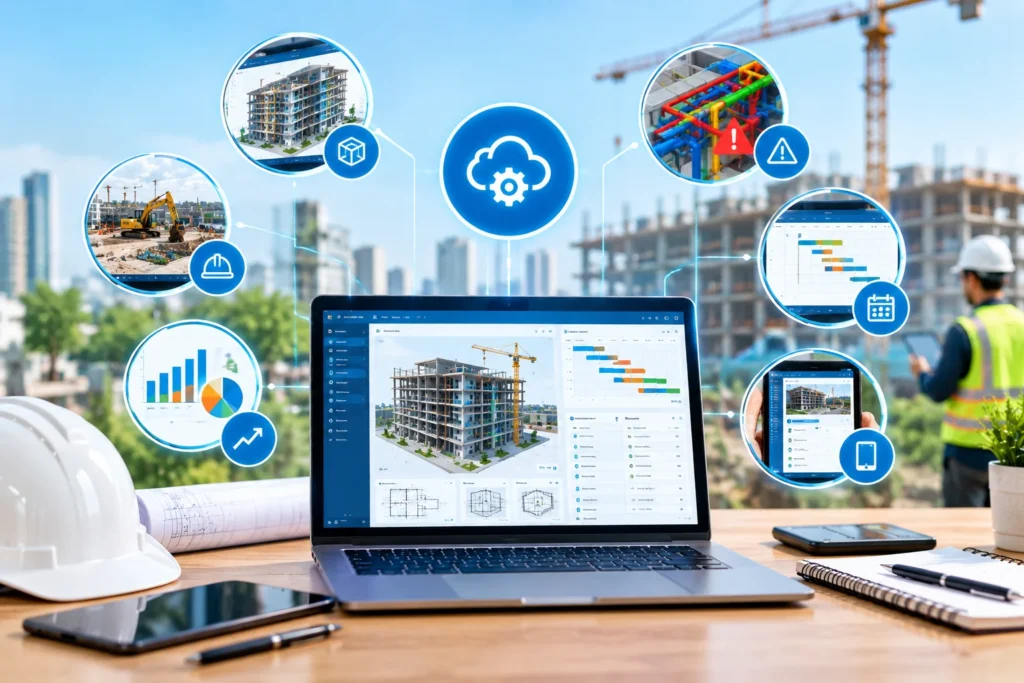
Infrastructure project management software is a specialized platform which is used to plan, implement, monitor, and report large infrastructure projects during their full lifecycle. It delivers scheduling, cost management, document control, cooperation, risk tracking, and compliance workflows all into one governed environment so that teams can work from a single source of truth.
It is not like basic task tools, and it is designed for multi-contract environments and heavy reporting demands. The goal is not limited to “tracking progress,” but it is supporting real delivery decisions i.e. what changed, who approved it, what it costs, what it effects, and what should happen next.
Why Infrastructure Project Management Needs Specialized Software
Infrastructure project management usually involves many moving parts which do not exist at smaller project scales. A road or rail package may incorporate multiple contractors, different design packages, multi-staged approvals, utility diversions, right-of-way issues, and safety/environmental compliance needs that should be traceable. Public infrastructure adds another layer i.e. governance, auditability, and interaction with agencies and communities.
That reality designs an anticipated problem, i.e. information is divided across emails, spreadsheets, and disconnected tools. This fragmentation of information affects teams to lose time reconciling “whose version is correct,” and leadership also loses confidence in reporting. Specialized platforms exist to decrease that friction by imposing structured workflows, records, and approvals, notably where governance matters most.
How It Differs from General Project Management Tools
General project management apps are great for simple tasks, simple timelines, and lightweight partnership. On the other hand, infrastructure delivery demands more depth and control. Infrastructure platforms by and large support critical-path scheduling, baselines, and change control; they also offer stronger document control (RFIs, submittals, transmittals), permission procedure, and audit trails that are compliant of audits and claims.
They also tend to combine engineering and asset ecosystems, such as GIS, BIM, ERP/finance, and asset management. For capital programs, this “digital backbone” is important because modern digital tools if applied well, can enhance how projects are managed and lower waste from rework and malalignment.
Core Features of Infrastructure Project Software
Infrastructure project software normally starts with planning structure. A strong work breakdown structure (WBS) creates a shared map of the project so that schedules, budgets, risks, and documents can attach to the same scope breakdown rather than living in silos.
Scheduling capacity is usually central, specifically for major work. Infrastructure delivery often trusts CPM-style logic, baselines, and formal change control; so, teams can show what the plan was, what changed, and why it changed. That historical record becomes necessary when approvals lag, utilities shift, or weather and access constraints impose resequencing.
Resource management is another core capacity because infrastructure trusts constrained resources such as specialized crews, critical equipment, lane closures, and possession windows. The software helps teams model resource loading, predict bottlenecks, and prevent planning work that cannot be staffed or achieved in the permitted window.
Partnership features in this context go beyond chat. They usually involve structured workflows for reviews and approvals, stakeholder routing, role-based access, and controlled allocation. This is important because infrastructure projects have many external parties who require visibility without being able to change baseline information.
Document control is the point where specialized tools often separate themselves. Infrastructure generates large volumes of drawings, specifications, RFIs, submittals, inspection records, and correspondence. A governed system helps keep versions stable, ensures that people build from approved information, and maintains an auditable record when clashes arise.
Risk management and issue tracking are also key, remarkably when projects must establish compliance and proactive controls. Risks which are tied to land access, utilities, environmental permits, and safety plans can be traced with owners, mitigation actions, and deadlines, instead of being buried in meeting minutes.
Compliance workflows matter because infrastructure is frequently regulated and publicly funded. Software can help teams handle permits, approvals, safety documentation, environmental commitments, and audit trails, lowering the risk that a missing approval becomes a schedule-critical surprise.
Finally, reporting and governance are also important. The ideal platforms provide dashboards that reconcile schedule, progress, and cost signals into coherent reporting, helping leadership see early warning indicators instead of learning about problems late.
Use Cases: Project Management for Infrastructure Projects
Roads, Highways, and Bridges
In road programs, project management for infrastructure projects often concentrates on staging, traffic organization, utilities, and tight coordination among packages. Software helps teams control staged baselines, approvals for detours and closures, inspection records, and progress reporting across multiple work fronts. It also establishes change control when utility controversies or design updates impose scope shifts, helping teams sustain a clean audit trail.
Rail and Metro Infrastructure
Rail and metro delivery frequently introduces possession windows, systems combination, and strict safety constraints. Here, project management for infrastructure requires deep scheduling, dependency management, and document workflows which control what gets installed and tested. Software facilitates coordinate interface points between civil works, stations, signaling, and power systems while preserving traceable approvals and test documentation.
Water, Wastewater, and Flood Protection
Water and flood protection projects frequently encounter environmental constraints, land access issues, and long-lead procurement items. Infrastructure platforms support allows tracking, quality records, and shaped reporting to owners and regulators. The “single source of truth” becomes especially valuable when multiple agencies supervise compliance and when field conditions involve design clarifications.
Power, Renewables, and Transmission
Transmission and renewables programs depend on standardized packages which are repeated across many locations. Software supports portfolio-level governance, coherent reporting, and procurement tracking for long-lead components. It also helps coordinate right-of-way, community engagement milestones, and inspection documentation across separated sites.
Public Buildings and Smart City Programs
Public buildings and works of smart city combine construction with digital systems, vendor dependencies, and handover conditions. Infrastructure project management software keeps document control, commissioning workflows, and asset data capture; so, handover is not a scramble at the end of the project.
Infrastructure Project Management Software and Financial Impact
Financial control with credibility is the strongest value of infrastructure project management software. Infrastructure budgets are frequently planned as baselines, then challenged by scope movement, procurement changes, and impacts of schedule. A governed system helps teams to distinguish the approved budget baseline from the live estimate, so leaders can observe variance early and take corrective measures.
Cost control increases when committed costs, change orders, and forecasts are linked to the same WBS and schedule logic. This linkage is specifically helpful for claims support because it maintains who approved what, when it changed, and what impacted. Earned value and progress-based prediction can be explained simply; that is if progress is measured consistently and linked to budgeted work, teams can project final cost more accurately instead of waiting for month-end surprises.
Cash flow prediction also benefits when the schedule and cost plan are connected. Infrastructure funding is often dependent on drawdowns, milestones, and staged payments. When forecasts exhibit real progress and rational procurement timing, finance teams can plan funding requirements and decrease the risk of cash gaps during peak delivery periods.
ROI is usually achieved through time saved on reporting, fewer coordination errors, decreased rework from document version issues, and earlier discovery of risks. Since public and academic sources normally highlight governance as a key driver of project outcomes, the software’s governance and auditability functions can be just as effective as its scheduling screens.
Selection Criteria
Begin by describing what problems you are solving. If your biggest pain is schedule control, select deep scheduling, baselines, and change control. If your pain is compliance and document chaos, select document control, workflows, and audit trails. If your pain is cost overruns and weak prediction, select cost combination, committed cost tracking, and reporting that settles schedule and cost signals.
Then proceed with demos with a real project scenario, not a vendor script. Choose a project as pilot that contains your typical complexity i.e. multiple stakeholders, approvals, and reporting cadence, so that you can gauge usability and data discipline. Execution matters as much as the tool, so plan onboarding, data standards, and role-based workflows before you scale further.
Common Challenges and How to Avoid Them
Most failures occur because of poor data discipline and uncertain ownership. If people do not have confidence in numbers, they stop using the platform and restore spreadsheets. Resistance for change is also common, specifically if workflows feel heavier than email. The fix is to begin with a small set of critical workflows, schedule baselines, document control, and change approvals and then expand after the team experiences detectable value.
Incorporation gaps can initiate double entry and frustration. For mitigating this, decide early which system is the “system of record” for schedule, cost, and documents, and then linking other tools around that core instead of trying to put together everything at once.
Future Trends
Infrastructure platforms are going toward digital twins and stronger BIM/GIS convergence, because owners progressively want continuity from delivery to asset operations. AI-assisted risk flagging and automated reporting are also coming up, with a focus on emphasizing exceptions rather than creating more dashboards. Recent capital-projects analysis often says that digital technologies can generate meaningful value when applied systematically and rooted into delivery routines.