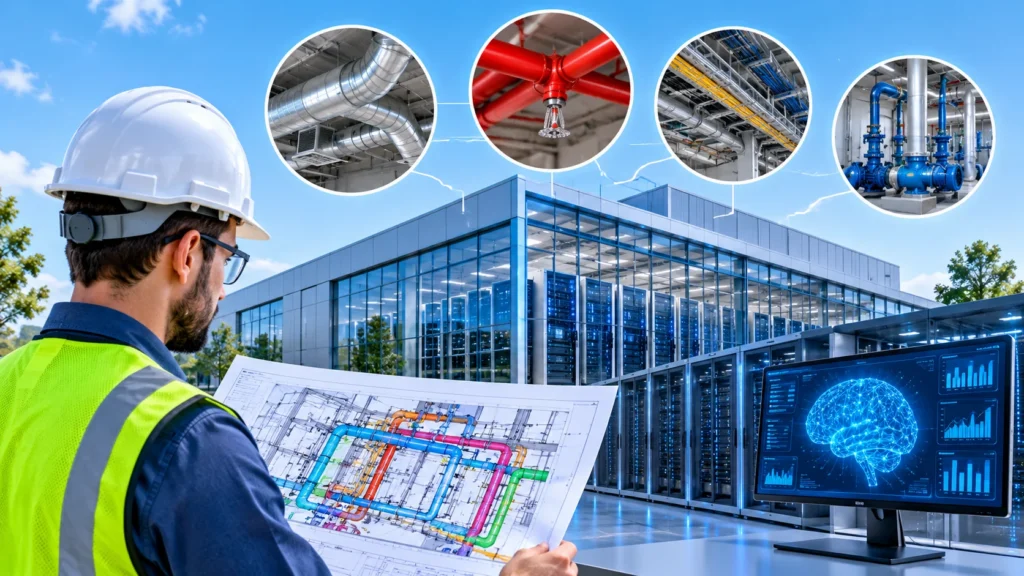
A hall full of GPUs can remain unusable when utility power, distribution, heat rejection, liquid loops, or controls are resolved too late. Effective MEP engineering for AI data centre converts the IT workload into dependable electrical, thermal, hydraulic, safety, and operational requirements before equipment is ordered.
AI clusters concentrate load and heat, evolve quickly, and may ramp differently from conventional computing. High performance is not a nameplate number; it is deployable compute capacity that the facility can energize, cool, maintain, monitor, and recover safely.
Why MEP Engineering for AI Data Centre Projects Is Different
The design begins with workload, server topology, rack schedule, voltage, cooling technology, network arrangement, availability objective, and growth sequence. Generic watts-per-square-metre assumptions are inadequate. Engineers must model coincident demand, conversion losses, auxiliary loads, transient behavior, ambient conditions, water constraints, and the consequences of losing each component.
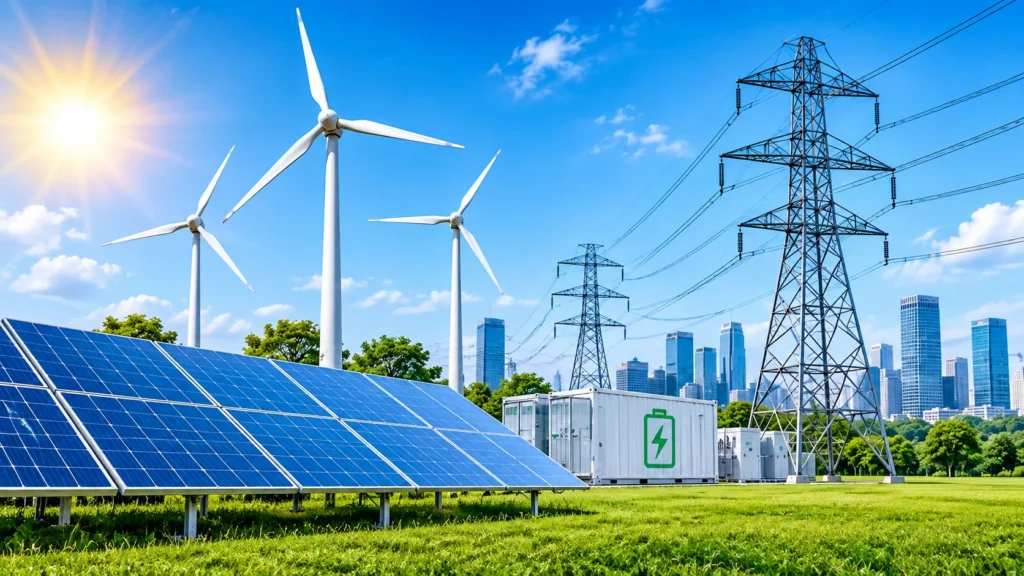
The US Department of Energy, citing Lawrence Berkeley National Laboratory, reported that data centres used about 4.4% of US electricity in 2023 and could reach 6.7%–12% by 2028. The IEA projects global consumption may more than double to roughly 945 TWh by 2030. These forecasts do not justify every proposed development.
Core Data Centre MEP Design Responsibilities
Electrical Capacity, Resilience, and Power Quality
A credible MEP design for AI data centre maps the route from grid connection and substations through switchgear, generators, UPS systems, transformers, PDUs or busways, rack distribution, grounding, and monitoring. Selectivity, harmonics, fault levels, protection settings, battery duty, generator step loading, maintenance bypasses, and expansion outages require coordinated studies.
Good MEP engineering for AI data centre work also separates installed megawatts from usable IT capacity. Redundancy should match the workload and business consequence rather than copying a tier label. Every claimed N+1 or 2N arrangement must be tested against common points, control dependencies, maintenance states, and fuel strategy.
Cooling, Hydraulics, and Heat Rejection
Air cooling, rear-door heat exchangers, direct-to-chip liquid cooling, and immersion systems impose different temperatures, flow rates, pressures, water quality, leak controls, and service access. MEP consultants in data centres should define the boundary between facility water and technology cooling systems, including coolant distribution units, isolation, filtration, treatment, metering, drainage, and emergency response.
Thermal design must follow rack diversity and failure cases. MEP engineering for AI data centre teams assess chilled-water production, pumping, economization, heat rejection, airflow containment, residual air load, controls, and recovery after equipment loss. CFD can test airflow questions, but its inputs and acceptance criteria must reflect the coordinated design.
Fire Protection, Plumbing, and Controls
Fire detection, suppression, compartmentation, egress, drainage, leak detection, and battery provisions must follow adopted codes, insurers, equipment hazards, and authorities. Controls should integrate electrical, cooling, environmental, fuel, and leak alarms without hiding local protective functions.
How Data Centre Engineering Firms Coordinate Delivery
Experienced data centre engineering firms establish one basis of design and one capacity model across civil, structural, architectural, MEP, ICT, security, vendors, and operations. BIM coordination must protect cable routes, pipe gradients, structural loads, fire zones, lifting paths, valve access, replacement envelopes, and temporary installation conditions—not merely clear visible clashes.
Useful data centre engineering services continue through procurement review, factory testing, site inspections, integrated systems testing, seasonal testing, training, and handover. Commissioning should prove normal operation and credible failures: utility loss, generator start, UPS transfer, pump or chiller loss, control-network failure, leak alarm, and restart sequencing.
A Better MEP Design for AI Data Centre Brief
- Define IT load, rack configuration, diversity, ramp profile, phasing, and forecast uncertainty.
- Confirm utility capacity, connection programme, backup duration, emissions limits, water availability, and discharge constraints.
- State availability, maintainability, efficiency, safety, metering, cybersecurity, and commissioning acceptance criteria.
- Identify vendor interfaces, design ownership, change control, model status, and information required for operations.
Owners comparing data centre engineering services should ask for evidence that electrical, mechanical, plumbing, fire, controls, and commissioning decisions share the same load assumptions. A technically elegant subsystem can still fail the facility if another discipline uses a different capacity, temperature, redundancy, or phasing basis.
Plan Capacity That Can Actually Operate
InfraTech Hub supports owners and delivery teams with coordinated MEP engineering for AI data centre programmes. Engage MEP consultants in data centres early to align loads, interfaces, resilience, efficiency, constructability, testing, and handover before procurement fixes the wrong assumptions.
Source Notes
US Department of Energy, Data Center Electricity Demand, 2024: US electricity-use history and 2028 projection
International Energy Agency, Energy and AI, 2025: global data-centre electricity projection to 2030
US Department of Energy, Best Practices Guide for Energy-Efficient Data Center Design: data-centre efficiency design guidance
NVIDIA DGX SuperPOD Data Center Design Guide: electrical resilience guidance