This is basically an informative article that educates professionals and common public to identify and manage hidden leaks in sewer line particularly in Atlanta GA. It is broadly applicable to USA and even worldwide.
Unseen sewer defects can cause different types of damage such as:
- contaminate soil,
- undermine pavement,
- damage interiors,
- interrupt operations.
To prevent those damages, it is necessary to detect such hidden sewer defects earlier. Early sewer line leak detection Atlanta GA establishes evidence before frequent backups require major excavation. The U.S. Environmental Protection Agency assesses that nationally each year, 23,000 to 75,000 sanitary sewer overflows release 3 to 10 billion gallons of untreated wastewater. In 2026 cost databases place camera inspections between $125 to $500; full replacement typically scale from $2,000 to over $10,000 for complex job sites.
What Sewer Line Leak Detection Atlanta GA Identifies
A sewer lateral (also known as a building drain or private sewer pipe) carries wastewater by gravity toward the public main. This underground pipe connects a home or business’s plumbing system to the municipal main sewer line running under the street. Any defect/leakage in this underground pipe may cause:
- release of sewage,
- admit groundwater,
- allow roots and soil inside.
Atlanta’s Department of Watershed Management advises customers to report if they find cloudy, sewage-smelling discharges. Professionals should distinguish private-lateral defects from municipal problems before destructive work. Inspection indicates damage, evaluates structural integrity and ownership, and informs cleaning, repair, or replacement options.
Causes and Warning Signs in Sewer Line Leak Detection Atlanta GA
When there are indications like corrosion, cracked clay or cast iron, failed joints, roots, settlement, poor slope, grease, debris, construction damage, and Orangeburg deterioration in the sewer system; it justifies sewer line leak detection. Rain can expose infiltration and inflow, i.e. groundwater or stormwater entering sanitary piping.
Warning signs consist of:
• Several slow or backing-up fixtures
• Sewage odors, gurgling toilets, or wastewater at a cleanout
• Soggy landscaping, unusual plant growth, or pavement settlement
• Frequent blockages after recent cleaning
• Moisture in basements, utility rooms, or floor drains
• Rodent or insect activity around drains
These signs justify sewer line leak detection Atlanta GA, specifically when snaking works only temporarily.
How Commercial Water Leak Detection Supports Sewer Diagnosis
Different tests are required for water and sewer systems. For example:
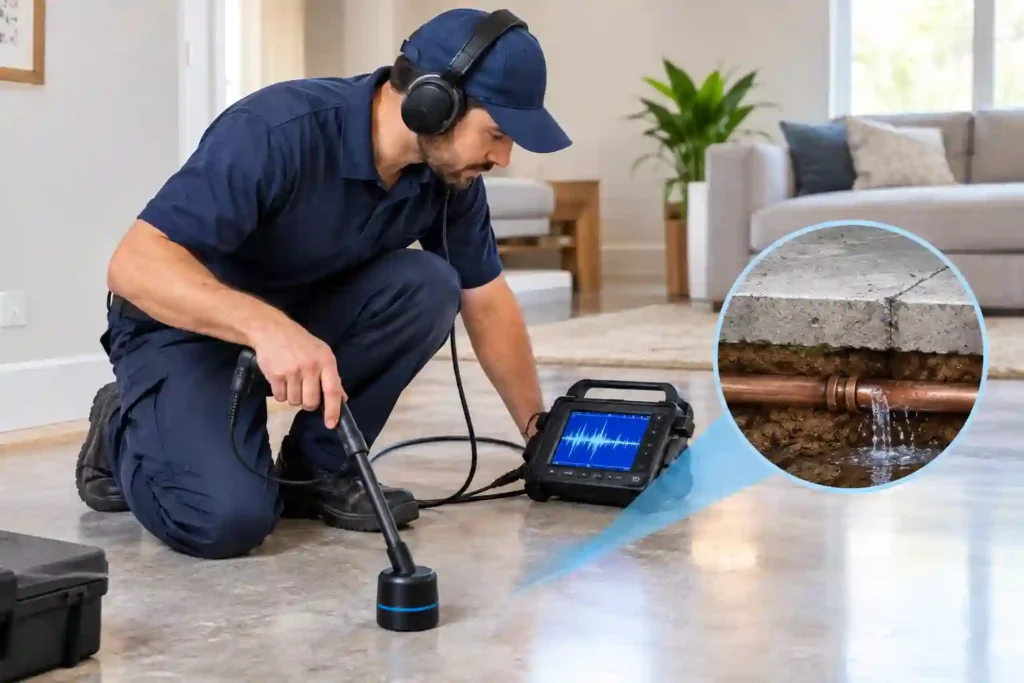
- Commercial water leak detection estimates pressurized potable, hot-water, irrigation, process, and fire-service pipes.
- Sewer assessment investigates gravity flow, blockages, defects, and inflow.
Either system can generate the same wet area.
EPA WaterSense recommends facilities to:
- compare bills,
- investigate abnormal use,
- submeter major equipment,
- use flow or moisture sensors.
A supply leak can result in saturation of soil near a lateral, so testing both systems prevents misdiagnosis.
Technologies for Sewer Line Leak Detection Atlanta GA
Successful diagnosis correlates various methods:
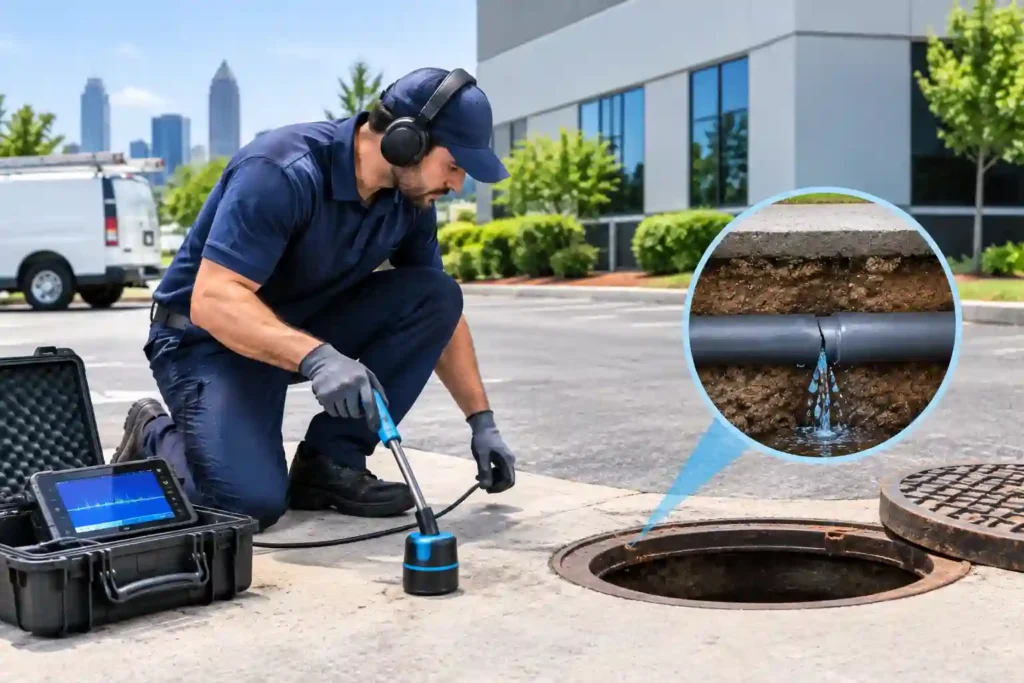
• CCTV cameras record cracks, offsets, roots, corrosion, standing water, and connections.
• A sonde in the camera head exhibits surface position and estimated depth.
• Isolation or hydrostatic tests divide a network and detect leaking sections.
• Dye testing traces drainage routes and suspected cross-connections.
• Smoke testing uncovers defective vents, open cleanouts, and some breaches.
• Flow logging recognizes unusual nighttime discharge or rain-related infiltration.
• Sonar investigates submerged pipe; laser profiling measures internal geometry.
• Acoustic instruments largely serve pressurized water pipes, not quiet gravity sewers.
EPA demonstrations found CCTV useful for leaks, sags, debris, roots, cracks, and offset joints. Methods must match diameter, flow, access, material, and failure mode.
Professional Sewer Line Leak Detection Atlanta GA Process
A valid sewer line leak detection Atlanta GA investigation usually follows this sequence:
1. Evaluation of complaints, drawings, repair history, and operating schedules.
2. Examine fixtures, cleanouts, manholes, and visible discharge points.
3. Decide whether one branch, the private lateral, or nearby properties are affected.
4. Clean grease or debris that blocks a consistent camera view.
5. Document continuous CCTV footage with distances and defect locations.
6. Locate priority defects at the surface and assess depth.
7. Add dye, smoke, isolation, or flow testing when video is inconclusive.
8. Categorize urgent failures, maintenance defects, and diagnostic limitations.
9. Compare cleaning, spot repair, trenchless rehabilitation, and replacement.
10. Supply footage, marked locations, assumptions, photographs, and itemized recommendations.
Owners should preserve reports for capital planning and request recognized condition coding.
For best results, ask technicians to:
- explain uncertainty,
- give dated footage,
- mark recommended excavation points before pricing starts.
Residential and Commercial Differences
A house frequently has one short lateral. Commercial sites may have multiple systems like grease systems, floor drains, lift stations, tenant branches, process discharge, and long networks. Therefore, sewer line leak detection Atlanta GA may necessitate:
- phased approach,
- traffic control,
- safety measures,
- bypass planning
- after-hours work.
Sewer backups result in room closures, contamination of food, operational downtime, property damage, and costly business interruption. Utilizing integrated monitoring helps isolate supply-side losses from true wastewater problems.
Benefits, Environmental Impact, and ROI
Early sewer line leak detection Atlanta GA can reduce demolition, constant cleaning, landscape loss, exposure, and infiltration that destroy public capacity. EPA warns that untreated overflows may carry pathogens, solids, debris, and pollutants.
A convenient calculation is:
Avoided loss = emergency cleanup + downtime + damaged finishes + excess utility costs + avoided excavation – inspection and planned repair.
Inspection cannot ensure savings, but evidence improves budgets, insurance records, repair selection, and quotations.
Costs of Sewer Line Leak Detection Atlanta GA and Repair
Following published 2026 figures serve as a good reference, but regard them as planning ranges, rather than Atlanta quotations:
• Camera inspection with a clean out: around $125 to $500
• Inspection without convenient entrance: about $175 to $750
• Snaking: around $150 to $500
• Hydro jetting: approximately $250 to $1,400
• Sewer repair: roughly $150 to $3,800 for many defined repairs
• Replacement: usually $50 to $250 per linear foot
• Typical full replacement: almost $2,000 to $10,000
The cost of sewer line repair Atlanta changes with depth, length, diameter, soil, pavement, traffic, permits, bypass pumping, disposal, and restoration. Quote toral cost with sub-cost of diagnosis, cleaning, excavation, pipe work, testing, and surface costs.
Repair Options After Sewer Line Leak Detection Atlanta GA
Sewer line leak detection Atlanta GA provides repair options such as:
- Cleaning may resolve an obstructed sound pipe.
- One failed joint may need spot excavation.
- Cured-in-place lining forms a resin pipe inside a suitable host; pipe bursting pulls replacement through the old path. Collapse, bellies, bad slope, or unsuitable connections require excavation.
Quality sewer line repair Atlanta focuses on the cause. Request post-repair video, testing, permit closeout, restoration scope, and warranty.
Choosing a Leak Detection Company Atlanta
A competent leak detection company in Atlanta should give explanation of each test and provide the followings:
• Georgia credentials, insurance, and relevant property experience
• Standardized footage with distances and surface locations
• Written findings, photographs, limitations, and repair options
• Transparent charges for emergency work, cleaning, inspection, and restoration
• Clear liability for permits, contamination controls, and warranties
• References or sample reports from comparable projects
Do not engage any leak detection company Atlanta that recommends replacement without showing defects or rejecting targeted and trenchless options with evidence.
Searching for a Sewer Leak Detection near Me
Searching for a sewer leak detection near me starts comparing. Verify cleaning, recorded CCTV, sonde locating, reporting, repair prices, emergency premiums, permits, and restoration.
For large properties, search for several providers of sewer leak detection with the same scope so that bids remain comparable.
Prevention After Sewer Line Leak Detection Atlanta GA
Following actions matter:
- map laterals and cleanouts,
- maintain grease controls,
- prevent improper flushing,
- review nighttime use,
- inspect high-risk lines,
- retain videos.
If sewage occupies, food, electrical, or public areas treat it as an emergency. Stop fixture use, separate the area, stop contact, and inform public spills through Atlanta Watershed’s 24-hour route. Never enter confined spaces or mix drain chemicals.
Insurance is policy specific. NAIC explains sewer-backup protection as a common optional add-on. Evaluate limits, deductibles, service-line endorsements, cleanup, pollution, and interruption coverage. Photograph damage, mitigate loss, save invoices, and obtain written decisions.
Conclusion
Well-timed sewer line leak detection Atlanta GA changes uncertainty into a documented decision. Effective evaluation separates water and wastewater, documents defensible evidence, and matches repairs to condition. Plan inspection before another backup and request a camera-supported, itemized plan protecting people, operations, and property value.