Modern civil infrastructure projects—spanning bridge rehabilitation, deep foundation drilling, mass transit tunneling, and industrial utility corridors—rely on advanced digital engineering tools. Teams deploy 4D Building Information Modeling (BIM), real-time GIS spatial tracking, and unmanned aerial vehicle (UAV) topography audits to anticipate risks well before heavy machinery breaks ground.
Yet, regardless of how refined a digital model is, the physical execution phase remains vulnerable to fundamental ground-level dynamics. Concrete pouring, structural steel erection, and aggregate grading involve uneven sub-bases, dynamic impact loads, and heavy equipment traffic. Mitigating risks on active job sites requires bridging high-level digital safety planning with tactile, certified personal protective equipment (PPE)—starting from the ground up.

1. The Ground-Level Risk Matrix in Heavy Civil Engineering
While overhead hazards often dominate safety discussions, lower-extremity and slip-trip-fall incidents account for a substantial percentage of lost-time occurrences on infrastructure sites:
- Sub-Base Instability and Puncture Exposure: Uncompacted gravel, exposed rebar dowels, discarded tie wire, and broken concrete slabs present continuous puncture risks to the plantar surface of the foot.
- Kinetic and Impact Hazards: Dropped precast components, heavy hand tools, trench shoring hardware, and hydraulic excavator swing zones demand robust toe protection capable of absorbing substantial mechanical energy.
- Multi-Substrate Friction Deficits: Moving between cured smooth-troweled slabs, slick structural steel decking, saturated soil, and unpaved aggregate requires outsoles engineered for variable friction coefficients.
- Vibration and Biomechanical Fatigue: Operating pneumatic tampers, plate compactors, and hydraulic hammers transmits high-frequency shocks directly through the musculoskeletal system. Over twelve-hour shifts, poor shock absorption leads to chronic plantar fasciitis, lumbar compression, and diminished operator alertness.
Integrating site-wide digital surveillance with individual physical protection ensures these risks are managed proactively rather than reactively.
2. Bridging BIM Hazard Mapping with Field-Level Ergonomics
Leading Infrastructure, Architecture, Engineering, and Construction (AEC) firms now use BIM models not merely for clash detection between structural elements and MEP runs, but for spatiotemporal hazard identification.
By overlaying worker telemetry data and scheduled site logistics onto 3D coordination models, safety directors can map high-risk zones, including:
- Dynamic drop zones beneath tower crane radii.
- Temporary utility trench crossings subject to water accumulation and mud slip hazards.
- High-voltage temporary power lines and generator distribution centers requiring strict electrical safety protocols.
However, predictive modeling only establishes the safety perimeter. The individual contractor navigating these mapped hazards depends on mechanical safeguards designed to absorb kinetic energy and stabilize body mechanics. High-traction, shock-attenuating footwear works in tandem with digital safety measures, reducing the micro-stumbles and muscular fatigue that precede major site incidents.
3. Engineering the Protective Envelope: ASTM Standards Demystified
Protective footwear on an infrastructure site cannot be treated as standard apparel; it functions as structural PPE engineered to strict mechanical tolerances. In North America, the primary benchmark is ASTM F2413-18 (Standard Specification for Performance Requirements for Protective (Safety) Toe Cap Footwear).
Engineers, safety officers, and contractors must evaluate three critical ASTM performance criteria when outfitting field crews:
Impact and Compression Resistance (I/75 & C/75)
The I/75 rating denotes that the toe cap can withstand a direct impact energy of 75 foot-pounds (approximately 101.7 Joules) delivered by a falling weight, maintaining a designated internal clearance. The C/75 rating specifies resistance to a continuous compressive force of 2,500 pounds (11,120 N).
When evaluating equipment for heavy earthwork and structural concrete crews, equipping personnel with certified steel toe work boots guarantees the required rigid perimeter barrier against rolling pipes, falling timbers, and accidental machinery contact.
Electrical Hazard (EH) Protection
Secondary electrical hazards are prevalent during early-stage utility trenching and substructure builds where temporary generators and submersible dewatering pumps operate continuously. Footwear carrying the EH classification is engineered with non-conductive, electrical shock-resistant soles and heels capable of withstanding 18,000 volts at 60 Hz for one minute under dry conditions, with leakage current restricted to under 1.0 milliampere.
Puncture Resistance (PR)
Sub-surface work frequently exposes workers to upward vertical penetration hazards. ASTM-rated puncture-resistant midsoles incorporate either a tempered steel plate or an aramid-fiber textile layer capable of resisting a minimum puncture force of 270 pounds (1,200 N) across the full surface of the footbed.
4. Materials Science in Action: Leather Durability vs. Outsole Dynamics
Engineering durable workwear for demanding infrastructure environments involves solving a materials science challenge: balancing structural integrity against ergonomics and weight.
| Component | Standard Field Requirement | Engineering Function & Impact |
| Upper Shell | Full-Grain Oil-Tanned Leather (2.0–2.2 mm) | Resists concrete lime abrasion, resists moisture intrusion, and provides breathability. |
| Toe Cap Structure | Tempered Steel or Composite Polymer | Protects the metatarsal and phalanx zones without collapsing under multi-directional lateral loads. |
| Midsole Cushioning | Dual-Density Polyurethane (PU) or EVA | Absorbs ground reaction force (GRF) across hard surfaces, reducing spinal and joint impact. |
| Outsole Compound | Oil- and Slip-Resistant Rubber / Wedge | Engineered tread siping channels mud, slurry, and liquids away to maintain traction contact. |
On civil construction sites where trade contractors spend long hours traversing rough subgrades and structural rebar lattices, specifying heavy-duty construction boots constructed with durable Goodyear welted or cemented dual-density outsoles provides the stability, torsional support, and puncture defense necessary for demanding environments.

5. Ergonomics and Long-Shift Productivity on Infrastructure Projects
Worker fatigue is a leading, yet underreported, catalyst for on-site construction accidents. The Occupational Safety and Health Administration (OSHA) continually emphasizes that cumulative physical fatigue degrades cognitive processing speed, situational awareness, and motor coordination.
When a worker walks 10,000 to 15,000 steps daily across compacted aggregate or cured reinforced concrete:
- Excess Footwear Weight: An unnecessary 200 grams per boot translates to metric tons of cumulative lifted load over a single standard workweek.
- Inadequate Arch Architecture: Lacking anatomical arch contouring leads to overpronation, stressing the anterior cruciate ligament (ACL) and aggravating lumbar vertebrae.
- Poor Thermal Regulation: Insufficient moisture evacuation macerates epidermal tissue, creating blisters that alter walking gait and increase slip-and-trip vulnerabilities.
Modern industrial boot manufacturing increasingly adopts biomechanical insights developed in athletic shoe engineering: anatomical footbeds, dual-density energy return soles, and padded collar geometries that support the Achilles tendon without restricting natural ankle articulation.
6. Integrating PPE Inspection into Digital Site QA Workflows
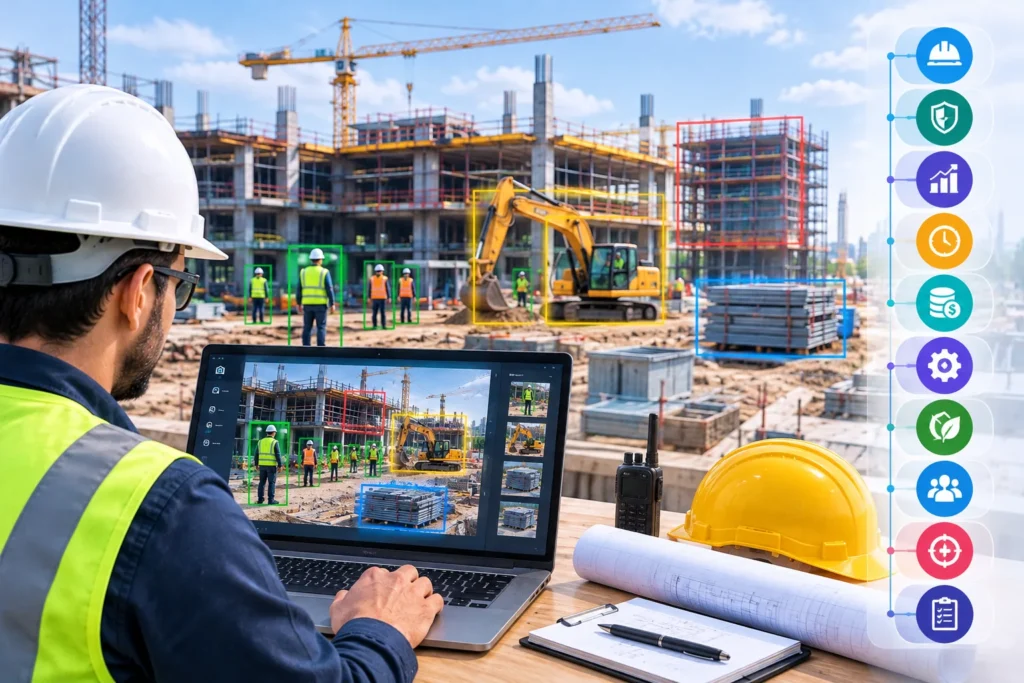
Modern infrastructure projects manage quality assurance via mobile-enabled inspection platforms like Procore, Autodesk Construction Cloud, or Bluebeam. While digital QA workflows systematically verify rebar spacing, concrete slump, and bolt torques, PPE verification should be integrated into these same automated checklists.
A robust digital site safety workflow includes:
- Daily Toolbox Barcode Audits: Scanning equipment identifiers at site turnstiles to ensure all active footwear meets site-specific safety classifications (e.g., EH vs. PR requirements for specific work zones).
- Visual Wear-and-Tear Logging: Flagging compromised footwear where the outsole tread depth has worn below 2 mm or where the protective toe cap has become exposed after heavy abrasion.
- Micro-Climate Adjustment Protocols: Using weather forecasting data within project management software to instruct contractors when waterproof membranes or slip-resistant siped soles are required due to impending rain or freeze-thaw cycles.
A Holistic Vision for Infrastructure Safety
Digital twins, BIM scheduling, and automated site inspection tools are transforming civil infrastructure delivery, drastically improving precision and reducing project lead times. However, the success of any capital project still relies on the field workers operating on the ground.
True site safety resilience requires combining digital coordination with certified, ergonomically engineered physical gear. By prioritizing ASTM-certified protective footwear that balances impact resistance, electrical safety, and biomechanical comfort, project stakeholders can protect their crews, reduce lost-time incidents, and keep complex infrastructure builds on schedule.