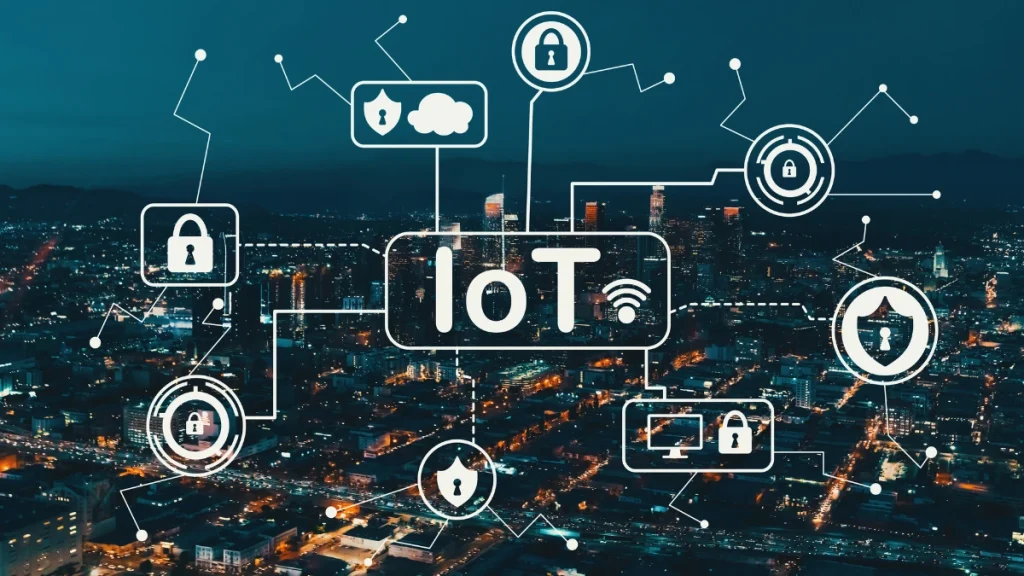
Industry deployments across utilities, transport, and facilities demonstrate a clear pattern: when infrastructure teams link real-time sensor data with predictive models, they cut unplanned downtime and discover failures earlier. Recent adoption tendencies also suggest that analytics is moving nearer to the edge to cut latency and bandwidth costs. That’s why many operators now ask: “what is machine learning in IoT, and how can it transform raw telemetry into decisions that improve consistency, safety, and cost control”.
What Is Machine Learning in IoT
What is machine learning in IoT? It is the use of machine learning models to study patterns from IoT device data (like temperature, vibration, pressure, location, and energy use) and then make predictions or discover anomalies automatically.
IoT machine learning in practical terms, means that your system does more than “collect data.” It learns from the data and increases outcomes over time.
To clarify the basics:
- Sensors: hardware that measures signals (temperature, vibration, flow, etc.).
- Telemetry: the time-stamped data sensors send continuously.
- Machine learning (ML): algorithms that learn patterns from data to predict, classify, or detect unusual behavior.
When we talk about the intersection of IoT and machine learning, we’re really talking about giving physical assets a ‘brain’. Whether it’s predicting a pump failure, fine-tuning an HVAC system, or catching a leak before it turns into a disaster, the goal is the same: creating a “measure → learn → act” loop that makes our infrastructure truly intelligent.
IoT and Machine Learning Fundamentals
A key reason that “what machine learning is in IoT” feels confusing is that IoT data is not like normal spreadsheet data. Most IoT data are:
- Time-series: readings over time (every second/minute/hour).
- Noisy: sensors drift, networks drop, values spike.
- Context-heavy: a “normal” vibration level that depends on load, weather, and asset age.
- Imbalanced: failures are uncommon, so “bad examples” are limited.
Important ML terms:
- Features: input signals a model uses (vibration RMS, temperature trend, voltage variance).
- Labels: the “answer” used in training (e.g., “failure in 7 days” or “normal vs faulty”).
- Supervised learning: learn from labeled data (known outcomes).
- Unsupervised learning: find patterns without labels (common in anomaly detection).
This is the reason that machine learning internet of things projects often start with cleaning data and defining the right features. In real deployments, internet of things machine learning succeeds when teams regard data quality as a first-class engineering task.
How IoT With Machine Learning Works
To understand “what machine learning in IoT is”, consider it as “it helps to see the workflow end to end”. IoT with machine learning usually follows these steps:
- Data capture
- Sensors generate telemetry (time-series readings).
- Connectivity + buffering
- Gateways store data when networks fail, then sync later.
- Data preparation
- Clean missing values, align timestamps, remove outliers, add context (location, asset ID).
- Feature engineering
- Convert raw signals into meaningful features (rolling averages, rate-of-change, frequency components).
- Model training (often in cloud)
- Cloud training uses larger compute to build models from historical data.
- Deployment (edge or cloud inference)
- Edge inference: model runs near devices for low latency.
- Cloud inference: model runs centrally for scale and easier updates.
- Monitoring + improvement
- Track accuracy, drift, false alarms, and retrain when needed.
This is where AI ML and IoT connect with each other. Please note that AI is the broader goal (automated intelligence), ML is the learning engine, and IoT is the data source. In many infrastructure systems, IoT AI machine learning also includes rules (if/then logic) alongside models to reduce false alarms.
Why teams choose edge inference
- Lower latency (quick response)
- Decreased bandwidth usage (send insights, not raw data)
- Better resilience (works even during outages also)
Why teams choose cloud inference
- Easy model updates
- Access to broader datasets
- Stronger Compute for Advanced Models
Machine Learning Internet of Things Architecture
A practical machine learning internet of things architecture is usually a layered system. Here’s a clean reference pattern for internet of things machine learning deployments:
- Device layer
- Sensors, meters, cameras, controllers
- Edge layer
- Gateway, protocol translation, buffering, edge inference
- Network layer
- LoRaWAN, cellular, Wi-Fi, Ethernet
- Platform layer
- Data ingestion, storage, device management, APIs
- ML layer
- Training pipelines, feature store, model registry, inference services
- Application layer
- Dashboards, alerts, work orders, optimization tools
Key concepts you need to manage:
- Latency: delay between sensing and action.
- Bandwidth: data volume sent over networks (cost + reliability impact).
- Data quality: missing data, drift, and sensor calibration issues.
When IoT and machine learning is done well, architecture supports both fast actions (edge) and deeper learning (cloud). This is a common design for internet of things and machine learning in infrastructure and industrial systems.
IoT AI Machine Learning: Models, Methods, and Real Examples
IoT ai machine learning is not one model: essentially, it’s a toolkit. Common model types that it includes are:
- Anomaly detection
- Finds unusual behavior without needing many failure labels.
- Forecasting
- Forecasts future values (energy demand, flow rates, temperature trends).
- Classification
- Labels states (normal vs faulty, leak vs no leak).
- Clustering
- Groups similar operating modes (useful for asset segmentation).
Two analytical operational terms:
- Model drift: model accuracy declines because of the real-world changes (new equipment, seasons, usage).
- Concept drift: the meaning of “normal” changes (e.g., new operating policy shifts baseline behavior).
To keep IoT machine learning consistent over months and years, teams apply MLOps (Machine Learning Operations):
- Monitor model performing and false alarms
- Follow data distributions and drift signals
- Schedule retraining and controlled rollouts
- Preserve versioning and approvals
This is the practical side of AI ML and IoT i.e. keeping models trustworthy, not just building them once.
Internet of Things and Machine Learning Use Cases in Finance and Fintech
You may think IoT is only about roads and buildings, but IoT and machine learning use cases in finance are also growing fast because finance depends on real-world risk signals.
Here are strong IoT and use of machine learning cases in finance:
- ATM and branch uptime prediction
- Foresee failures from temperature, vibration, power quality, and door sensors.
- Insurance telematics
- Pricing and risk scoring from vehicle sensor patterns and driving behavior.
- Cold-chain asset verification
- Constant temperature/location proof for financed inventory.
- Fraud and tamper detection
- Detect unusual device access patterns and sensor signatures.
Now look at IoT machine learning applications in fintech, where speed and automation matter:
- Real-time risk scoring from asset telemetry
- Automated alerts that trigger confirmation workflows
- Smart lending models for asset-backed financing (condition + location + usage)
- Dynamic insurance products using continuous signals
These IoT machine learning applications in fintech trust on strong security, privacy controls, and explainability, because finance teams must rationalise decisions. That’s why internet of things and machine learning in finance often combines models with clear rules and audit logs.
Machine Learning for IoT Based Engineering Systems
A major reason people ask “what machine learning in IoT is” is to solve engineering problems at scale. Machine learning for IoT based engineering systems naturally focuses on consistency, efficiency, and safety.
High-impact examples of machine learning for IoT based engineering systems:
- Predictive maintenance
- Vibration + temperature models to forecast bearing or motor failure.
- Leak detection
- Pressure/flow anomaly recognition across zones.
- HVAC fault detection
- Find coil fouling, sensor failure, or compressor inefficiency.
- Structural health monitoring
- Recognize unusual vibration modes in bridges and towers.
- Energy optimization
- Predict demand and optimize setpoints automatically.
In these deployments, IoT with machine learning decreases guesswork:
- Repairs become condition-based, not calendar-based.
- Operations move from reactive to predictive.
- Costs drop through few emergency repairs and better asset life planning.
This is the day-to-day value of IoT and machine learning in modern infrastructure.
Benefits, Challenges, and Security Considerations
Key Benefits of IoT Machine Learning
- Lower downtime through earlier warnings
- Better efficiency via optimized operations
- Improved safety by detecting abnormal conditions
- Faster response using real-time alerts
- More accurate planning with forecasting models
Common Challenges in Machine Learning Internet of Things Projects
- Data quality issues (missing data, noisy sensors, wrong timestamps)
- Label scarcity (few recorded failures for supervised learning)
- Model drift and changing environments
- Integration complexity with existing SCADA/BMS/CMMS
- Explainability needs (especially for finance decisions)
Security Checklist for AI ML and IoT
- Unique device identity and secure provisioning
- Encryption in transit and at rest
- Role-based access control and audit logs
- Segmentation between OT and IT networks
- Secure update pipelines for devices and models
If IoT ai machine learning is built without strong security, you risk exposing operational systems, data reliability, and decision logic.
Future Trends: Where Internet of Things Machine Learning Is Going Next
The next wave of internet of things machine learning will be shaped by:
- TinyML: running models on microcontrollers for ultra-low latency
- Federated learning: training across sites without centralizing sensitive data
- Digital twins + ML: simulation + learning for better forecasting
- Self-healing operations: automated remediation (within safety limits)
- Privacy-preserving analytics: stronger governance for finance and public systems
As these mature, the question won’t just be what is machine learning in IoT, but it will be “how fast can we deploy and govern it safely?”
Conclusion
What is machine learning in IoT? It’s the engine that learns from linked device data and turns it into estimates, anomaly recognition, and smarter automation. Whether you’re building infrastructure systems or exploring IoT and machine learning use cases in finance, success depends on quality of data, security, and a disciplined operating model.
Next steps
- Begin with one high-value use case (maintenance, leaks, energy)
- Describe KPIs and data requirements early
- Select edge vs cloud inference based on latency and bandwidth needs
- Plan MLOps to manage drift, retraining, and safe rollouts