What is smart irrigation and why is everyone talking about it? The answer to this important question is, water is gradually more expensive, scarce, and challenging to manage at scale. The UN World Water Development Report observes that agriculture is responsible for roughly 70% of freshwater withdrawals worldwide, making irrigation efficiency a global importance. On the other hand, the U.S. Environmental Protection Agency (EPA) notes up to 50% of that water can be wasted due to inefficient irrigation and overwatering. In simple terms, what is smart irrigation? It is the shift from “watering by utilization” to “watering by data,” and that shift is where ROI (Return on Investment) appears.
This guide explains what smart irrigation is, how IoT + AI is functioning, the key system types, and how to estimate payback with a realistic cost model.
What is Smart Irrigation?
What is smart irrigation? It’s irrigation that automatically adjusts watering based on parameters like:
- soil moisture
- weather conditions (rain, temperature, wind, humidity, sunshine hours)
- Evapotranspiration (ET) (a simple way to estimate how much water plants lose through evaporation + plant transpiration)
- flow and pressure behavior (to detect leaks or clogs)
Different from a basic timer, a smart system tries to match water application to actual plant need, not a fixed schedule. That’s the core efficiency idea behind smart irrigation.
What is Smart Irrigation System and What’s Inside it?
If you’re examining what smart irrigation system is, think of it as five building blocks working simultaneously:
- Controller (the brain): runs schedules and decisions
- Sensors (the eyes/ears): soil moisture, rainfall, temperature, flow, pressure
- Actuators (the hands): valves, pumps, variable frequency drives (VFDs), relays
- Connectivity (the nerves): Wi-Fi, cellular, LoRaWAN (Long Range Wide Area Network), sometimes wired links
- Software (the interface): dashboards, alerts, analytics, user roles, reporting
A complete answer to what is smart irrigation system also comprised of the physical basics: piping, filtration, pressure regulation, and zone design. Smart tech can’t “fix” poor hydraulics—so design still matters.
What is a Smart Irrigation Controller?
A general question is what is a smart irrigation controller and how is it distinct from a typical controller?
A standard controller follows a fixed timetable. A smart controller updates watering using:
- weather and ET estimates
- soil moisture thresholds
- rules (e.g., “don’t irrigate if rainfall > X”)
- learning/optimization (in advanced systems)
EPA WaterSense describes weather-based controllers as using local weather and landscape conditions to tailor schedules. So, replacing a standard controller can conserve an average home about 7,600 gallons annually. That’s a rational, “real money” example of why what is a smart irrigation controller matter.
How Smart Irrigation Works
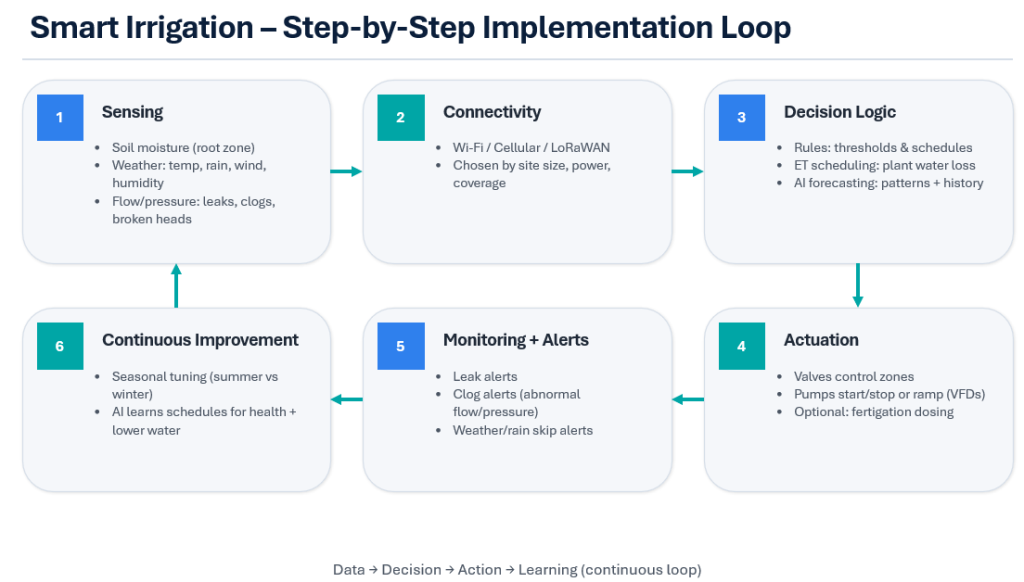
Here’s the full loop of what is smart irrigation in action:
- Sensing
- Soil moisture sensors gauge water in the root zone.
- Weather inputs capture temperature, rainfall, wind, and humidity.
- Flow/pressure sensors identify abnormal usage (leaks, broken heads, clogged lines).
- Connectivity
- Data moves through Wi-Fi, cellular, or LoRaWAN dependent on site size, power access, and coverage.
- Decision logic
- Rule-based logic: thresholds and schedules (simple and reliable).
- ET-based scheduling: adjusts runtime based on plant water loss.
- Artificial Intelligence (AI) estimating demand using patterns and history.
- Actuation
- Valves open/close zones.
- Pumps start/stop or ramp via VFDs.
- Fertigation systems (optional) dose nutrients with controlled timing.
- Monitoring + alerts
- Leak warnings if flow continues when a zone should be off.
- Clog warnings when pressure/flow patterns look abnormal.
- Weather/rain skip warnings to prevent unnecessary runs.
- Continuous improvement
- Seasonal adjustments (summer vs winter).
- AI models learn which schedules produce healthy crops/landscapes with fewer water.
Smart Irrigation System Using IoT and AI
A smart irrigation system using IoT is viable: IoT gathers consistent field data and makes it accessible remotely (dashboards, alerts, history).
Then AI turns that data into better decisions:
- Forecasting water demand: AI combines weather forecasts with crop/landscape patterns to anticipate demand (instead of reacting late).
- Anomaly detection: AI flags “this looks wrong” patterns—continuous flow, abnormal nighttime spikes, or zones that suddenly require much more water.
- Adaptive scheduling: AI learns from results (soil response, plant stress indicators, operator adjustments) to improve future schedules.
This pairing—smart irrigation system using IoT + AI—generates a feedback loop that standard controllers can’t match.
Key Features and Benefits of Smart Irrigation System
The advantages of smart irrigation system appear as measurable control, not just convenience.
Key Features
- Weather + ET scheduling
- Regulate watering to conditions rather than a rigid timer.
- Zone-based control
- Distinct plant types/soil zones get different schedules.
- Leak detection / abnormal flow alerts
- Prevents catch broken lines, stuck valves, or broken sprinklers early.
- Remote control + dashboards
- Control schedules, pause zones, and review water history from anywhere.
- Soil moisture-driven automation
- Water only when the root zone requires it.
- Optional fertigation monitoring
- Track dosing events and reduce nutrient waste (especially in agriculture).
Benefits You can Expect
- Water conservation (less overwatering and fewer waste events)
- Energy conservation (less pumping runtime where pumping is used)
- Labor conservation (fewer manual checks, fewer emergency repairs)
- Improved crop/landscape health (less stress from under/overwatering)
EPA notes soil moisture sensors can drive at least ~20% water conservation as noted in recent studies. The U.S. GSA (with performance findings from a smart irrigation assessment) reports weather-based systems have shown ~20–40% water conservation dependent on conditions. These ranges help frame realistic expectations for the advantages of smart irrigation system.
Types of Smart Irrigation Systems
When evaluating the smart irrigation system types, focus on how decisions are made.
1) Weather-Based Controllers
How they work: Apply local weather data + ET logic to alter schedules.
- Pros: easy retrofit, strong for landscapes, clear ROI potential
- Cons: can be less precise if microclimates/soil variability are high
- Best for: residential/commercial landscaping, parks, campuses
2) Sensor-based Systems
How they work: Watering responds directly to soil moisture thresholds; flow data adds protection.
- Pros: very responsive to real root-zone requirements; strong waste reduction
- Cons: requires correct sensor placement and calibration
- Best for: agriculture, turf, high-value landscapes, greenhouses
3) Smart Irrigation System Using IoT
This is the modern “stack” approach where weather + soil + flow data are linked, monitored, and optimized remotely.
- Pros: scalable monitoring, multi-site reporting, better accountability
- Cons: connectivity planning and data governance become essential
- Best for: farms with multiple blocks, cities/campuses, large commercial landscapes
Installation & Implementation
Smart tech delivers ROI fastest when the physical system is healthy.
Site Assessment Checklist
- soil type and infiltration (sandy vs clay behavior)
- slope and runoff risk
- zone layout (group plants with similar water needs)
- pressure and flow capacity per zone
- water source reliability (municipal, canal, borewell)
- filtration needs (especially for drip systems)
- pump condition and control method (on/off vs VFD)
- connectivity coverage (Wi-Fi/cellular/LoRaWAN)
- power access for gateways/sensors
Retrofit vs New Install
- Retrofit: attach a smart controller + particular sensors (flow + soil moisture) to an existing system.
- New install: design zones properly from day one and embed sensors where they are needed.
Calibration and Commissioning Steps
- confirm pressure/flow per zone and fix leaks first
- place soil moisture sensors at correct root depth and representative locations
- set ET/soil thresholds and “rain skip” logic
- test alerts (leak, abnormal flow, valve stuck)
- run a 2–4 week tuning period and adjust schedules
Common Difficulties
- Bad zoning
- Fix: group by plant type, sun exposure, and soil behavior.
- Wrong sensor placement
- Fix: place in representative root zones, not near drains or sprinkler heads.
- Connectivity gaps
- Fix: use cellular/LoRaWAN where Wi-Fi is weak.
- No filtration in drip systems
- Fix: add filtration and maintenance routines before automation.
ROI and Costs: Smart Irrigation System Cost, Payback, and Financial Outcomes
This is where ‘smart irrigation’ becomes a CFO-style conversation.
Total Cost of Ownership (TCO) in Simple Terms
TCO = upfront cost + ongoing operating cost − savings.
Smart Irrigation System Cost
A realistic smart irrigation system cost typically includes:
- controller (weather-based or sensor-driven)
- soil moisture sensors + rain sensor (as needed)
- flow meter / pressure sensor (high ROI for leak detection)
- valves/actuators and wiring
- gateway/connectivity (Wi-Fi/cellular/LoRaWAN)
- installation labor + commissioning
- optional subscription/software + support
- maintenance (sensor checks, calibration, replacements)
Where the Savings Come From
- water savings from reduced overwatering and smarter schedules
- pumping energy savings (less runtime)
- labor savings (fewer manual checks and emergency repairs)
- fewer plant/crop losses from stress or uneven watering
Simple Payback Example
Assumptions (example only):
- Baseline water + pumping cost: $12,000/year
- Expected savings: 25% (within common ranges reported for smart irrigation depending on conditions)
- Upfront system investment: $7,500
- Ongoing software/support: $300/year
Annual savings = $12,000 × 0.25 = $3,000
Net annual savings = $3,000 − $300 = $2,700
Simple payback ≈ $7,500 / $2,700 = 2.8 years
KPIs to Track (6–10)
- water use per zone (m³/week or gallons/week)
- ET-based variance (planned vs ET-adjusted runtime)
- soil moisture stability (time within target band)
- leak events (count) and leak response time
- pump runtime hours and energy cost
- labor hours spent on irrigation operations
- plant/crop health indicator (NDVI, yield, or turf quality score)
- cost per hectare/acre irrigated
- subscription + maintenance cost per season
- payback period and annual ROI