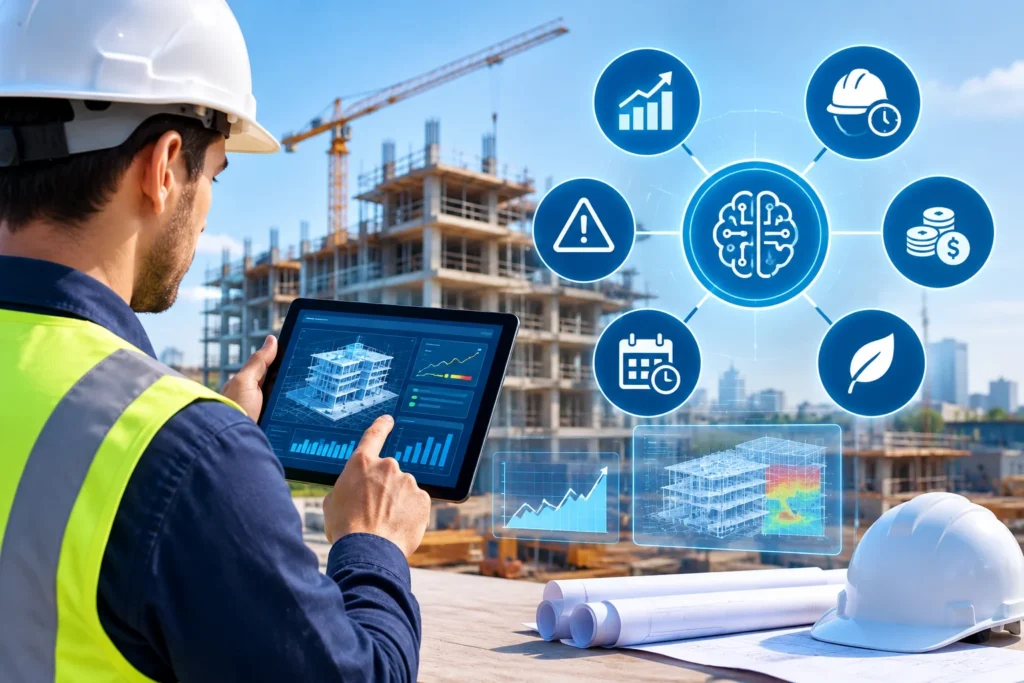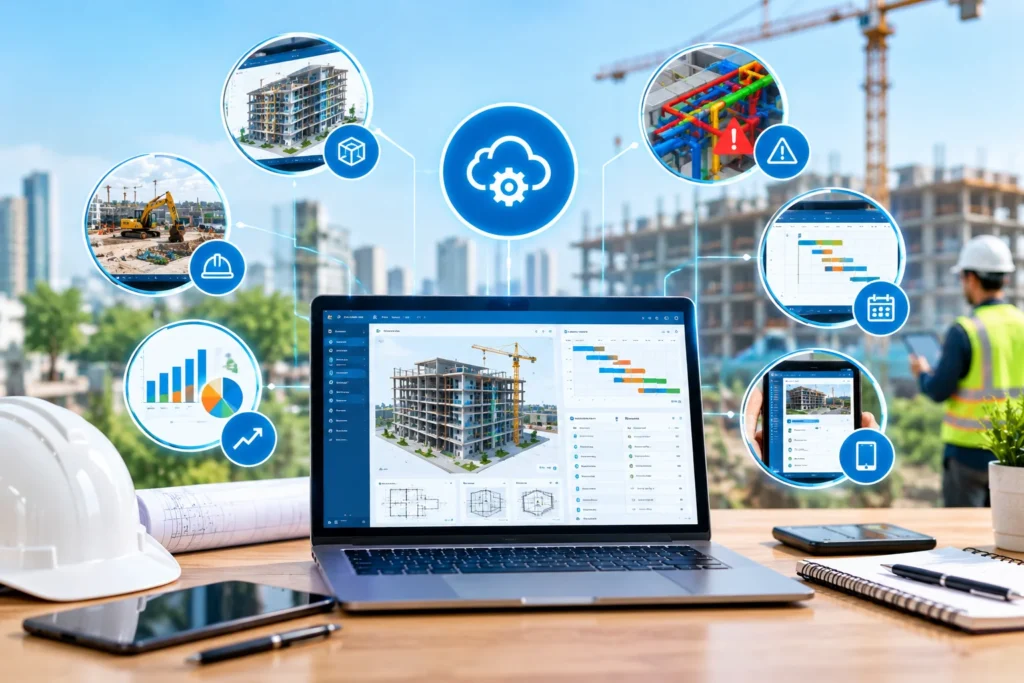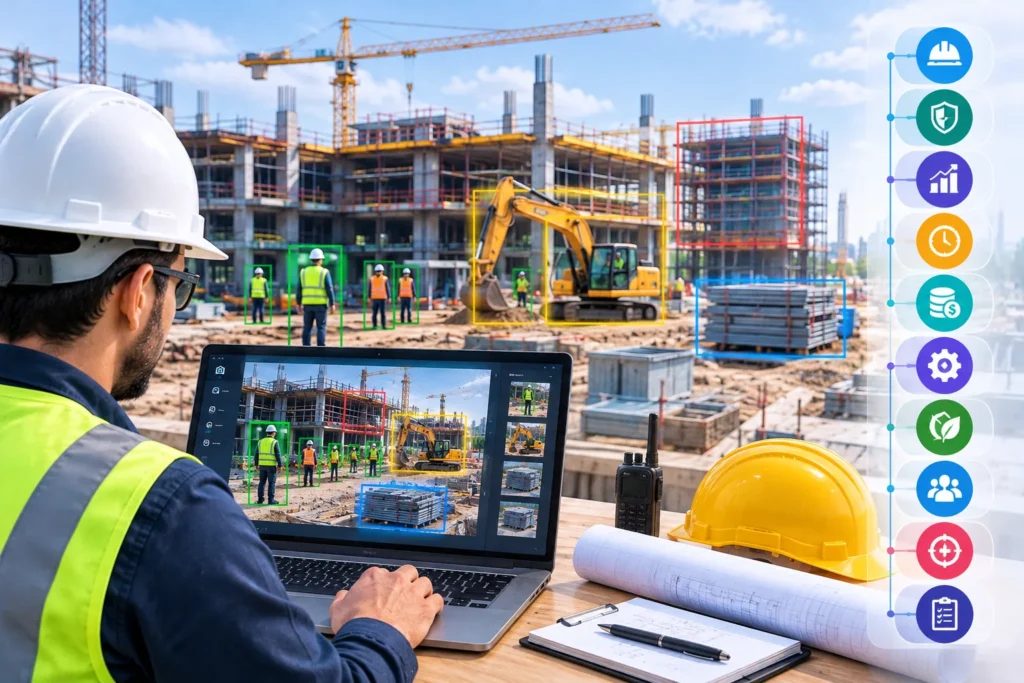
Understanding digital twin advantages and disadvantages is essential for engineers, contractors, owners, and facility teams deciding whether a connected virtual representation will create measurable value. A digital twin links a physical asset, process, or environment with data for monitoring, prediction, scenario testing, and lifecycle decisions. In construction and engineering, the strongest business case appears when the twin answers an operational question.
Digital Twin Advantages and Disadvantages: The Engineering View
The core trade-off behind digital twin advantages and disadvantages is decision quality versus system complexity. Twins can connect design, construction, sensor, maintenance, and operational information, but they also introduce integration, governance, cybersecurity, validation, and lifecycle-maintenance obligations.
The UK Government’s 2025 definition ties a digital twin to a real-world counterpart and requires information exchange in a decision-relevant timeframe. In August 2026, the Digital Twin Consortium formalized four system layers: Data, Context, Decision and Process Orchestration, and Actuation, supported by the Digital Thread. This distinction separates an operational twin from a disconnected model.
For engineers, the practical digital twin pros and cons therefore depend on whether the connected information improves a real decision.
Benefits of Digital Twin in Construction and Engineering
The strongest benefits of digital twin in construction appear when project information is structured for a defined use case. Instead of searching drawings, spreadsheets, BIM files, inspection records, and maintenance manuals separately, teams can connect relevant information to the asset and its current condition.
Key advantages include:
- Better visibility of design intent, as-built condition, asset data, and operational performance.
- Earlier detection of anomalies, degradation, clashes, or emerging maintenance needs.
- Safer what-if testing before changing a live building, plant, bridge, utility, or process.
- Stronger handover because structured asset information remains usable after construction.
- Better collaboration between designers, contractors, operators, and owners.
- Support for energy, water, reliability, space, and maintenance optimization.
- A reusable information foundation for renovation, expansion, and decommissioning.
These benefits of digital twin in construction matter at global scale. UNEP’s 2025-2026 Global Status Report says buildings and construction account for around 37% of global CO2 emissions and nearly 50% of global material extraction. Digital twins cannot solve those problems alone, but they can help engineers compare interventions and verify performance.
A U.S. Department of Energy retrofit project led by Oak Ridge National Laboratory reported automated generation of a building-facade twin in about 12 minutes at 1/8-inch accuracy, compared with more than four hours for semi-automated point-cloud segmentation. This shows how well-designed automation can accelerate decision-ready geometry.
Digital Twin Pros and Cons: Main Advantages
When assessing digital twin pros and cons, advantages become strongest when the physical asset enters operation.
- Lifecycle continuity: extend BIM and engineering information into commissioning, operations, maintenance, and renovation.
- Predictive decisions: combine monitoring with simulation for loads, degradation, demand, or maintenance scenarios.
- Operational optimization: reveal patterns hidden across isolated dashboards.
- Better handover: deliver structured, searchable asset information.
- Safer change: test scenarios before interventions affect live systems.
At Ford’s Dearborn Research and Engineering Campus, a twin monitors a new central energy plant and tracks progress toward a projected 50% reduction in campus office-space energy and water use versus the older system. This illustrates digital twin advantages and disadvantages clearly: the twin supports performance management, but it is not the sole cause of savings.
Digital Twin Pros and Cons: Disadvantages and Risks
The disadvantages are equally important. A twin that is inaccurate, insecure, or difficult to maintain can create false confidence.
Common limitations include:
- High initial effort for requirements, data cleaning, integration, sensing, and model preparation.
- Ongoing hosting, licensing, connectivity, cybersecurity, and specialist costs.
- Interoperability problems across BIM, GIS, IoT, CMMS, SCADA, BMS, and vendor platforms.
- Model drift when physical changes are not reflected digitally.
- Poor decisions from weak sensor quality, calibration, timestamps, metadata, or assumptions.
- Cybersecurity and privacy exposure from careless connectivity.
- Unclear data ownership and long-term stewardship.
- Skills gaps spanning engineering, data, software, and operations.
These digital twin advantages and disadvantages make governance an engineering requirement. The UK’s National Digital Twin Programme emphasizes measurable value, trustworthiness, security, adaptability, and interoperability, useful acceptance criteria for owners.
How to Build a Digital Twin: Practical Engineering Workflow
The best answer to how to build a digital twin is to start with the decision, not the software.
- Define the use case and measurable outcome.
- Identify scope, critical assets, accuracy, update frequency, and decision timeframe.
- Build the information backbone from BIM, CAD, GIS, registers, documents, and operational systems.
- Connect only required sensors and data streams.
- Standardize identifiers, classifications, units, timestamps, and metadata.
- Add analytics or simulation only where they improve decisions.
- Validate outputs and document uncertainty, tolerances, and failure modes.
- Assign ownership for updates, cybersecurity, access, and change control.
Teams asking how to build a digital twin should define what happens when data is missing. A safe twin communicates uncertainty rather than presenting stale information as current.
A second rule is to design for lifecycle change. Sensors fail, equipment is replaced, and asset IDs evolve, so update procedures belong in the operating model.
Digital Twin as a Service: When Managed Delivery Makes Sense
Digital twin as a service can reduce the burden of assembling integration, hosting, dashboards, analytics, and specialist support internally. It suits owners that need outcomes without maintaining a large technology stack.
However, digital twin as a service should be tested for data portability, open APIs, security responsibilities, exit provisions, service levels, and vendor lock-in. Low entry cost becomes risky if structured asset information cannot be exported.
A sound managed-service model keeps the owner’s information requirements and governance independent from the technology vendor.
Types of Digital Twins in Construction and Engineering
Common types include:
- Component twins for equipment or structural elements.
- Asset twins for buildings, bridges, substations, or treatment units.
- System twins for HVAC, electrical, water, transport, or utility networks.
- Process twins for logistics, commissioning, maintenance, or operations.
- Infrastructure twins combining assets with GIS and context.
- Predictive twins using validated simulation or analytics.
Scale does not equal value; digital twin advantages and disadvantages still depend on data quality, scope, and decisions.
Lifecycle Value by Project Phase
Lifecycle value changes by phase. During design, a twin-ready information strategy clarifies future asset data. During construction, reality capture can improve progress verification and as-built records. Commissioning connects tests to assets, while operations can use the twin for maintenance, performance analysis, energy optimization, and capital planning.
Across handover, digital twin advantages and disadvantages depend heavily on consistent naming, classifications, and asset identifiers. That discipline keeps the twin useful after handover.
Evaluating the Business Case
Fund a twin against a measurable problem. Estimate baseline downtime, energy waste, inspection effort, rework, reactive maintenance, or poor handover, then compare lifecycle cost with expected savings or risk reduction.
This keeps digital twin advantages and disadvantages visible through procurement and prevents technology-first buying. A credible digital twin pros and cons assessment uses a staged pilot, data-quality metrics, cybersecurity review, interoperability tests, and scaling only after value is demonstrated.
IMES Digital Twin Services
IMES supports offshore digital twin planning, BIM/CAD/GIS integration, asset-information structuring, model coordination, and implementation support for construction and infrastructure clients. We build dependable information workflows for engineering decisions without unnecessary platform complexity.