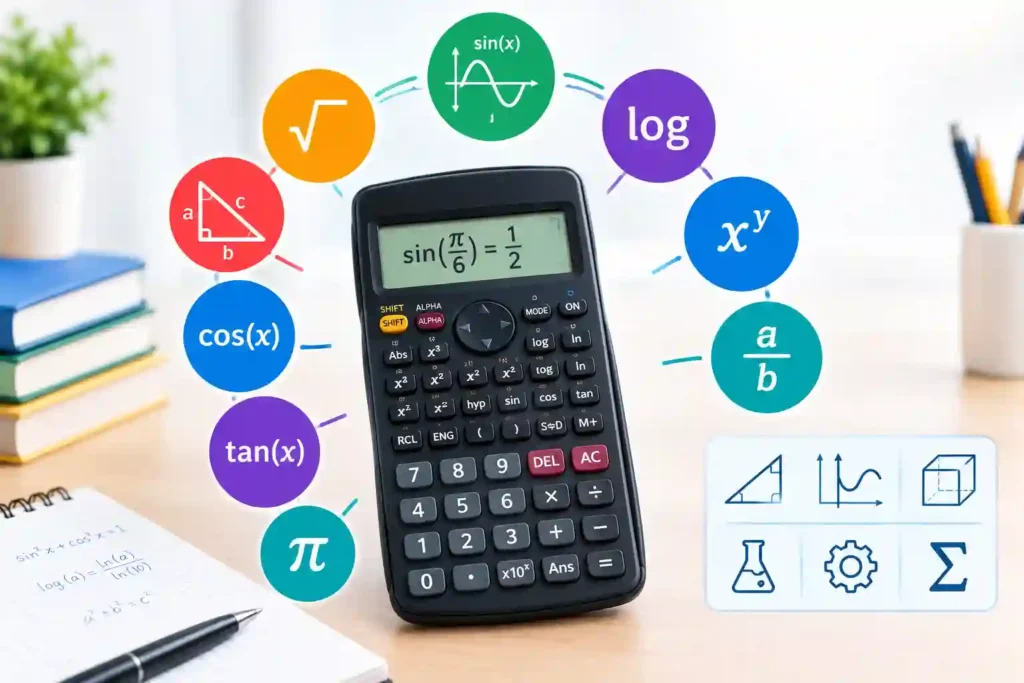
The text provided in this article describes a scientific calculator with detail about its history, internal operations, basic functions, major types like standard, multiline, programmable, and how it is different from a graphing calculator. It also specifies operating workflows, functional applications, common faults, and also provides answers to frequently asked questions about a scientific calculator.
This overview presents solutions onf the problems of readers searching via topic or relevant primary and secondary keywords like what is a scientific calculator, scientific calculator functions, or how to use scientific calculator by helping them select the right device for their academic or professional requirements, evade costly calculation errors, and operate correctly functions like angle modes and precedence rules.
Pew Research Center reported that 91% of U.S. adults owned a smartphone in 2025, so calculator software is widely available. Yet students, engineers, technicians, and scientists still ask what is a scientific calculator because dedicated models offer tactile keys, offline reliability, examination compatibility, and focused mathematical tools. This guide explains operating logic, scientific calculator functions, correct use, applications, limitations, and calculator selection.
What Is a Scientific Calculator?
A scientific calculator is defined as an electronic or software tool for use in arithmetic and advanced mathematics. It normally deals in powers, roots, logarithms, exponentials, trigonometry, fractions, scientific notation, statistics, and constants such as pie. Some advanced models also solve equations, assess tables, process complex numbers, or calculate derivatives and integrals numerically.
Realizing what is a scientific calculator also implies identifying its limits, i.e. it decreases repetitive computation but cannot substitute formulas, units, assumptions, or judgment. An answer can still be wrong if the user chooses an incompatible mode, mistypes an expression, or employs the wrong method.
The History of Scientific Calculator Technology
The modern history of scientific calculator design changed dramatically in 1972. The Computer History Museum identifies Hewlett-Packard’s HP-35 as the first handheld scientific calculator. HP records that it cost $395, sold more than 100,000 units in its first year, and exceeded 300,000 sales within three years. Its logarithmic, exponential, and trigonometric capabilities helped replace slide rules for many professionals.
The history of scientific calculator development then brought lower prices, algebraic entry, programming, multiline displays, solar assistance, and classroom-focused interfaces. Today, the history of scientific calculator design continues through hardware, browser tools, and apps. College Board’s current SAT policy provides embedded Desmos scientific and graphing options in Bluebook, showing how specialized calculation now supports digital assessment.
How Does a Scientific Calculator Work?
A keypress sends an input code to the processor. Firmware interprets the number, operator, function, and mode, then applies stored numerical algorithms. Memory holds values and intermediate results, while the display shows the expression, answer, error, or setting.
Many calculations use numerical approximation rather than symbolic reasoning. Trigonometric, logarithmic, and exponential results are rounded to the available display precision. The main stages are:
- Input numbers, functions, parentheses, and variables.
- Interpret the expression using the selected entry system.
- Apply precedence rules and numerical algorithms.
- Store intermediate values in memory.
- Format the result as a decimal, fraction, or scientific notation.
This process explains why learning how to use scientific calculator controls matters as much as memorizing formulas.
Essential Scientific Calculator Functions
Common scientific calculator functions include:
- Powers, roots, reciprocals, and absolute values
- Base-10 and natural logarithms
- Exponential functions
- Sine, cosine, tangent, and inverse trigonometry
- Degree, radian, and sometimes gradian modes
- Fractions, mixed numbers, and decimal conversion
- Scientific and engineering notation
- Factorials, permutations, and combinations
- Mean, standard deviation, regression, and probability
- Memory registers, answer recall, and table generation
Advanced features may include complex numbers, vectors, matrices, equations, numerical calculus, and probability distributions. Availability varies, so inspect the manual before assuming similarly named devices behave identically.
How to Use Scientific Calculator Controls Correctly
A reliable workflow for how to use scientific calculator operations is:
1. Estimate the expected scale and sign.
2. Clear previous entries and unnecessary memory.
3. Confirm the angle, display, and calculation modes.
4. Enter the expression with visible parentheses.
5. Use shift or second-function keys carefully.
6. Press equals and review the complete displayed expression.
7. Check units, significant figures, and reasonableness.
For example, sin(30) equals 0.5 in degree mode but a different value in radian mode. Negative and subtraction keys may also differ. Users learning how to use scientific calculator models should practice fractions, exponents, logarithms, and parentheses before an examination or professional task.
Main Types of Scientific Calculator
The major types of scientific calculator products serve different levels of work. Each model has advantages/pros and limitations/cons. Their specifications and pros & cons are given below:
Standard Nonprogrammable Scientific Model
This common classroom device is useful for algebra, trigonometry, logarithms, fractions, and elementary statistics.
Pros
- Affordable, portable, and generally accepted in education
- Focused interface with long battery life
- Appropriate for most secondary-school science and mathematics
Cons
- Restricted display history and data storage
- No graph plotting or reusable programs
- Even advanced models may still use unfamiliar menus
Advanced Multiline Scientific Model
These devices present textbook-style expressions and may add equations, tables, matrices, vectors, calculus, and distributions.
Pros
- Easier authentication of complex expressions
- Greater support for engineering and university mathematics
- More efficient without the bulk of a graphing device
Cons
- More costly and menu-heavy
- Features differ considerably by model
- May not be allowed in particular examinations
Programmable Scientific Model
Programmable models save sequences or formulas for repetitive calculations.
Pros
- Decreases repetitive entry
- Helpful for field procedures and technical workflows
- Supports custom-made calculations
Cons
- Needs set up, testing, and documentation
- Programming may not be allowed in assessments
- Hidden mistakes can be repeated always
Selection of these types of scientific calculator should be made by actual functions, not appearance alone.
Scientific Calculator vs Graphing Calculator
The concept of scientific calculator vs graphing calculator can be grasping by considering numerical calculation versus visual exploration.
People usually ask, what is a scientific calculator?
The answer is A scientific calculator aims at calculating numerical expressions, statistical data, and complex formulas without trusting on a full graphical show.
A graphing calculator adds plots, intersections, tables, regressions, and data visualization.
| Type of Calculator | Pros | Cons |
| Scientific calculator | lower cost, smaller size, simpler operation, longer battery life, and broader examination acceptance. | no full graph window, limited data analysis, and fewer programming or visualization tools. |
| Graphing calculator | visual understanding, multiple representations, extensive data tools, and programmable applications. | higher price, greater complexity, more charging or battery concerns, and possible test restrictions. |
For routine algebra, chemistry, physics, and statistics, the scientific calculator is usually sufficient. However, for calculus visualization, function behavior, or extensive datasets, graphing capability can justify the upgrade and use of graphing calculator.
Practical Uses and Internal Tool Links
Further explanation about scientific calculators includes its use in laboratory calculations, surveying checks, electrical formulas, mechanical relationships, medication mathematics, financial growth, and classroom problem solving. However, high-stakes engineering, medical, tax, and investment decisions involve verified formulas and qualified review.
Continue through InfraTech Hub’s topic cluster with Different Types of Calculators, Basic Calculator, Scientific Calculator, Graphing Calculator, and Unit Converter. Percentage Calculator, Loan Calculator, and Construction Calculators support narrower workflows.
Common Errors Experts Check
Even users who understand a scientific calculator; they can make entry mistakes. Verify for:
- Degree-radian confusion when dealing with angles
- Missing or misplaced parentheses
- Inaccurate negative signs
- Premature rounding
- Wrong scientific-notation exponent
- Forgetting units or conversion factors
- Unacceptable significant figures
- Stored values from an earlier calculation
Knowing a scientific calculator also indicates realizing that it confirms computation, not the validity of the chosen model.
Conclusion
Understanding what is a scientific calculator helps users decide on capability without pointless complexity. Select a model that is supportive for the subjects, compliant with examination rules, and exhibits expressions. Estimate first, verify modes and units, then confirm results. InfraTech Hub’s guides facilitate comparing models and calculating with confidence.